 Italiano
 English

| 0 Comments | James Whitfield
The Masonic ring is the most publicly visible emblem a Freemason wears, more immediate than the apron, more portable than the lodge room, and far older than most people assume. Its symbolism is not decorative shorthand. Each element engraved or cast into the metal, the Square and Compasses, the letter G, the degree numerals, the rite-specific emblems, corresponds to a layer of Masonic moral philosophy that initiates spend years unpacking through ritual and study. The ring functions simultaneously as a personal commitment, a fraternal identifier, and a compressed statement of values worn on the hand. Yet despite its visibility, the Masonic ring is widely misunderstood: conspiracy theorists treat it as a badge of secret power, jewelry retailers describe it in vague mystical terms, and curious observers rarely find a clear, factual account of what the object actually means and where it comes from. This article traces the ring’s historical origins, decodes its core symbols, distinguishes between Scottish Rite and York Rite variations, examines etiquette and authentication, and addresses the persistent misconceptions that follow this small piece of metalwork wherever it appears in public.
What Is a Masonic Ring?
A Masonic ring meaning, at its core, is straightforward: the ring is a personal emblem of fraternal membership worn by Freemasons to signify their affiliation with the craft. It carries no official rank, confers no authority, and is not issued by any grand lodge as part of a formal credentialing process. Its significance is symbolic and personal, not institutional.
That distinction matters more than it might first appear. Unlike military insignia or professional badges, a Masonic ring is not conferred during degree ritual in most jurisdictions. A Mason typically acquires one voluntarily, purchasing it himself or receiving it as a gift from a family member, often to mark a milestone such as raising to the third degree or completing a York Rite or Scottish Rite body. There is no standardized design mandated by grand lodges, which is why the variety of rings in circulation is so wide: square-and-compass motifs, chapter emblems, shrine crescents, and skull-and-crossbones designs associated with certain rite degrees all qualify, depending on the wearer’s affiliations and preferences.
The ring’s function, then, is genuinely dual. Privately, it serves as a tactile reminder of the obligations a Mason accepted at initiation, a kind of wearable mnemonic for the ethical commitments the fraternity emphasizes. Publicly, it acts as a signal of fraternal identity, recognizable to other members and to anyone familiar with Masonic jewelry and its conventions. Neither function requires the ring to be authenticated, certified, or registered anywhere. It is, in the most precise sense, a personal choice that carries communal meaning.
The History and Origins of Masonic Rings
From Operative to Speculative: The Transition of Craft Symbolism
Long before speculative Freemasonry codified its ritual and philosophy, working stonemasons used identifying marks as a practical necessity. Medieval craft guilds assigned each mason a personal mark, carved into finished stone to track output and establish accountability. Signet rings bearing these marks, or the insignia of a guild more broadly, served a dual function: they authenticated documents when pressed into wax, and they signaled membership in a recognized trade body. This tradition was not unique to stonemasons. Goldsmiths, merchants, and civic officials across 14th- and 15th-century Europe wore rings that communicated professional identity and social standing. The ring was already a well-established vehicle for institutional belonging before any lodge of speculative Freemasons met to discuss moral philosophy.
When speculative Freemasonry formalized its structure with the founding of the Premier Grand Lodge of England on June 24, 1717, it inherited this material culture and reinterpreted it. The working tools of the operative mason, the square, the compass, the plumb line, were no longer instruments for dressing stone. They became emblems of ethical conduct: the square as a measure of moral rectitude, the compass as a reminder of the boundaries a person of principle keeps. This symbolic reinterpretation extended gradually to personal adornment. Rings bearing the square and compasses, or the letter G at their center (representing Geometry, the foundational science of the craft), began to appear among lodge members as quiet declarations of fraternal identity. The transition was organic rather than legislated; no grand lodge decree mandated the Masonic ring. It emerged from the same impulse that had always made rings meaningful: the desire to carry an institution’s identity on one’s person.
The 19th-Century Fraternal Boom and Ring Standardization
Between roughly 1820 and 1900, Freemasonry in the United States grew from a moderately sized fraternal network into a mass institution. The Masonic Service Association of North America estimates that lodge membership expanded dramatically across this period, with hundreds of new lodges chartered in newly settled territories as the country pushed westward. This growth created sustained commercial demand for fraternal regalia, and American jewelers responded with standardized product lines. Ring designs coalesced around rite-specific emblems: the double-headed eagle for the Scottish Rite’s 32nd degree, the distinctive insignia of the York Rite’s Knights Templar commanderies, and the ubiquitous square and compasses for the symbolic (or “blue”) lodge degrees. Catalog-based manufacturing, viable after the Civil War as industrial metalworking matured, meant that a lodge member in Ohio could order the same ring design as one in Virginia. What had been an individual or regional choice became, by the close of the 19th century, a recognizable and relatively consistent visual language. The forms established during this fraternal boom remain the baseline for Masonic jewelry design today, which is worth keeping in mind when evaluating claims that any particular ring style carries ancient or esoteric origins. Most of what looks “traditional” is, in practice, Victorian.
Core Masonic Symbols Found on Rings and What They Mean
The Square and Compasses: Moral Geometry in Metal
No emblem appears more consistently on Masonic rings than the Square and Compasses, and for good reason: it functions as the primary visual identifier of the fraternity across jurisdictions, rites, and centuries. The two instruments are not decorative choices. Each carries a precise allegorical assignment rooted in lodge instruction. The square, a carpenter’s or stonemason’s right-angle tool, symbolizes moral rectitude, the idea that a Mason’s actions should be measured and true, never crooked in conduct or intention. The compasses, used to draw circles and set limits on a working plan, represent the discipline of restraint, specifically the obligation to keep one’s desires and passions within a defined boundary. Together, the two tools form a single statement: act with integrity, and govern yourself accordingly. When this emblem is cast in gold or silver on a ring, it is not meant as ornamentation. It is a portable reminder of an ethical framework the wearer has formally accepted.
The Letter G: Geometry, Grand Architect, or Both?
Positioned at the center of the Square and Compasses, the letter G invites a question that Masonic authorities have never fully resolved, and seem content to leave open. The two most widely acknowledged interpretations are Geometry, the foundational science of the medieval stonemason’s craft, and the Grand Architect of the Universe, Freemasonry’s deliberately non-denominational reference to a supreme being. The phrase “Grand Architect” is significant precisely because of what it avoids: it does not name a god specific to any one religious tradition, allowing members of different faiths to participate in the same ritual language without doctrinal conflict. The United Grand Lodge of England and most mainstream Masonic authorities acknowledge both readings without mandating one over the other. A ring bearing the G therefore carries an intentional ambiguity, one that reflects the fraternity’s historically pluralist stance on theology.
Skull, Sun, Moon, and Other Degree-Specific Symbols
Beyond the core emblem, a range of symbols appears on rings tied to specific degrees or rites rather than to Freemasonry as a whole. The skull, perhaps the most visually striking of these, functions as a memento mori, a reminder of mortality that appears in the ritual context of higher degrees, particularly within the York Rite’s Chapter and Cryptic degrees and certain Scottish Rite ceremonies. Its presence on a ring signals degree attainment, not any association with the macabre for its own sake. The sun and moon, frequently depicted together, carry allegorical weight related to universality: the sun governs the day, the moon the night, and their pairing suggests that Masonic principles apply without interruption, across all conditions. The trowel, a working tool of the operative mason, represents the spreading of brotherly love and affection, binding members together as mortar binds stone. The plumb and level, common in the Fellow Craft degree, symbolize upright conduct and equality among men respectively. Each of these symbols functions as a degree marker, a shorthand that communicates rank and ritual context to those familiar with the system, while remaining largely opaque to those outside it. A ring bearing the masonic skull ring meaning or the sun-and-moon pairing is, in that sense, a credential as much as an ornament.
Types of Masonic Rings: Scottish Rite, York Rite, and Beyond
Blue Lodge Rings: The Foundation
The Blue Lodge ring is the most widely recognized form of Masonic jewelry, and for good reason: it is the only ring a Mason can wear based solely on the three foundational degrees conferred in a symbolic lodge. Any Master Mason, having received the third degree, is entitled to wear one. The primary emblem is the Square and Compasses, sometimes enclosing the letter G (representing both Geometry and the concept of a Supreme Being, depending on the jurisdiction). Design varies considerably, from a plain gold signet to an elaborate raised emblem set in onyx, but the core symbol remains constant. Because Blue Lodge membership is the prerequisite for every other Masonic body, this ring functions as the baseline against which all other types are understood.
| Ring Type | Primary Emblem | Degree / Body Required | Distinctive Design Feature |
|---|---|---|---|
| Blue Lodge | Square and Compasses (with or without G) | Third Degree (Master Mason) | Often a flat or raised signet; onyx or gold settings common |
| Scottish Rite 32nd Degree | Double-headed eagle or numeral 32 | 32nd Degree, Scottish Rite | Eagle frequently rendered in high relief; “SPES MEA IN DEO EST” motto appears on many versions |
| York Rite Royal Arch | Triple tau or keystone | Royal Arch Chapter membership | Keystone shape occasionally echoed in the ring’s bezel; interlaced triangles also appear |
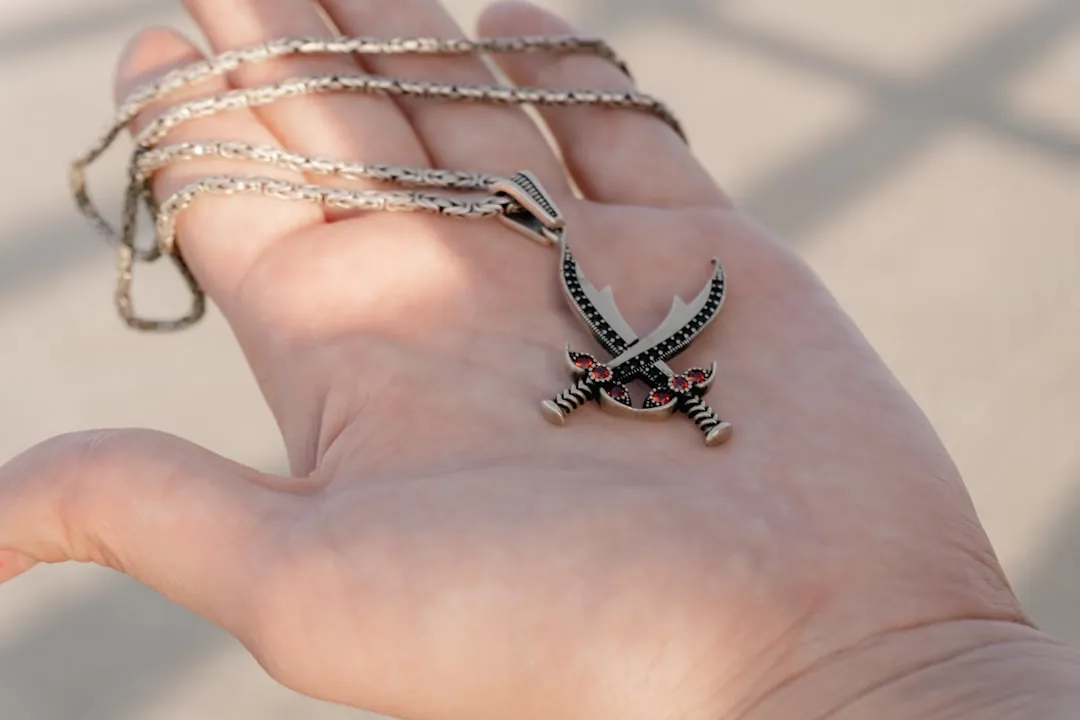
| Shrine (A.A.O.N.M.S.) | Scimitar and crescent | Shriner membership (requires Master Mason status) | Crescent often set with stones; red fez motif sometimes incorporated |
Scottish Rite rings occupy a distinct visual register. The double-headed eagle, emblem of the 32nd degree, is the most immediately recognizable element, though some members opt for a simpler ring bearing only the numeral 32 or the motto Spes Mea in Deo Est (“My Hope Is in God”). These rings are worn exclusively by Masons who have completed the Scottish Rite’s degree sequence above the Blue Lodge, which in the Southern Jurisdiction of the United States runs from the 4th through the 32nd degree. The 33rd degree, conferred honorarily by the Supreme Council, carries its own insignia and is not available as a purchased ring. York Rite rings present a different visual vocabulary altogether: the Royal Arch Chapter uses the triple tau and the keystone as its principal emblems, while the Knights Templar Commandery favors the cross and crown, reflecting that body’s explicitly Christian character. A Mason active in multiple York Rite bodies may own several rings, each tied to a specific chapter, council, or commandery affiliation.
Shrine rings introduce imagery from the Ancient Arabic Order of the Nobles of the Mystic Shrine, an appendant body whose scimitar-and-crescent emblem is deliberately theatrical, a product of the organization’s 19th-century founding aesthetic rather than any genuine claim to Middle Eastern heritage. Shrine membership requires Master Mason status, so the ring presupposes Blue Lodge affiliation even when it displays no square and compasses. The variety across these ring types reflects a broader structural truth about Masonic appendant bodies: each organization within the broader fraternal ecosystem develops its own symbolic language, and its jewelry follows accordingly.
Order of the Eastern Star and Masonic Rings for Women
The Order of the Eastern Star, founded in its modern form by Rob Morris in the 1850s, is a Masonic-affiliated body open to both men and women, with women eligible to hold all offices including Worthy Matron, the presiding officer. Its ring symbolism is entirely its own. The central emblem is an inverted five-pointed star, each point assigned a color and a Biblical heroine: blue for Adah (Jephthah’s daughter), yellow for Ruth, white for Esther, green for Martha, and red for Electa. This inverted star is categorically different from the square-and-compasses imagery of mainstream Masonic ring symbols meanings, and conflating the two is a common error. The Order of the Eastern Star is not a female branch of Freemasonry proper; it is a related but constitutionally separate organization. Members who wear its ring are signaling affiliation with that specific body, not with any Masonic lodge. The distinction matters both to Freemasons and to Eastern Star members, who maintain their own ritual, their own governance, and their own proud institutional identity.
Want to learn more?
Ring Colors and Materials: What They Signify
Color and material in Masonic jewelry are not arbitrary choices, though the commercial ring market has made them feel that way. Historically, gold was the uncontested standard for fraternal rings, and the reasoning was as much symbolic as practical. Gold does not corrode, tarnish, or oxidize. For a fraternity built around the language of working tools and durable craftsmanship, a metal that resists decay over centuries made an obvious metaphor for enduring virtue and lifelong commitment. The Masonic Service Association has long described the ring as a visible sign of a permanent obligation, and gold’s physical properties reinforced that message without requiring any additional explanation. Silver appears in some traditions, particularly in Scottish Rite regalia where it carries its own heraldic weight, but gold remains the historical baseline against which other choices are measured.
Black Masonic rings occupy a more specific symbolic territory. In many jurisdictions, black onyx settings or black enamel work traditionally signal either a mourning piece (worn after the death of a lodge brother) or a ring associated with the degree of Past Master, where the darker palette reflects a more subdued, reflective station. Red Masonic rings, by contrast, point in a different direction entirely: they are most closely associated with the Royal Arch degree within the York Rite, where red is the chapter’s traditional color, representing the veil of the tabernacle in the ritual’s allegorical framework. The difficulty is that online retailers now produce black and red rings with no connection to these specific traditions, marketing them as general Masonic jewelry. A brother wearing a red ring in a lodge that follows York Rite conventions is communicating something precise; a non-Mason purchasing the same design from a commercial vendor almost certainly is not. The distinction matters to anyone trying to read Freemason ring symbolism accurately rather than decoratively.
Masonic Skull Rings: Memento Mori, Not Macabre Fashion
The skull motif appears in Masonic ring design with enough frequency to warrant a direct explanation, because its origin has nothing to do with gothic aesthetics or countercultural fashion. The skull in Masonic symbolism is a memento mori, a Latin phrase meaning “remember that you will die,” and it is rooted specifically in the third-degree ritual. The Fellow Craft who seeks advancement to Master Mason undergoes a ceremonial drama centered on mortality, the loss of something irreplaceable, and the hope of its restoration. The skull (sometimes rendered as a full skeleton or as crossed bones beneath a skull) serves as a physical reminder of that meditation. Historically, lodge rooms used actual or replica skulls as furniture during these workings, a practice documented in eighteenth-century Masonic records from both English and Continental jurisdictions.
A Masonic skull ring, then, is not an attempt to look dangerous. It is a wearable reference to one of the fraternity’s most serious philosophical teachings: that awareness of mortality sharpens the quality of one’s living. The distinction between this tradition and the skull imagery found in biker culture or heavy metal iconography is one of intent and context, not visual similarity. Collectors and historians who study Masonic jewelry explained in period catalogs from the nineteenth and early twentieth centuries find skull rings listed alongside compasses and square rings as legitimate fraternal pieces, not novelties. The memento mori reading is the correct one; the gothic reading is a projection from outside the tradition.
Masonic Ring Etiquette: Wearing Conventions and Their Rationale
Which Finger for a Masonic Ring? The Evidence and the Custom
No grand lodge in the United States or the United Kingdom has issued a binding constitutional rule specifying which finger a Masonic ring must occupy. That absence of legislation is itself informative: the fraternity treats ring-wearing as a matter of personal expression and local custom rather than regulated ritual. In practice, the ring finger of the right hand is the most commonly observed convention among American Masons, a preference documented in lodge etiquette guides and fraternal publications from the late nineteenth century onward. The third finger of the left hand is equally widespread, particularly in the UK and among Masons who simply prefer the symmetry of wearing a signet-style ring on the same hand as a wedding band. Neither choice carries a disciplinary consequence; neither is “correct” in any authoritative sense. What predominates is the custom of the jurisdiction, the lodge, or the individual member.
The more debated question of orientation, often called the “points in or points out” convention, concerns the direction of the compasses’ points relative to the wearer. A Mason who positions the points facing inward, toward the palm, treats the ring as a private reminder of personal obligation, a symbol meant first for the wearer rather than the observer. A Mason who rotates the ring so the points face outward, toward any onlooker, frames the piece differently: as a visible signal to fellow members who might recognize it in passing. Both interpretations circulate in Masonic literature and lodge conversation, and neither has been formally codified. The Masonic Service Association of North America, which publishes widely consulted educational materials, acknowledges both orientations without prescribing one. The debate, such as it is, tends to generate more forum discussion than lodge-room controversy.
Etiquette within the lodge room itself introduces a separate layer of custom. Some jurisdictions maintain an informal expectation that rings, along with other personal jewelry carrying Masonic symbols, are worn discreetly or removed during certain degree work, particularly at the altar. The rationale is one of focus: the ritual itself carries the symbolic weight, and visible regalia or jewelry worn outside the lodge’s prescribed dress code can distract from the ceremony’s structure. These customs are rarely written into trestleboard announcements; they are passed on by the lodge’s more senior members, which means they vary considerably from one lodge to the next. A Mason relocating from a lodge in Virginia to one in California may find that the informal expectations around Masonic ring significance during degree work differ noticeably, even though the ritual content is drawn from the same source. Awareness of local custom, in other words, is the practical guide that no grand lodge regulation fully replaces.
Who Can Wear a Masonic Ring, and Common Misconceptions
Inherited and Heirloom Rings: A Special Case
No grand lodge in the United States or United Kingdom has ever issued a regulation prohibiting a non-Mason from owning or wearing a Masonic ring. The fraternity holds no jurisdiction over civilian dress, and no legal mechanism exists to enforce such a prohibition even if one were desired. Within Masonic culture, though, the consensus is clear: wearing a ring one has not earned through initiation is widely regarded as disrespectful, a form of symbolic misrepresentation. The response from practicing Masons is social, not punitive, but it is genuine. That distinction matters because it separates a question of etiquette from a question of law.
Heirloom rings are treated quite differently. When a Mason dies and leaves his ring to a son, daughter, or grandchild, most Masonic authorities and fraternal commentators consider preserving or even wearing that ring a legitimate act of remembrance rather than an infringement. In that context, the ring functions as a family artifact, a tangible connection to the person who earned it, not as a claim to membership the wearer does not hold. Many lodges actively encourage families to retain such pieces. The Masonic Service Association of North America has published guidance affirming that heirloom rings occupy a distinct category: tribute rather than impersonation.
Masonic Rings and Religious Objections
The question of who should wear Freemason ring symbolism is complicated, for some, by religious affiliation. The Catholic Church’s position is the most formally documented: the Sacred Congregation of the Holy Office issued condemnations of Freemasonry across several centuries, and the 1983 Declaration on Masonic Associations, signed by Cardinal Joseph Ratzinger, stated that Catholics who enroll in Masonic associations “are in a state of grave sin.” By extension, Catholic teaching has historically discouraged the display of Masonic symbols, including rings, as endorsements of an incompatible fraternal philosophy. Some conservative Protestant denominations, particularly within Southern Baptist and Methodist traditions, have adopted similar positions, citing Freemasonry’s non-denominational theism as incompatible with exclusive Christological commitments.
What these religious objections do not claim is worth stating plainly. They are critiques of Masonic membership and its theological implications, not assertions that the ring itself carries occult power or functions as a religious object. The persistent myth in conspiracy-adjacent media, that a Masonic ring confers protection, grants access to hidden networks, or operates as a talisman, has no basis in any Masonic teaching, ritual, or published doctrine. The ring is a symbol of personal commitment to the fraternity’s stated values: brotherly love, relief, and truth. Treating it as anything more projects popular mythology onto an object whose actual significance is, by Masonic standards, entirely moral and memorial.
Identifying Authentic Masonic Rings: What to Look For
Distinguishing a genuine Masonic ring from a decorative imitation requires attention to three overlapping criteria: metallurgical marking, iconographic accuracy, and provenance. Authentic pieces produced by established fraternal jewelers carry standard metal hallmarks: a karat stamp (10K, 14K, or 18K) for gold alloys, or a 925 mark for sterling silver. These stamps appear on the inner shank and are a baseline indicator of material integrity, not fraternal authenticity on their own, but their absence on a supposedly “traditional” ring is a reliable warning sign. Beyond the hallmark, craftsmanship quality matters considerably. Genuine rings feature crisp, well-defined engraving with clean edges; the kind of detail that comes from hand finishing or precision tooling. Stamped or molded approximations of Masonic imagery, common in mass-produced novelty pieces, tend to show shallow relief, blurred contour lines, and inconsistent depth across the design surface.
Iconographic accuracy is equally telling. On a legitimate piece, the Square and Compasses are geometrically precise, with the compass points at a consistent angle and the square’s arms forming a true right angle. The letter G, where present, should be correctly proportioned and centered within the interlocked tools, not crowded or offset. Rite-specific emblems, such as the double-headed eagle associated with the Scottish Rite’s 32nd degree or the crossed swords of certain York Rite bodies, should correspond accurately to the iconographic conventions of the body they represent, not to a generic “secret society” aesthetic assembled from internet image searches. Reputable sourcing reinforces all of the above: fraternal supply houses with decades of documented history, jewelers formally associated with grand lodges, and estate pieces with clear ownership provenance are the most reliable channels. Rings marketed through generic online marketplaces under labels like “Illuminati ring” or “secret society jewelry” are, almost without exception, decorative novelties. They carry no fraternal significance and frequently misrepresent the symbols they claim to reproduce.
FAQ
What do the symbols on a Masonic ring mean?
The Square and Compasses, the most recognized emblem in fraternal iconography, carries a straightforward allegorical message: the square represents moral rectitude and honest dealing, while the compasses define the boundaries of proper conduct. The letter G at the center references both Geometry, the foundational science of the operative stonemason’s craft, and the Grand Architect of the Universe, the fraternity’s non-denominational term for a supreme being.
Additional symbols correspond to specific degrees or rites. The double-headed eagle signals Scottish Rite membership; the triple tau is associated with the Royal Arch; the skull appears in certain higher degrees as a memento mori, a reminder of mortality central to that degree’s allegorical lesson. Each symbol functions as shorthand for a broader body of ritual instruction, not as a supernatural claim.
Which finger do you wear a Masonic ring on?
No grand lodge jurisdiction has codified a universal rule on finger placement. In the United States, the ring finger of the right hand is the most widely observed convention, though the third finger of the left hand is also common, and individual lodge cultures vary. The absence of a binding rule reflects the fraternity’s broader approach: personal expression within shared symbolism.
A separate, equally informal question concerns orientation. Some members wear the compasses with the points facing inward toward themselves, signifying that the lessons of the degree are still being internalized. Others rotate the ring outward, toward the world, to signal that those lessons have been fully absorbed. Both orientations are in common use, and neither is officially mandated.
Can non-Masons wear a Masonic ring?
No grand lodge regulation and no civil law prohibits a non-member from wearing fraternal jewelry. Within lodge culture, however, the practice is widely viewed as disrespectful, on the grounds that the emblem signifies an initiatory commitment the wearer has not made. The response is social, not legal, typically limited to polite correction if the matter arises in conversation.
Heirloom rings inherited from a deceased member occupy a different category. Most Masonic authorities treat their preservation by family members as a respectful tribute rather than an appropriation of fraternal identity. Wearing a grandfather’s ring as a memorial keepsake is broadly regarded, within the fraternity, as an honorable exception to the general norm.
What is the difference between a Scottish Rite and a York Rite Masonic ring?
Both rites build on the foundational three degrees of the Blue Lodge, whose members typically wear the standard Square and Compasses design. The two appendant systems diverge from there, and their rings reflect that divergence in iconography.
Scottish Rite rings commonly display the double-headed eagle or the numeral 32, marking completion of the rite’s degree sequence above the Blue Lodge. York Rite rings draw from the emblems of their constituent bodies: the triple tau or keystone for the Royal Arch Chapter, and the cross and crown for the Knights Templar Commandery. A member active in both rites may own rings from each body, wearing them according to the occasion or the assembly being attended.
Are there Masonic rings for women?
Mainstream Freemasonry in most jurisdictions remains male-only, so the traditional fraternal ring has historically been associated with male members. Two categories of exception exist. The Order of the Eastern Star, a Masonic-affiliated body open to both women and men, has its own distinctive ring design centered on a five-pointed star whose colored points correspond to the order’s five heroines drawn from Biblical narrative.
Co-Masonic and women’s grand lodge jurisdictions, which do initiate women under the same ritual framework as mainstream lodges, produce rings consistent with standard fraternal iconography, including the Square and Compasses. These bodies operate independently of the United Grand Lodge of England and most mainstream American grand lodges, which do not recognize their degrees.
