 Italiano
  English
The 33rd degree Freemason holds a title that has generated more mythology per syllable than almost any other designation in fraternal history. In reality, it is an honorary degree conferred by the Supreme Council of the Scottish Rite upon members who have rendered exceptional service to Freemasonry and their broader communities, not a secret rank unlocking hidden power or esoteric knowledge. The Scottish Rite, one of several appendant bodies a Master Mason may join after completing the three foundational degrees of the Craft, organizes its initiatory work across 29 additional degrees (the 4th through the 32nd). The 33rd stands apart: it cannot be earned through attendance or ritual progression alone. It is conferred by election, based on documented merit and sustained contribution. The Supreme Council, 33°, Southern Jurisdiction, USA, the oldest Supreme Council in the world, founded in Charleston, South Carolina, on May 31, 1801, has defined and administered this degree for over two centuries. Understanding what the 33rd degree actually represents requires tracing the structure of the Scottish Rite, the criteria the Supreme Council applies, and the documented history behind a number that conspiracy culture has thoroughly misread.
What Is the 33rd Degree in Freemasonry?
A 33rd degree Freemason holds an honorary distinction conferred by a Scottish Rite Supreme Council, awarded not through sequential initiation but by election. The degree recognizes exceptional service to Freemasonry and the broader community. It is the highest honor the Scottish Rite can bestow, and it carries no additional ritual content beyond what a 32nd degree Mason already receives.
That clarification matters because the most persistent misconception frames this honor as the top rung of a ladder, something climbed through years of progressive initiation. The Scottish Rite’s degree system does work that way for the first thirty-two degrees, each conferred in sequence with its own ceremonial instruction. The thirty-third operates on an entirely different logic. A Supreme Council, acting as a body, elects recipients from among those who have already completed the 32nd degree and demonstrated sustained, distinguished service. No amount of attendance, memorization, or ritual participation automatically qualifies a Mason for it. The formal title conferred on most recipients in the Southern Jurisdiction of the United States is Inspector General Honorary, a designation that appears in the Supreme Council’s own statutes and clarifies the honorific rather than administrative nature of the award.
What the degree does not confer is equally worth establishing. Recipients gain no access to secret teachings withheld from 32nd degree Masons, no additional ritual content, and no governing authority within their home lodge. The Supreme Council of the Southern Jurisdiction, headquartered in Washington, D.C., has been explicit in its published materials: the thirty-third is a service award, a recognition of what a Mason has contributed rather than a passport to hidden knowledge. Conspiracy narratives that treat it as the threshold of an inner circle capable of directing governments or financial systems find no support in any primary Masonic document. The degree’s significance is honorific, and within the Scottish Rite’s administrative structure it is also a prerequisite for appointment to certain supervisory roles, but that function is far removed from the shadowy omnipotence popular culture tends to project onto it.
The Difference Between the 32nd and 33rd Degrees
The 32nd degree, titled Master of the Royal Secret, is the highest degree a Scottish Rite Mason completes through the regular initiatory sequence. A candidate progresses through the degree system, participates in the conferral ceremonies, and upon completion holds the 32nd degree as a permanent credential. Every Scottish Rite Mason who finishes the full curriculum holds it. The thirty-third is something else entirely. Conferred by election on top of the 32nd, it means no Mason can receive it without first holding the degree below, but holding the 32nd creates no entitlement to the thirty-third. The gap between the two is not a matter of additional coursework or ritual; it is a qualitative distinction between what a Mason has done within the fraternity and for the wider community over years or decades.
Inspector General Honorary vs. Sovereign Grand Inspector General
Popular coverage of the thirty-third degree rarely distinguishes between its two principal titles, but the difference is constitutionally significant. The title Inspector General Honorary applies to the overwhelming majority of recipients: Masons elected to the degree in recognition of their service, who hold it as an honor without holding a seat on the Supreme Council itself. The title Sovereign Grand Inspector General, by contrast, is reserved for the thirty-three active members who constitute the Supreme Council, the governing body of the Scottish Rite jurisdiction. These active members hold administrative authority over the jurisdiction and are limited by the Supreme Council’s own rules to exactly thirty-three seats, a number that carries its own symbolic resonance within the degree’s historical design. The two titles are not interchangeable, and conflating them obscures how the Scottish Rite’s governance actually functions.
History and Origins of the 33rd Degree
From the Rite of Perfection to the Scottish Rite
The Scottish Rite did not emerge fully formed in 1801. Its roots reach back to the 25-degree Rite of Perfection, a system developed in France around 1754 and subsequently carried to the Caribbean, where it took hold in the French colonial lodges of Saint-Domingue (present-day Haiti). Over the following decades, additional degrees were appended to this framework as the rite traveled between Europe, the Caribbean, and the American colonies, accumulating ritual content from multiple Masonic traditions until the structure grew unwieldy enough to demand formal consolidation. That consolidation arrived on May 31, 1801, when John Mitchell and Frederick Dalcho established the Supreme Council, 33°, Southern Jurisdiction, in Charleston, South Carolina, the oldest Supreme Council in the world, according to Masonic historians.
The 33rd degree was not an afterthought grafted onto an existing system; it was designed from the outset as the governing degree of the Supreme Council itself, conferring authority on the body responsible for administering all the degrees below it. The number thirty-three carried symbolic weight, loosely associated with the traditional age of Christ at the crucifixion and with numerological significance in esoteric traditions, but its primary function at the founding was organizational: the degree defined who held supreme jurisdiction over the rite.
Albert Pike and the Codification of the Degrees
The Charleston founding established the structure, but ritual content remained inconsistent across jurisdictions for decades. That changed when Albert Pike took office as Sovereign Grand Commander of the Southern Jurisdiction in 1859, a post he held until his death in 1891. Pike undertook a comprehensive rewrite of the Scottish Rite’s ritual work, producing philosophical commentaries and revised ceremonial texts that culminated in his 1872 publication Morals and Dogma of the Ancient and Accepted Scottish Rite of Freemasonry. The book is dense and eclectic, drawing on sources ranging from Kabbalah and Neoplatonism to comparative religion. That eclecticism has made it a perennial target for conspiracy writers who lift passages out of context to imply the rite endorses Luciferianism or occult practice. The Supreme Council’s own scholarship has addressed these misreadings repeatedly. What Pike actually produced was a Victorian-era philosophical synthesis, reflecting the broad reading habits of a nineteenth-century intellectual rather than any doctrinal statement of Masonic belief. His influence on how the 33rd degree’s symbolism is understood in the Southern Jurisdiction remains substantial, even as the Supreme Council revised its ritual materials in 1974 and again in subsequent decades to reflect contemporary practice.
The Northern Masonic Jurisdiction, headquartered in Lexington, Massachusetts and operating its own Supreme Council since 1813, follows the same broad honorific framework but administers its own criteria independently. The two jurisdictions are coordinate, not hierarchical: neither governs the other, and a 33rd degree conferred in one carries no formal authority in the other’s territory. This structural distinction matters for anyone researching specific recipients, since the criteria, nomination processes, and historical records are maintained separately by each body.
The Scottish Rite Degree Structure: The Road From the 4th to the 32nd
The Scottish Rite does not begin from scratch. A candidate must already hold the third degree of the Blue Lodge, the rank of Master Mason, before petitioning to enter the Scottish Rite system. From that foundation, the degrees proceed through four distinct administrative bodies, each responsible for conferring a specific cluster of degrees. Understanding this architecture is essential to grasping why the 33rd degree occupies a category entirely separate from everything that precedes it.
| Scottish Rite Body | Degree Range | Thematic Focus |
|---|---|---|
| Lodge of Perfection | 4th, 14th | Ancient craft allegory, the legend of Hiram Abiff extended, and the search for the lost word |
| Chapter of Rose Croix | 15th, 18th | Themes of death, resurrection, and philosophical inquiry drawn from Rosicrucian and Christian allegorical traditions |
| Council of Kadosh | 19th, 30th | Chivalric and philosophical allegory, exploring duty, knighthood, and moral courage across historical settings |
| Consistory | 31st, 32nd | Master of the Royal Secret: synthesis of the preceding degrees into a culminating statement on Masonic philosophy |
The degrees within each body are best understood as a curriculum rather than a ladder of command. Progressing from the 4th to the 32nd does not grant a Mason administrative authority over those at lower numerical degrees. Each ceremony presents a philosophical or allegorical lesson, drawing on historical settings that range from the Temple of Solomon to medieval Crusader orders. Albert Pike, whose 1871 work Morals and Dogma remains the most widely cited commentary on Scottish Rite symbolism, described the degrees collectively as an exploration of moral philosophy through dramatic allegory. The Scottish Rite’s own Supreme Council, 33°, Southern Jurisdiction, has framed the sequence in similar terms in its official publications.
The 32nd degree, formally titled Master of the Royal Secret, is where a candidate completes the full instructional arc of the initiatory system. It is the highest degree a Scottish Rite Mason earns through participation in the degree work itself. The 33rd degree operates under an entirely different logic: it is not conferred through a ritual curriculum but awarded by the Supreme Council as a recognition of service. That distinction is the central fact around which any honest account of the scottish rite 33rd degree must be organized, and it is one the degree’s own governing body has never obscured.
Requirements and Qualifications for the 33rd Degree
The path to the 33rd degree is not a ladder with numbered rungs. It is, formally speaking, an act of recognition: the Supreme Council identifies individuals whose service has already distinguished them, rather than rewarding candidates who have simply waited long enough. The starting point is unambiguous. A candidate must hold the 32nd degree of the Scottish Rite, and the nomination must come from a sitting 33rd degree Mason. Self-nomination is structurally impossible. The process begins with a peer’s judgment, not a personal application. Once a nomination is submitted, the Supreme Council evaluates the nominee’s record across three broad categories: service to the Scottish Rite specifically, contributions to the wider community, and conduct that consistently reflects the fraternity’s stated principles. Seniority alone carries no weight in this assessment. A Mason who has held the 32nd degree for thirty years without meaningful engagement will not advance on the strength of tenure. A Mason who has spent a decade in active leadership, charitable work, and educational programming stands on considerably stronger ground.
The Southern Jurisdiction’s Supreme Council confers the degree at its biennial session, a scheduling detail that carries a practical consequence: the number of new recipients in any given cycle is inherently limited. That limitation is deliberate. Restricting the conferral to a fixed ceremonial occasion, rather than processing nominations on a rolling basis, preserves the distinction’s weight. The Supreme Council has been explicit, in its own publications and official communications, that sustained and documented service is the primary criterion, not the passage of time. There is no published minimum tenure, but the pattern across documented recipients suggests that most have been active Scottish Rite Masons for well over a decade before their names are formally put forward.
How Long Does It Take to Reach the 33rd Degree?
Because the 33rd degree is honorary and elective rather than a sequential step any Mason can work toward, no defined timeline governs the process. The Supreme Council of the Southern Jurisdiction does not publish a minimum service requirement, and the Northern Masonic Jurisdiction operates under similarly discretionary criteria. In practice, however, the record of documented recipients points consistently toward long-term engagement. A decade of active Scottish Rite involvement is closer to a floor than a ceiling for most honorees. What the Supreme Council is looking for is a demonstrated pattern, not a milestone date, which means that the quality and consistency of a Mason’s contributions matter far more than the calendar.
The Nomination and Election Process
A sitting 33rd degree Mason submits a formal written recommendation to the Supreme Council, outlining the nominee’s Masonic record and civic contributions in documented detail. The Supreme Council then reviews that record before putting the nomination to a vote among its active members. The mechanics here are worth noting, because they bear a closer resemblance to the election procedures of learned honorary societies (think the American Academy of Arts and Sciences or a university’s honorary degree committee) than to any notion of a secret initiation ritual. The vote is conducted by peers who have themselves met the same standard. A nomination that cannot survive that scrutiny does not advance. For those researching 33rd degree freemason requirements, the clearest summary is this: distinguished service, a credible nominator, and a successful vote before an informed body of equals.
Want to learn more?
The Role and Responsibilities of a 33rd Degree Mason
The responsibilities attached to the 33rd degree divide along a clear structural line. Honorary recipients, formally titled Inspector General Honorary, function primarily as ambassadors of the Supreme Council within their home valley or jurisdiction. In practice, this means representing the Scottish Rite’s values at local events, supporting recruitment and retention of members in the lower degrees, and mentoring brothers progressing through the numbered degrees of the rite. The title carries genuine expectation of continued engagement; it is not, in the language of the Supreme Council’s own literature, a retirement honor. Active members of the Supreme Council itself carry a heavier administrative load. These Sovereign Grand Inspectors General vote on governing policy, participate in the election of the Sovereign Grand Commander (the rite’s chief executive officer), and exercise oversight of the organization’s charitable and educational infrastructure. The distinction between honorary and active membership is therefore not merely ceremonial; it maps directly onto different levels of institutional accountability.
That philanthropic infrastructure is substantial enough to be worth naming precisely. The Scottish Rite’s RiteCare Childhood Language Program operates a network of clinics across the United States, providing speech-language therapy to children regardless of their families’ Masonic affiliation or ability to pay. According to the Supreme Council, Southern Jurisdiction’s published reports, 33rd degree Masons in leadership positions play a significant administrative role in sustaining and expanding that program at both the valley and jurisdictional level. None of this translates into civil authority of any kind. The degree confers no legal standing, no governmental privilege, and no formal influence over any institution outside the fraternal structure itself. The “secret power” narrative that circulates around the scottish rite 33rd degree collapses almost immediately against the documented reality: the actual responsibilities are committee work, mentorship, philanthropy administration, and organizational governance. None of it requires secrecy, and all of it is consistent with how any large civic fraternity manages its senior membership.
Symbolism of the 33rd Degree: The Number, the Ring, and the Regalia
The symbolism attached to the 33rd degree is frequently overstated in popular commentary, and just as frequently misattributed. Within the Scottish Rite’s own published literature, the number 33 carries a straightforward organizational meaning: the rite comprises 33 degrees, and the Supreme Council limits its active membership, the Sovereign Grand Inspectors General, to 33 individuals at any one time. That structural correspondence is the primary documented reason for the number’s significance, not numerological mysticism or coded theology. Popular writers have drawn connections between 33 and the traditional age of Christ at the crucifixion, or to sequences in Kabbalistic numerology, but no official doctrinal publication of either the Northern or Southern Jurisdiction has adopted those interpretations as part of the degree’s formal meaning. They remain popular glosses, not institutional doctrine.
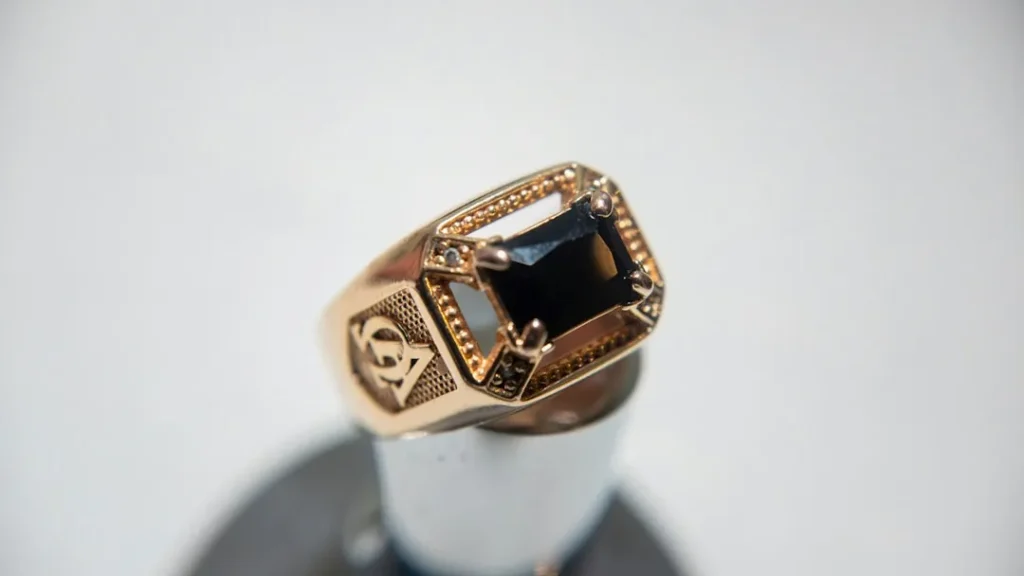
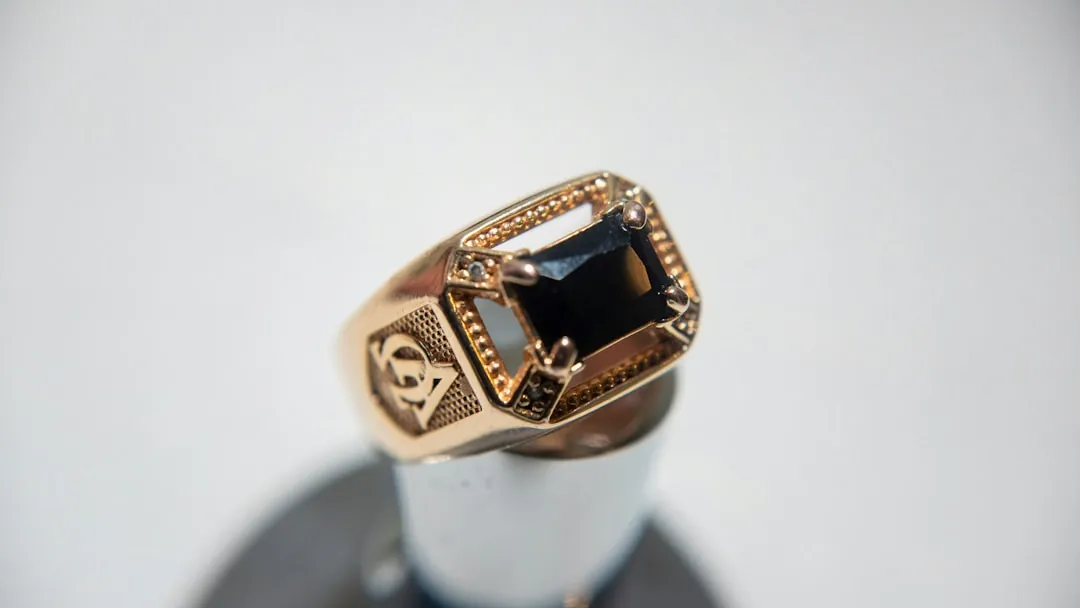
The physical regalia associated with the degree is ceremonial in the most literal sense: it marks rank at official Scottish Rite functions and carries no claim to talismanic or supernatural properties. The most recognizable item is the distinctive black cap bearing a gold double-headed eagle, worn by members who have received the honor at formal assemblies. Recipients also receive a gold ring, traditionally engraved with the double-headed eagle and the numeral 33. The ring serves as a mark of recognition within the fraternity, functioning much as a class ring or professional insignia does in secular contexts. The Supreme Council’s own publications describe these objects in terms of fraternal honor and organizational identity, not as instruments of power or esoteric activation.
The Double-Headed Eagle: Symbol of the Scottish Rite
The double-headed eagle, sometimes identified by historians as the “Eagle of Lagash” after its ancient Mesopotamian antecedents, is the primary emblem of the Scottish Rite and appears prominently on the ring, cap, and other regalia associated with the highest degree. As a heraldic device, it has a documented history stretching back through the Holy Roman Empire, the Byzantine court, and medieval European nobility, long predating any Masonic organization. The Scottish Rite adopted it as an organizational emblem, not as a symbol with Masonic-exclusive or occult significance. Albert Pike’s Morals and Dogma (1871) discusses the eagle’s historical and allegorical dimensions at length, but Pike himself was explicit that the symbol’s meaning derived from its broader heraldic and philosophical heritage rather than from any secret Masonic revelation. Treating the double-headed eagle as evidence of hidden occult purpose requires ignoring several centuries of mainstream European heraldry in which the same image appeared on imperial seals, cathedral facades, and royal coats of arms.
How Many 33rd Degree Masons Are There?
The active membership of a Supreme Council, those holding the full title of Sovereign Grand Inspector General, is constitutionally capped at 33. Beyond that inner circle, the total number of living honorary 33rd degree recipients is considerably larger, since the honor has been conferred annually for well over a century. The Supreme Council, Southern Jurisdiction, does not publish a comprehensive enumerated list of all living honorary members, a fact that has fueled speculation about a “secret list” of powerful initiates. The more prosaic explanation is that membership records are maintained as internal fraternal documents, consistent with the record-keeping practices of most private civic organizations. Researchers who have cross-referenced obituaries, lodge histories, and Supreme Council proceedings have confirmed that thousands of honorary degrees have been conferred since the 19th century, making the total population of living recipients a matter of archival research rather than conspiratorial concealment. The Scottish Rite, Southern Jurisdiction’s official website provides publicly accessible information about the degree’s criteria and history, which is not the behavior of an organization intent on suppressing its own membership rolls.
Misconceptions and Conspiracy Theories About the 33rd Degree
Few symbols in American fraternal culture attract as much unfounded speculation as the 33rd degree of the Scottish Rite. The claims are familiar: a hidden governing elite, secret initiation rites that reveal doctrines concealed from ordinary members, and shadowy coordination with financial or political power structures. None of these claims survives contact with the primary sources. The Supreme Council, 33°, Southern Jurisdiction, publishes its proceedings from biennial sessions, and those proceedings document the conferral criteria, the names of recipients, and the structure of the honor in plain institutional language. There is no governing body of 33rd degree recipients directing world affairs, because no such body exists in the Supreme Council’s own organizational framework.
The conflation of the Scottish Rite with the Bavarian Illuminati deserves particular attention, because it is historically illiterate on its own terms. The Bavarian Illuminati was founded on May 1, 1776, by Adam Weishaupt, a professor of canon law at the University of Ingolstadt, and it was dissolved by government decree of the Elector of Bavaria in 1785, effectively ceasing to exist by 1787. The Scottish Rite’s 33rd degree was not formalized until the Supreme Council was established in Charleston, South Carolina, in 1801, fourteen years after the Illuminati had already collapsed. The two organizations were never affiliated, never shared membership criteria, and operated in entirely different national and institutional contexts. Treating them as interchangeable is not a matter of contested interpretation; it is a straightforward error of chronology.
The Albert Pike Misquotation Problem
Albert Pike, who served as Sovereign Grand Commander of the Southern Jurisdiction from 1859 to 1891, is the figure most frequently distorted in conspiracy literature about the Scottish Rite. His major work, Morals and Dogma of the Ancient and Accepted Scottish Rite of Freemasonry (1871), is a dense, allegorical text written for an audience already familiar with the degree structure, drawing on Neoplatonic philosophy, Kabbalistic allegory, and comparative religion. Conspiracy writers routinely strip sentences from their rhetorical context and present them as literal policy statements. The Supreme Council itself has addressed this pattern directly in its own publications, noting that Pike wrote in the symbolic register of the degrees and not as a political manifesto. The most damaging fabrication is a letter allegedly written by Pike in 1871 predicting three world wars in explicit detail. No original document of this letter has ever been located. The British Museum, responding to inquiries as early as 1977, confirmed that no such letter exists in its holdings, despite claims that it was once displayed there. The letter is a forgery, and its continued circulation says more about the appetite for conspiratorial narrative than about anything Pike actually wrote.
Why the “Secret List” Narrative Persists
Because the Supreme Council does not maintain a publicly searchable, real-time database of every living honorary 33rd degree recipient, critics interpret the absence of such a database as deliberate concealment. The logic is circular: the absence of a comprehensive public roster is itself treated as evidence of secrecy, which is then treated as evidence of hidden power. In practice, the names of honorary recipients are announced at biennial sessions of the Supreme Council and recorded in the published proceedings of those sessions, which are available to academic researchers and Masonic historians. The proceedings are not classified documents. They are institutional records of a private fraternal organization, comparable in accessibility to the annual reports of any private membership body. The gap between “not published in a searchable online format” and “deliberately hidden from the public” is significant, and conflating the two is a failure of basic evidentiary reasoning, not a discovery of concealment.
Notable 33rd Degree Masons in History
The Supreme Council, 33°, Southern Jurisdiction, publishes biennial proceedings listing all newly elected honorary and active members at the thirty-third degree. That document is the starting point for any serious fact-checking, and it eliminates a large portion of the names that circulate on unverified online lists. What remains is a shorter but far more defensible roster of historically significant recipients.
Among the most thoroughly documented figures is J. Edgar Hoover, who served as director of the Federal Bureau of Investigation from 1924 to 1972. Hoover received the thirty-third degree from the Southern Jurisdiction, a fact recorded in the Supreme Council’s own published records and corroborated in mainstream biographical sources, including Curt Gentry’s 1991 biography. Senator Strom Thurmond and General Douglas MacArthur are similarly documented as honorary recipients during the twentieth century, their elevations noted in fraternal proceedings of the period. All three held positions of considerable public authority, which is why their Masonic affiliations attract recurring attention.
That attention tends to generate more heat than light. The presence of prominent public figures among Scottish Rite 33rd degree recipients is sometimes treated as circumstantial evidence of coordinated institutional influence. A more grounded reading, consistent with how historians approach similar fraternal organizations, is that Freemasonry has historically attracted civic-minded individuals from professional and public life, much as Rotary International or the Knights of Columbus have done. Membership within such organizations reflects shared cultural networks, not operational control of government agencies. The fraternity’s own stated criteria for the honorary degree center on service to the Rite and to the broader community, criteria that, by definition, tend to produce a list weighted toward individuals who were already active in public roles before any Masonic recognition was conferred.
FAQ
Can you become a 33rd degree Mason without being nominated?
No. The degree is conferred exclusively by election within the Supreme Council, and the process begins with a formal nomination by a sitting 33rd degree Mason. There is no application form, no examination, and no petition a candidate can file on his own behalf.
The Supreme Council of the Southern Jurisdiction’s own published guidelines confirm that nomination and subsequent election by active members are the only recognized path to conferral. A Mason who has not been nominated cannot advance to this level, regardless of seniority or personal accomplishment within the lodge.
Is the 33rd degree the highest degree in Freemasonry?
It is the highest degree within the Scottish Rite, but Freemasonry is not a single unified system with one apex. The York Rite has its own degree structure culminating in the chivalric orders of the Knights Templar. These two rites operate independently, and neither subordinates itself to the other.
Across all recognized grand lodges, the foundational three degrees of the Blue Lodge (Entered Apprentice, Fellowcraft, and Master Mason) are considered the essential core of the fraternity. Appendant bodies, including the Scottish Rite, build upon that foundation rather than replace it.
What is the difference between the 32nd and 33rd degrees?
The 32nd degree, Master of the Royal Secret, is the highest degree a Scottish Rite Mason completes through the regular initiatory sequence. It is open to any eligible member who participates in the degree work and follows the established curriculum.
The 33rd degree is honorary and elective, conferred by the Supreme Council on 32nd degree Masons who have demonstrated exceptional service to the fraternity or to the broader community. The honor also carries genuine administrative responsibilities: active members holding the degree serve as Sovereign Grand Inspectors General and participate directly in governing the Supreme Council, a role the 32nd degree does not include.
How many 33rd degree Masons are there in the United States?
The Supreme Council, Southern Jurisdiction, caps its active membership at exactly 33 Sovereign Grand Inspectors General at any one time. The total number of living honorary recipients, designated Inspector General Honorary, is considerably larger but is not published as a single consolidated public list.
The Northern Masonic Jurisdiction operates its own Supreme Council with a comparable governance structure. Any precise global count circulating on social media or conspiracy-adjacent websites should be treated with skepticism: none of those figures are sourced from official Supreme Council records, and the Supreme Councils themselves do not publish a unified registry.
Do 33rd degree Masons have secret beliefs or doctrines unavailable to other Masons?
No credible primary source supports this claim. The Supreme Council’s own publications describe the conferral ceremony as one of honor and rededication to service, not as a revelation of hidden doctrine inaccessible to other members.
Albert Pike’s Morals and Dogma (1871), the text most frequently cited as supposed proof of concealed teaching, was distributed freely to Scottish Rite members for decades and has long been available in public libraries and digitized archives. A text handed out at degree conferrals and catalogued by the Library of Congress does not fit any reasonable definition of a secret document. The Supreme Council itself eventually made the volume optional reading rather than standard issue.