 Italiano
  English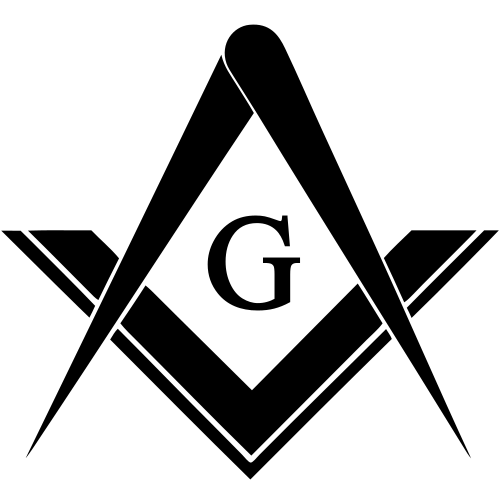
| 0 Comments | James Whitfield
Masonic symbolism is one of the most misread visual languages in Western cultural history. Since the formal founding of the first Grand Lodge in London on June 24, 1717, Freemasonry has communicated its moral and philosophical teachings almost entirely through symbols: working tools, geometric forms, architectural elements, and allegorical figures drawn from operative stonemasonry, classical antiquity, and scripture. The Square and Compasses, the Letter G, the All-Seeing Eye, the acacia sprig, the beehive: each carries a specific instructional meaning within the lodge, and each has accumulated centuries of interpretation, misinterpretation, and outright myth outside it. This article maps the full landscape of Masonic symbolism, covering what the major symbols are, where they came from, how their meanings shift across different rites and degrees, and why they have attracted so much attention from historians, conspiracy theorists, and curious observers alike. The goal is straightforward: accurate, sourced explanation over sensationalism.
What Masonic Symbolism Is, and What It Is Not
Masonic symbolism is a structured visual language through which Freemasonry communicates its moral and philosophical teachings. Drawn primarily from the tools and vocabulary of medieval stonemasonry, the system assigns ethical meanings to physical instruments, from the square and compass to the plumb line, and uses those meanings as the primary instructional medium of lodge degree work.

Freemasonry describes itself as a speculative fraternity, a term that distinguishes its intellectual and moral concerns from the practical, or operative, craft of building in stone. That distinction is not incidental; it is the conceptual engine behind the entire symbolic program. The tools a working mason carried to a building site became, in the speculative lodge, metaphors for how a person ought to conduct a life. Albert Mackey’s Encyclopedia of Freemasonry (1874), still one of the most cited reference works on the subject, catalogs these symbols in detail and is freely available to anyone who looks for it. Masonic symbols are not secret in the sense of being concealed. Ritual monitors, grand lodge publications, and scholarly encyclopedias have documented them for more than two centuries. What the fraternity does protect is the experiential dimension of ritual: the specific ceremonial context in which a symbol is presented to a candidate for the first time. The symbol itself can be described; the moment of its presentation is what members regard as private. Understanding that distinction resolves most of the confusion that surrounds public discussions of the topic.
The Operative-to-Speculative Transition
The shift from craft guild to philosophical fraternity did not happen overnight. Historians of the institution generally point to the late 17th century as the period when speculative members, gentlemen with no training in stonecutting, began joining operative lodges in Scotland and England in significant numbers. By June 24, 1717, when four London lodges formed the first Grand Lodge of England at the Goose and Gridiron alehouse in St. Paul’s Churchyard, the operative membership had become a minority. The tools remained, but their referents changed entirely. A plumb line that once tested whether a wall was vertical became a symbol of upright conduct. A level that once checked horizontal surfaces became an emblem of equality among members. The transition was pragmatic as much as philosophical: a fraternity that had lost its original trade needed a coherent reason to keep the working-tool vocabulary, and moral allegory provided exactly that rationale.
How Symbols Function Within Lodge Ritual
Within the degree structure of a Masonic lodge, each symbol is formally introduced and explained to candidates at a specific point in their initiation or advancement. This is not casual or improvised. The explanations follow scripted charges and lectures that have been refined over generations, and in many jurisdictions they are drawn from printed monitors, official guides that grand lodges publish and distribute openly. A candidate encountering the square for the first time does not simply see an object; the presiding officer delivers a prepared address explaining what moral quality the tool is meant to represent. The pedagogical intent is explicit and deliberate. Masonic ritual and symbolism are therefore inseparable in practice: the symbol carries its meaning only because the ritual context activates it, which is precisely why the fraternity treats the two as related but distinct. One is a visual sign anyone can examine; the other is a structured experience the lodge reserves for its members.
The Square and Compasses: Freemasonry’s Core Symbol
Two interlocking tools, one measuring angles and one drawing circles, have become the most widely recognized emblem in the fraternity’s history. The square, a right-angle instrument, carries a moral charge in Masonic teaching: it represents the obligation to act squarely toward others, measuring one’s conduct against an ethical standard as precisely as a craftsman checks a joint. The compasses, the drafting instrument used to draw circles and arcs, carry a complementary meaning oriented inward rather than outward. Where the square governs relations with others, the compasses symbolize self-restraint, the deliberate circumscription of one’s own desires within rational and ethical limits. Together, these two tools form the visual core of masonic symbolism, and their combined image appears on lodge buildings, grave markers, jewelry, official documents, and fraternal regalia across every continent where the fraternity has established itself. A third element, the Letter G at the center, is treated separately in the section that follows; the three components together constitute the single most reproduced piece of Masonic iconography in existence.
Historical Antecedents in Craft Guilds
The square and compasses did not originate as symbols. They were tools, used daily by operative stonemasons throughout medieval Europe to cut stone, lay foundations, and raise cathedrals. Guild records from the operative building trades, including marks registered by masons’ guilds in England and Germany as early as the thirteenth century, show both instruments appearing in craftsmen’s personal marks and in the decorative programs of the buildings they constructed. The Regius Manuscript, dated by scholars to approximately 1390 and considered the oldest known Masonic document, references the working tools of the mason’s trade in terms that would later be formalized into symbolic instruction. When speculative Freemasonry coalesced in the early eighteenth century, it inherited these tools not as invented metaphors but as objects already embedded in the cultural memory of building craft. The symbolic meanings assigned to them in lodge ritual were, in that sense, a formalization of associations that operative tradition had been accumulating for centuries.
Cathedral building records from sites including Strasbourg and York add further context. The lodge, the on-site workshop where masons planned, stored tools, and conducted guild business, was the physical and organizational precursor to the speculative lodge, and the instruments used there carried professional prestige long before they carried philosophical weight.
Variations Across Jurisdictions
The combined emblem is not rendered identically everywhere. The position of the compasses relative to the square carries degree-specific meaning that differs by jurisdiction and grand lodge tradition. In some representations, both points of the compasses appear above the square, a configuration associated in certain traditions with a particular degree of initiation. In others, both points fall below, or one point appears above and one below, each arrangement understood within its ritual context as a marker of the candidate’s progress through the degrees. The United Grand Lodge of England and the various grand lodges of the United States do not all follow identical conventions, and Masonic scholars such as Albert Mackey, whose Encyclopedia of Freemasonry (first published in 1874) remains a standard reference, document these jurisdictional differences without resolving them into a single authoritative reading. What remains constant across all variations is the pairing of the two instruments as complementary moral principles, one pointing outward toward social obligation, the other pointing inward toward personal discipline. That consistency across otherwise divergent traditions is a large part of what gives the emblem its durability as a fraternal identifier.
The Letter G: Geometry, Deity, and Debate
Few elements in masonic iconography generate as much scholarly friction as the single letter suspended at the center of the square and compasses. The Letter G carries at least two simultaneous readings in standard lodge ritual. The first is Geometry, described in Masonic monitors as the “noblest of sciences” and the intellectual foundation upon which operative stonemasonry, and by extension speculative Freemasonry, was built. The second is the Grand Architect of the Universe, the deliberately non-denominational term Freemasonry uses to acknowledge a supreme being without prescribing any particular theology. Both meanings are treated as active within the ritual context, not as competing alternatives but as overlapping layers, which is exactly the kind of symbolic ambiguity the fraternity tends to favor.
The third interpretation surfaces primarily in American jurisdictions, where some ritual monitors gloss the letter simply as God in the plain English sense. British and Continental lodges are generally less explicit on this point, keeping the theological register at the more abstract level of the Grand Architect. The underlying debate about which meaning came first is not new. In his Encyclopedia of Freemasonry (1874), Albert Mackey argued that Geometry was the original and primary referent, and that the theological reading developed as a later overlay once speculative Masonry had absorbed more explicitly religious language. Mackey’s position has never been conclusively settled: later scholars, including those writing for the Masonic Service Association of North America, have pointed to ritual texts that treat the theological meaning as equally foundational. What the debate illustrates, more than any definitive answer, is that freemasonry symbols and meanings were never designed to resolve into a single, fixed interpretation. The Letter G is not a riddle with one correct solution; it is a prompt for reflection, and Masonic ritual is comfortable leaving it exactly that way.
The All-Seeing Eye and the Eye of Providence
The Eye of Providence predates Freemasonry by a considerable margin. A watchful divine eye appears in ancient Egyptian religious iconography as the Eye of Horus, a symbol of protection and royal power. By the Renaissance, Christian artists had adapted the image into a Trinitarian emblem, placing a single eye within a triangle to represent God’s omniscience. When the Continental Congress commissioned the Great Seal of the United States in 1776, the Eye of Providence was already a well-established piece of Western religious visual vocabulary. The three principal designers of the 1782 seal, Charles Thomson, William Barton, and Secretary of Congress Thomson working from earlier committee drafts, were not documented Freemasons. The State Department’s own historical records on the Great Seal make no mention of Masonic influence on the eye motif. The symbol arrived in masonic iconography by adoption, not by invention.

The Eye on the Dollar Bill: Separating Fact from Folklore
The claim that the eye on the one-dollar bill is a Masonic symbol has achieved the status of settled fact in popular culture. The historical record does not support it. The reverse of the Great Seal, which carries the unfinished pyramid and the Eye of Providence, was not printed on any US currency until 1935, when Secretary of the Treasury Henry Morgenthau and Secretary of Agriculture Henry Wallace recommended its inclusion on the redesigned dollar bill. Wallace, who championed the design, had an interest in esoteric symbolism, but his documented affiliations were with Theosophy, not Freemasonry. The 1782 design committee left no correspondence, minutes, or annotation connecting the eye to lodge ritual. As the US State Department’s Bureau of Public Affairs has noted in its official history of the seal, the pyramid and eye were intended to convey permanence and divine oversight of the new nation. Freemasonry is not mentioned. The persistence of the Masonic attribution owes more to the visual similarity between the seal’s eye and lodge imagery than to any documented genealogy.
The All-Seeing Eye in Lodge Furnishings and Tracing Boards
Whatever its origins elsewhere, the Eye of Providence holds a genuine and documented place within masonic ritual and symbolism. Lodges began incorporating the symbol into their furnishings and visual programs during the late eighteenth century, a period when Enlightenment-era Freemasonry was actively borrowing from classical, biblical, and allegorical traditions to build its symbolic vocabulary. In lodge settings, the eye is typically positioned above the altar or rendered prominently on the First Degree tracing board, a painted or printed teaching aid used to explain the lodge’s symbolic furniture to newly initiated members. Its meaning in this context is specific and relatively modest: it serves as a reminder of moral accountability, representing the Grand Architect of the Universe who observes every Mason’s conduct regardless of whether a lodge officer is watching. The freemasonry symbols and meanings associated with the eye are ethical rather than cosmological. It is not a claim about hidden knowledge or supernatural power; it is a conscience prompt rendered in paint and plaster. That function, straightforward as it is, has not prevented the symbol from accumulating centuries of projection from outside the fraternity.
Want to learn more?
Working Tools and Architectural Symbols
Every tool a stonemason carried to a building site had a measurable, practical purpose. Freemasonry’s genius, if one wants to call it that, was to reassign those purposes inward: the instrument that checked a wall’s straightness became a prompt to examine one’s own conduct. This principle of moral application governs the entire system of masonic symbolism as it operates through the Blue Lodge degrees, where specific working tools are formally presented to the candidate at each stage of initiation.
| Degree | Working Tool(s) | Symbolic Meaning (per ritual monitors) |
|---|---|---|
| Entered Apprentice (First Degree) | 24-inch gauge and common gavel | The gauge divides the day into labor, refreshment, and service to God and a worthy distressed brother; the gavel teaches the removal of vices and superfluities from conduct. |
| Fellowcraft (Second Degree) | Square, level, and plumb | The square measures actions by the standard of morality; the level reminds that all men meet on equal footing; the plumb directs upright conduct. |
| Master Mason (Third Degree) | Trowel | Spreads the cement of brotherly love and affection that unites the fraternity into one common mass. |
Beyond the working tools, the physical lodge room is arranged as a symbolic representation of Solomon’s Temple, drawing directly on the description in 1 Kings 7. The two bronze pillars named Jachin and Boaz, which stood at the porch of the historical Temple, are reproduced at the entrance of every lodge. The mosaic pavement underfoot, a black-and-white checkered floor, represents the ground floor of the Temple and carries the broader lesson that human life alternates between joy and sorrow. The tracing board stands as a portable encyclopedia of degree imagery, while the central altar holds the Volume of Sacred Law open during every working. A second tier of emblems, including the beehive (industry), the acacia sprig (immortality), the ark and anchor (hope and well-grounded trust in God), and the hourglass (the swift passage of time), appears in ritual lectures and lodge art without being formally assigned to any single degree. These form the supporting vocabulary of masonic iconography, present throughout but not tied to a specific moment of initiation.
The Masonic Apron: A Working Tool Worn, Not Displayed
The white lambskin apron holds a distinction no other emblem in the fraternity can claim: it is worn by every initiate from the moment of the first degree onward. Albert Mackey’s Encyclopedia of Freemasonry (1874) calls it “the most important and significant of all Masonic symbols,” and the standard American ritual monitor describes it as “more ancient than the Golden Fleece or Roman Eagle, more honorable than the Star and Garter.” The origin is entirely practical. Operative stonemasons wore leather aprons to protect themselves from stone dust, mortar, and the sharp edges of their tools. Speculative Freemasonry inherited the garment and transformed it into a reminder that the fraternity grew from a tradition of skilled physical labor. The apron’s whiteness carries a secondary layer of meaning: purity of conduct expected of the initiate. As a member advances through the degrees, the apron’s decorations change, with blue borders and specific emblems added at the Fellowcraft and Master Mason levels, making the garment a wearable record of progression through the lodge system.
Unlike most Masonic symbols, the apron is not mounted on a wall or printed in a monitor. It is put on, which makes it unique as a piece of masonic ritual and symbolism that operates through the body rather than through the eye.
Tracing Boards as Visual Encyclopedias
Before painted panels became standard lodge furnishings, the symbols of each degree were drawn on the floor in chalk before every meeting and then erased by the newest initiate at the close, a practice that served both instruction and security. By the late eighteenth century, these floor drawings had migrated onto portable boards, first painted on canvas and later printed, that could be displayed during degree work and stored afterward. Each of the three Blue Lodge degrees has its own tracing board, densely packed with the symbols relevant to that stage: the first-degree board typically shows the two pillars, the mosaic pavement, the ladder of Jacob, and the tools of the Entered Apprentice; the third-degree board centers on the sprig of acacia and the imagery of mortality associated with the Master Mason degree. The United Grand Lodge of England holds a significant collection of historical boards dating to the early nineteenth century. These objects function as the closest thing Freemasonry has to a visual catechism: a lodge officer working through the lecture of a degree could point to each element in turn, turning the board into a structured teaching aid rather than mere decoration. For historians of freemasonry symbols and meanings, tracing boards are primary sources of the first order, preserving iconographic conventions that oral ritual alone would never have transmitted so consistently.
Masonic Symbolism Across Rites: Blue Lodge, Scottish Rite, and York Rite
Not every Freemason travels the same symbolic road. The three degrees of the Blue Lodge, collectively known as Craft Masonry, form the universal foundation upon which all further Masonic work rests. Every man who has received the third degree holds the complete symbolic inheritance of the fraternity in its original form. The Scottish Rite and the York Rite are appendant bodies, optional paths that elaborate on that foundation rather than supplanting it. Understanding this architecture matters: a Master Mason who never joins an appendant body has not missed a hidden layer of the tradition. He has simply stayed on the main floor.
The Scottish Rite extends the symbolic vocabulary across 29 additional degrees, numbered 4° through 32°, plus the honorary 33°. Albert Pike’s Morals and Dogma (1871), the most exhaustive American commentary on these degrees, draws explicitly on Kabbalistic, Hermetic, Rosicrucian, and chivalric traditions. Pike framed this as philosophical allegory rather than literal doctrine, a distinction that later readers have not always honored. The degrees introduce figures such as the double-headed eagle (adopted as the emblem of the 32nd degree), alchemical color sequences, and elaborated Temple mythology that extend the stonemason metaphor into broader esoteric territory. The York Rite takes a different path, organizing its work through the Chapter (Royal Arch degrees), the Council (Cryptic degrees), and the Commandery (chivalric degrees). The Royal Arch degree centers on the recovery of a “lost word” and the symbolic geometry of the keystone arch, presenting the arch as a completion of the earlier degree work in a way the Scottish Rite does not replicate.
The 32nd and 33rd Degrees: What the Numbers Actually Signify
Popular culture has invested considerable drama in the higher degree numbers, particularly the 33rd. The reality is more procedural. The 32nd degree of the Scottish Rite is the highest degree regularly conferred on members in good standing, typically awarded after a multi-day reunion or class. The 33rd degree is an honorary distinction voted on by the Supreme Council and awarded to members who have rendered distinguished service to the fraternity or to the broader community. It confers no additional ritual content unavailable elsewhere and carries no governing authority over lower-degree Masons. The Supreme Council of the Southern Jurisdiction of the United States states this plainly in its own published materials. The numbers are markers of progression through a structured curriculum, not rungs on a ladder of secret knowledge.
Symbol Overlap and Divergence Between Rites
Certain symbols appear in every Masonic context regardless of rite: the Square and Compasses, the letter G, the working tools, and the lambskin apron are universal. A Blue Lodge Mason and a 32nd-degree Scottish Rite Mason share this core visual language completely. Where the rites diverge is in their proprietary emblems. The double-headed eagle, formally known as the Eagle of Lagash in historical iconography, belongs specifically to the Scottish Rite and carries no official standing in Blue Lodge or York Rite ritual. The Royal Arch keystone, conversely, is central to York Rite Chapter work but peripheral in the Scottish Rite’s symbolic scheme. This divergence is not a contradiction; it reflects the fact that each appendant body developed its own iconographic tradition across separate institutional histories. Recognizing which symbols are universal and which are rite-specific is the first step toward reading masonic iconography with any precision.
The Historical Evolution of Masonic Symbols
The visual language of Freemasonry did not arrive fully formed. It accumulated over centuries, shaped by guild traditions, Enlightenment philosophy, and the organizational ambitions of men who understood that shared symbols create shared identity. Tracing that accumulation requires separating what is genuinely old from what merely looks old, a distinction the fraternity’s own historians have not always been eager to make.

The earliest documentary evidence for proto-Masonic thought appears in two medieval manuscripts: the Regius Poem (c. 1390) and the Cooke Manuscript (c. 1410). Both treat geometry and the builder’s craft as morally instructive, framing the mason’s work as a form of ethical discipline. Neither document references the Square and Compasses as emblems. The iconic interlocked tools that now function as the fraternity’s universal shorthand are conspicuously absent from these foundational texts, which suggests their symbolic elevation came considerably later. James Anderson’s Constitutions of the Free-Masons, published on January 17, 1723, codified the fraternity’s organizational principles and its mythologized history, but devoted surprisingly little attention to iconographic detail. The systematic cataloging of freemasonry symbols and meanings developed across the 18th and 19th centuries through writers such as William Preston, Thomas Smith Webb, and, most comprehensively, Albert Mackey, whose Encyclopedia of Freemasonry (1874) became the reference text most lodges still cite today.
The Victorian era produced the elaborate visual vocabulary that contemporary observers tend to assume is ancient. Between roughly 1800 and 1900, Masonic regalia, jewelry, and lodge furnishings were standardized and aestheticized to a degree that earlier generations of speculative Masons would not have recognized. Much of what is now perceived as timeless masonic iconography was, in practical terms, a product of nineteenth-century craft production, fraternal competition, and the broader Victorian appetite for ceremonial pageantry. This does not diminish the symbols’ significance within the tradition; it simply locates their current form in a specific historical moment rather than in an unbroken line from antiquity.
Ancient Egypt, Solomon’s Temple, and the Question of Origins
Freemasonry has always presented its own origins as legendary rather than literal, and that distinction matters enormously when evaluating claims about Egyptian hieroglyphs or Solomonic architecture. The fraternity’s ritual narrative locates its symbolic ancestry in the construction of the First Temple in Jerusalem, specifically in the figure of Hiram Abiff, the master craftsman described in 1 Kings and 2 Chronicles. References to ancient Egypt appear in certain higher degrees and in the iconographic borrowings of the 18th century, a period when Egyptomania was fashionable across European intellectual culture long before the Rosetta Stone was deciphered. The obelisk, the pyramid, and the All-Seeing Eye all carried Egyptian associations in the popular imagination of the 1700s, and Masonic ritual absorbed that cultural moment.
No credible historical evidence establishes an organizational or doctrinal link between ancient Egyptian priesthoods and the speculative lodges that emerged in early modern Britain. The United Grand Lodge of England, founded on June 24, 1717, makes no such claim in its official constitutional documents. What Freemasonry presents, and what its own ritual texts consistently frame as allegory, is a symbolic lineage: the builder as moral archetype, Solomon’s Temple as a model of ordered human endeavor, Egypt as a reservoir of ancient wisdom. Treating these narratives as literal history misreads the genre. Treating them as meaningless decoration misreads the tradition. The honest position, and the one most Masonic scholars now hold, is that the fraternity’s symbolic origins are early modern, its allegorical origins are genuinely ancient, and the two are not the same thing.
Masonic Symbols in Architecture, Regalia, and Public Space
The symbolic vocabulary of Freemasonry was never confined to the lodge room. From the orientation of the building itself to the jewels worn by officers, the fraternity translated its core ideas into physical form with a consistency that reflects deliberate design rather than decorative habit. Lodge buildings frequently align their principal room on an east-to-west axis, mirroring the daily path of the sun, a choice that reinforces the symbolic role of the East as the seat of wisdom and light. Three lights, representing the sun, the moon, and the Master of the lodge, are positioned at specific stations within the room. The three classical column orders, Doric, Ionic, and Corinthian, appear in Masonic architecture as direct references to the three degrees of Craft Masonry, each order paired with a specific officer and a corresponding moral quality. These are not aesthetic choices borrowed from a pattern book. They are a built argument about the relationship between structure, order, and moral instruction.
The claim that Washington, D.C.’s street plan encodes Masonic symbols, most often a pentagram pointing toward the White House, is one of the more persistent examples of Masonic iconography being read into unrelated material. The documented record does not support it. The original city plan was designed by Pierre Charles L’Enfant, a French-born engineer who was not a Freemason. The supposed pentagram is incomplete: one of its five points is simply absent, which tends to undermine the theory that a geometrically precise secret symbol was being deliberately embedded. The U.S. Commission of Fine Arts has found no credible evidence of intentional Masonic encoding in the city’s layout. George Washington did lay the Capitol’s cornerstone with Masonic ceremony in September 1793, a fact that is historically documented and entirely public, but a ceremonial cornerstone and a city-wide symbolic diagram are very different things.
At the level of material culture, masonic ritual and symbolism find expression in the regalia worn by lodge officers. Grand lodge regulations codify these objects precisely. The Worshipful Master wears a square as his jewel of office, the most direct possible statement of his role as the embodiment of moral rectitude within the lodge. The past master’s jewel pairs a set of compasses with a representation of the sun, marking the transition from active leadership to earned seniority. In Scottish Rite chapter rooms, collar jewels specific to each of the higher degrees carry imagery drawn from the degree’s central allegory, whether that is a pelican feeding its young (the 18th degree, Knight Rose Croix) or a Teutonic cross (the 32nd degree, Sublime Prince of the Royal Secret). These are not ornamental flourishes. They are, as grand lodge publications consistently describe them, mnemonic devices worn on the body.
Masonic Symbolism in Music and Literature: Mozart’s The Magic Flute
Wolfgang Amadeus Mozart’s 1791 opera Die Zauberflöte (The Magic Flute) is the most thoroughly documented example of masonic symbolism in the Magic Flute tradition of artistic expression. Mozart was initiated into the Viennese lodge Zur Wohltätigkeit (Beneficence) in December 1784 and remained an active member until his death. The opera’s Masonic content is not a matter of scholarly conjecture. The overture opens with three solemn chords, a direct reference to the three knocks used in Masonic ritual. The protagonist Tamino undergoes trials of silence, fire, and water before achieving enlightenment, a narrative arc that maps closely onto the initiatory structure of the Craft degrees. The high priest Sarastro presides over a temple of wisdom and solar symbolism, his name almost certainly derived from Zoroaster, a figure associated in 18th-century esoteric thought with ancient priestly knowledge. Mozart’s librettist Emanuel Schikaneder was himself a Freemason, which makes the collaboration less a case of coded secrecy and more a case of two initiates writing openly for an audience they expected to understand the references. The opera premiered two months before Mozart’s death, and its symbolic architecture has been analyzed in detail by musicologists including Jacques Chailley, whose 1968 study The Magic Flute, Masonic Opera remains a standard reference on the subject.
Misconceptions, Conspiracy Theories, and What the Symbols Actually Say
Few subjects attract as much confident misinformation as masonic symbolism. The most persistent claim is that the symbols encode a blueprint for world government, a hidden agenda visible only to initiates. This theory collapses almost immediately under scrutiny. The meanings of Masonic symbols are not secret: they are published in widely available ritual monitors, reference texts that American grand lodges began printing for public distribution as early as the nineteenth century. Jeremy Cross’s True Masonic Chart (1819) reproduced the iconography and its explanations in full. No credible historian, including those who have spent careers in fraternal history at institutions like the Masonic Service Association of North America, has produced evidence of a coordinated political conspiracy built around these symbols. The square and compasses mean what the ritual monitors say they mean: tools of moral geometry, reminders to keep conduct within ethical bounds.
The Illuminati Conflation
A separate and equally durable misconception fuses Masonic iconography with the imagery of the Bavarian Illuminati. The historical record here is specific. Adam Weishaupt founded the Illuminati on May 1, 1776, at the University of Ingolstadt. The organization was banned by Elector Karl Theodor of Bavaria in 1785 and had effectively ceased to exist by 1787, a lifespan of roughly eleven years. During that period, Weishaupt did recruit some Freemasons into his organization, using lodge networks as a social infrastructure. That tactical overlap produced a permanent but historically inaccurate association in the popular imagination. The two bodies had distinct rituals, distinct symbols, and distinct purposes. Treating their iconographies as interchangeable is roughly equivalent to conflating the symbols of the Red Cross with those of the Swiss Confederation because both use a cross on a contrasting background and one borrowed the other’s visual logic.
The Catholic Church’s Position
The Catholic Church’s objections to Freemasonry are sometimes cited as evidence that the symbols carry anti-Christian or occult content. The actual documentary record tells a more precise story. Pope Clement XII’s bull In Eminenti, issued in 1738, condemned Freemasonry on two principal grounds: the nature of the oaths members swore to secrecy, and what the Church characterized as a naturalistic philosophy that placed reason and universal brotherhood above confessional allegiance. Subsequent papal documents, including the Congregation for the Doctrine of the Faith’s 1983 declaration under Cardinal Ratzinger, maintained those same objections without adding any charge that the symbols themselves are occult instruments. The Church’s concern is theological and disciplinary, rooted in questions of loyalty and oath-taking, not in a finding that the square, the compasses, or the letter G carry demonic significance. Reporting the Church’s position accurately means neither dismissing it nor inflating it into something the documents do not say.
FAQ
What is the meaning of the Square and Compasses in Freemasonry?
The Square represents moral rectitude, the idea of acting “on the square” with others in everyday conduct. The Compasses symbolize self-discipline: the ability to contain personal desires within ethical limits, much as a draftsman uses the instrument to define a boundary and stay within it.
Together, the two tools form the fraternity’s most universally recognized emblem, appearing on lodge buildings, official documents, and Masonic jewelry worldwide. Albert Mackey’s Encyclopedia of Freemasonry (1874) remains the standard reference for their ritual interpretation and is the first stop for anyone seeking a primary-source grounding in their meaning.
Why do Freemasons use symbols rather than plain language in their rituals?
The symbolic method was inherited from medieval operative stonemasons’ guilds, where trade knowledge passed through practical demonstration rather than written manuals. When speculative lodges emerged in the early eighteenth century, they kept the approach as a deliberate pedagogical choice: a well-chosen image engages memory and invites reflection in ways that a direct statement rarely does.
The Masonic Service Association has noted an additional practical benefit: symbolic language allows members from widely different religious and cultural backgrounds to find shared moral ground without requiring doctrinal agreement. The symbol holds the meaning; the member supplies the interpretation within their own tradition.
What does the Letter G represent in Masonic symbolism?
In most English-speaking jurisdictions, the Letter G carries a dual reference. It stands for Geometry, described in ritual as the foundational science underlying both architecture and moral order, and for God (or the Grand Architect of the Universe), Freemasonry’s non-denominational term for a supreme being.
American ritual monitors tend to foreground the theological reading; British and Continental traditions more often emphasize Geometry. Mackey, in his Encyclopedia of Freemasonry, argued that the geometric meaning was historically primary and that the theological reading developed as a later interpretive layer. Both readings coexist in active use today.
Are Masonic symbols different across the Scottish Rite, York Rite, and Blue Lodge?
The three Blue Lodge degrees establish a symbolic foundation common to all Masonic bodies. Certain emblems, the Square and Compasses, the apron, and the altar among them, appear across every rite without significant variation.
Beyond that shared core, the rites diverge. The Scottish Rite’s additional degrees (4° through 32°) expand the vocabulary with Kabbalistic, Hermetic, and chivalric imagery, most systematically cataloged in Albert Pike’s Morals and Dogma (1871). The York Rite draws more heavily on biblical and architectural sources, with particular emphasis on the Royal Arch keystone. The differences are additive rather than contradictory: each rite builds on the same foundation with its own thematic emphasis.
Do Masonic symbols have a connection to the Catholic Church’s opposition to Freemasonry?
The Catholic Church’s opposition is grounded in canon law and theology, not in any claim that the fraternity’s emblems are inherently anti-Christian or occult. The Church’s position was first formalized in Pope Clement XII’s In Eminenti in 1738 and reaffirmed by the Congregation for the Doctrine of the Faith in 1983. Both documents cite concerns about secret oaths and religious indifferentism as the basis for the prohibition.
The iconography itself, squares, compasses, pillars, and working tools, is not the subject of the Church’s objection. Treating the opposition as evidence of hidden occult content in the imagery is a misreading of the primary documents, which are a matter of public record and straightforward to consult.
