 Italiano
  English
On June 24, 1717, four London lodges gathered at the Goose and Gridiron Ale-House in St. Paul’s Churchyard and constituted what would become the most influential Masonic governing body in history: the Premier Grand Lodge of England. That single meeting set the institutional template for Freemasonry as it is practiced across more than 180 countries today. Now formally styled the United Grand Lodge of England (“United” since its 1813 merger with the rival Grand Lodge of the Antients), the UGLE governs roughly 200,000 Freemasons across approximately 7,000 lodges in England, Wales, and districts abroad. Its headquarters at Freemasons’ Hall on Great Queen Street in London has served as the fraternity’s administrative center since 1776. This article traces the UGLE from its 1717 founding through its organizational evolution, its role in establishing Masonic degrees and ritual, its extensive charitable work, its international recognition framework, and the criticisms and modern challenges it continues to navigate. Readers looking for conspiracy narratives will not find them here; the documented history is considerably more interesting than the mythology.
The 1717 Founding: From Ale-House Meeting to Premier Grand Lodge
The Grand Lodge of England was established on June 24, 1717, when representatives of four London lodges gathered at the Goose and Gridiron Ale-House in St. Paul’s Churchyard and elected a Grand Master, creating the first governing body in the history of organized Freemasonry. That single evening transformed a loose network of operative and speculative lodges into an institution.
The four lodges present that Midsummer evening were identified by their meeting venues: the Goose and Gridiron, the Crown Ale-House in Parker’s Lane, the Apple-Tree Tavern in Charles Street, and the Rummer and Grapes in Channel Row. Anthony Sayer, described in early records as a gentleman, was elected the first Grand Master by acclamation. The date itself was not accidental. June 24 is the Feast of St. John the Baptist, a figure already embedded in operative stonemason tradition and one of the two patron saints of Freemasonry. Choosing Midsummer’s Day gave the new institution an immediate symbolic calendar to stand on, connecting it to a craft heritage that predated any of the men in that room.
Historians note that the 1717 meeting was less a dramatic revolution than a practical consolidation. The four lodges had been operating independently for years, possibly decades. What changed was governance: a central authority now existed to regulate membership, settle disputes, and, crucially, grant warrants to new lodges. Within a generation, that authority would extend across Britain and into the colonial world. The body formed that evening is now referred to as the Premier Grand Lodge, a term that became necessary only after 1751, when a rival organization entered the picture and the original needed a distinguishing label.
Anderson’s Constitutions of 1723
Six years after the founding meeting, the Premier Grand Lodge produced the document that would define Masonic governance for centuries. The 1723 Constitutions were drafted by James Anderson, a Scottish Presbyterian minister, under the direction of Grand Master the Duke of Montagu. Anderson compiled and systematized what had been an oral and manuscript tradition into a printed code covering the history of the craft (written in a grandly mythologized style), the “Charges of a Free-Mason,” and the regulations for lodge conduct. Among the most consequential of those charges was the instruction that Masons were to avoid discussion of religion or politics within the lodge, a rule designed to preserve harmony among members of differing denominations and political allegiances in a period when both topics were genuinely dangerous. The United Grand Lodge of England’s own library holds the original printed edition, and the text remains a primary reference for English Freemasonry history and Masonic jurisprudence worldwide.
The Antients vs. the Moderns: The Schism of 1751
The Premier Grand Lodge did not go unchallenged for long. In 1751, a group of largely Irish-born Masons in London formed a competing grand lodge, which they named the Grand Lodge of the Antients, or “Ancients.” Their central accusation was that the original body, which they pointedly called the “Moderns,” had quietly dropped or altered several ritual elements they considered essential landmarks of the craft. The specific changes are still debated by Masonic historians, but the split was real and consequential: two rival grand lodges now competed for the loyalty of English lodges, and each refused to recognize the other’s members as legitimately made Masons. The schism lasted 62 years. It ended with the Articles of Union signed on December 1, 1813, which merged the two bodies into the United Grand Lodge of England, the institution that governs English Freemasonry to this day. The compromise ritual that emerged from that union, known as the Emulation working, drew from both traditions, which is one reason the question of what the “Moderns” actually changed has never been fully resolved.
The 1813 Union and the Birth of the United Grand Lodge of England
By the early nineteenth century, English Freemasonry was split between two competing authorities that had spent decades trading accusations of irregularity and inauthenticity. The Premier Grand Lodge, founded in 1717, and the rival Grand Lodge of the Antients, established in 1751, had developed distinct ritual practices and held incompatible positions on the Royal Arch degree. What ended this schism was not a gradual rapprochement but a formal diplomatic settlement. On November 25, 1813, the Articles of Union were signed, with HRH the Duke of Sussex presiding over the Premier body and HRH the Duke of Kent leading the Antients. The two royal brothers brought considerable political weight to the negotiating table, and the agreement they ratified was comprehensive: it addressed governance, ritual, and the very definition of what Freemasonry consisted of. The formal union ceremony followed on December 27, 1813, the feast of St. John the Evangelist. That date was not accidental. Just as the 1717 founding had taken place on the feast of St. John the Baptist (June 24), the organizers of the union chose a Johannine feast day to invest the occasion with the same symbolic register. The result was the United Grand Lodge of England, a body that absorbed both predecessor institutions and claimed continuity with each.
The Articles of Union required both sides to make genuine concessions on ritual. To manage the reconciliation process, a body called the Lodge of Reconciliation was convened to harmonize the divergent ceremonial workings of the two grand lodges. Its output, refined and codified in the years following 1813, became the basis for what English lodges now call Emulation working, the most widely practiced ritual form in UGLE-recognized lodges worldwide. One area of compromise that generated lasting debate was the Royal Arch. The Antients had long regarded it as an integral fourth degree; the Premier body had treated it as a separate and optional appendage. The Articles of Union resolved this by declaring that “pure ancient Masonry consists of three degrees, including the Supreme Order of the Holy Royal Arch.” In practice, this formula confirmed three Craft degrees as the core structure and acknowledged the Royal Arch as a completion of the third, without technically calling it a fourth degree. As compromises go, it was admirably constructed to satisfy both parties without fully satisfying either.
Standardizing the Three Craft Degrees
The 1813 union produced a canonical degree structure, Entered Apprentice, Fellowcraft, and Master Mason, that became the global template for lodges operating under UGLE recognition. Before the union, the sequence and content of these degrees had varied between the two grand lodge traditions, and the Antients had accused the Premiers of having altered the original ritual forms (hence the pointed nickname “Moderns”). The Lodge of Reconciliation’s work produced an agreed working that smoothed over those differences, establishing fixed ritual landmarks that could be transmitted consistently across lodges. This standardization had consequences far beyond England. As British colonial administration expanded through the nineteenth century, UGLE-warranted lodges carried this three-degree framework to North America, India, Australia, and beyond, embedding it as the default structure that most of the Masonic world now recognizes. The Emulation working codified after 1813 remains the dominant ritual form in English lodges today, and its influence on English Freemasonry history as a whole is difficult to overstate. The Masonic degrees explained in virtually every mainstream jurisdiction trace their canonical form, directly or indirectly, to the decisions made in the months following that December ceremony.
Structure and Governance of the UGLE
The United Grand Lodge of England operates through a formal hierarchy that has remained structurally consistent since the 1813 union, even as its membership and geographic reach have expanded considerably. At the apex sits the Grand Master, a position currently held by HRH The Duke of Kent, who has served in that role since 1967, the longest tenure in the institution’s recorded history. Directly beneath him, the Pro Grand Master and Deputy Grand Master handle day-to-day governance, while a broader tier of Grand Officers is appointed annually at the May Investiture ceremony. The Board of General Purposes functions as the effective executive committee of the UGLE, overseeing financial management, administrative policy, and regulatory matters during the intervals between the quarterly Grand Lodge meetings at which the full governing body convenes. This layered arrangement distributes authority deliberately, preventing any single officer below the Grand Master from accumulating unchecked administrative power.
Provincial and District Grand Lodges
England and Wales are divided into 47 Provinces, each presided over by a Provincial Grand Master appointed directly by the Grand Master. This federal design gives individual regions meaningful autonomy in scheduling, ceremonial practice, and local charitable activity, while keeping all lodges formally accountable to the central governing body in London. Overseas lodges follow a parallel arrangement, organized into Districts rather than Provinces, with a District Grand Master fulfilling an equivalent supervisory role. The distinction between a Province and a District is largely geographic and historical rather than hierarchical; both report upward through the same chain of authority. Individual lodges within each Province or District retain their own officers, bylaws, and meeting schedules, which is why the overall structure is better described as a federated governance model than a strictly top-down command structure. The lodge system at the local level preserves considerable procedural independence, a feature that has historically helped English Freemasonry absorb regional variation without fracturing into competing jurisdictions.
Freemasons’ Hall: Architecture and Public Access
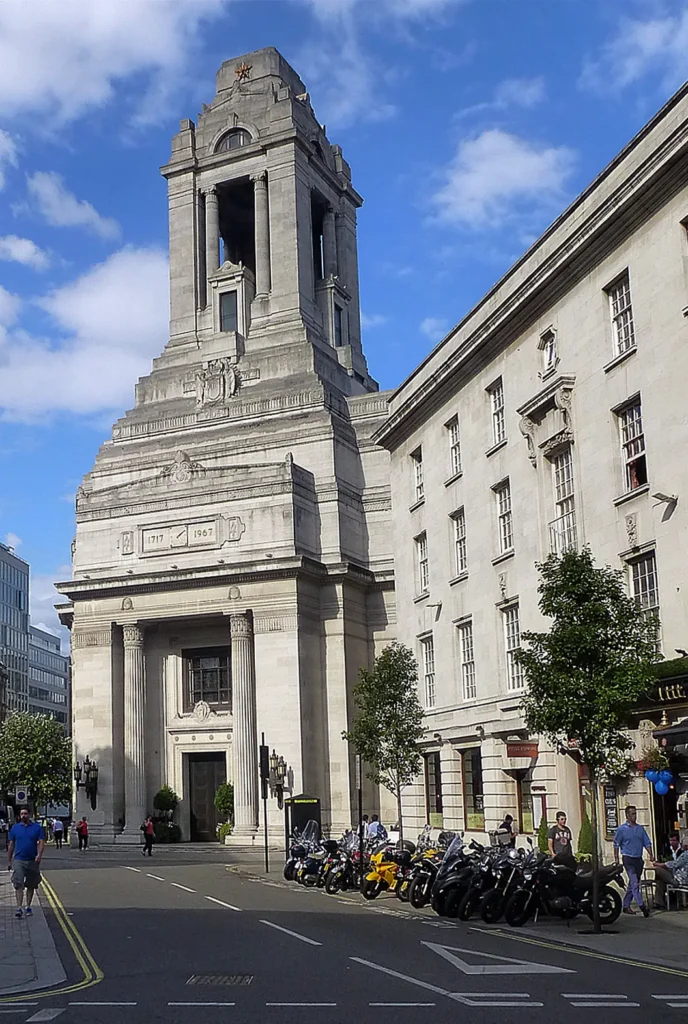
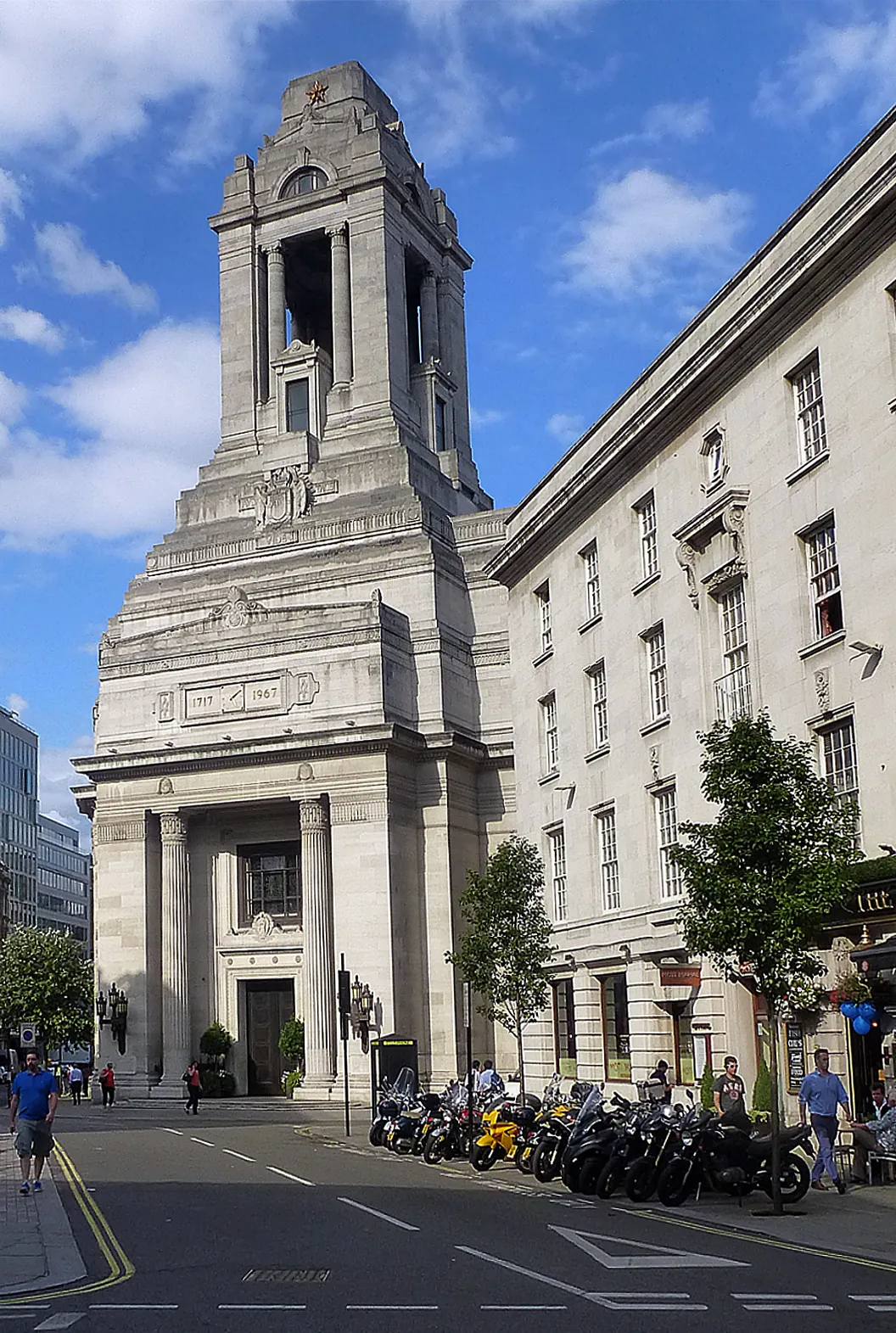
The physical seat of the UGLE is Freemasons’ Hall on Great Queen Street in London, a building whose current form dates to 1933. It was constructed in the Art Deco style as a memorial to the Freemasons who died during World War I, replacing an earlier structure on the same site. The building is Grade II* listed by Historic England, reflecting both its architectural merit and its cultural significance. Inside, the Grand Lodge room seats over a thousand people beneath a vaulted ceiling decorated with Masonic symbols and allegorical imagery, while separate wings house administrative offices, a library, and a museum whose collections include lodge warrants, regalia, and documents spanning three centuries of English Masonic history. The UGLE offers public guided tours, and the museum’s holdings are accessible to researchers, making Freemasons’ Hall one of the more genuinely open institutions among organizations that popular culture insists are impenetrably secretive. The library alone holds approximately 50,000 volumes, according to the UGLE’s own published records, covering English Freemasonry history, ritual, and symbolism in a depth that few comparable collections can match.
Masonic Degrees Under the UGLE: Craft, Royal Arch, and Beyond
The United Grand Lodge of England recognizes three foundational Craft degrees, and understanding their structure matters before any discussion of the wider Masonic world. Each degree carries its own candidate title, symbolic focus, and set of working tools drawn from the stonemason’s trade. The table below compares the three Craft degrees as defined under UGLE doctrine.
| Degree | Candidate Title | Central Symbolic Theme | Key Working Tool |
|---|---|---|---|
| First Degree (Entered Apprentice) | Entered Apprentice | Preparation and moral foundation | The 24-inch gauge and common gavel |
| Second Degree (Fellow Craft) | Fellow Craft | Intellectual development and the liberal arts | The square |
| Third Degree (Master Mason) | Master Mason | Mortality, resurrection, and fidelity | The skirret, pencil, and compasses |
Beyond these three degrees, the UGLE officially recognizes the Holy Royal Arch as a companion chapter rather than a separate tier of rank. Appendant orders exist alongside the Craft structure, including the Mark Master Mason degree, the Ancient and Accepted Rite (which extends to the 33rd degree), and the chivalric order of the Knights Templar. Each body operates under its own governing authority. The UGLE does not administer them directly, though Craft lodge membership is almost universally required before a Mason may petition to join any appendant order. The relationship is one of recognition, not jurisdiction.
A persistent source of public confusion involves the 33 degrees of the Scottish Rite, formally known in England as the Ancient and Accepted Rite. Many people encounter references to “33rd-degree Masons” and assume those degrees sit atop the UGLE’s three Craft degrees like floors on a building. They do not. The Scottish Rite and the Craft system are parallel structures, each with its own ceremonial logic and governing body. Reaching the 33rd degree of the Ancient and Accepted Rite confers no authority over a Craft lodge and carries no rank within the UGLE’s framework. The two systems share a common membership pool, not a common ladder.
The Royal Arch: Freemasonry’s ‘Fourth Degree’ Explained
The Holy Royal Arch occupies a unique and frequently misunderstood position in English Freemasonry. In 1813, the Articles of Union that merged the Premier Grand Lodge and the rival Grand Lodge of the Antients declared explicitly that “pure ancient Masonry consists of three degrees, including the Supreme Order of the Holy Royal Arch.” That phrasing was deliberate. The Royal Arch is not a fourth degree in the UGLE’s official view; it is the completion of the third, the point at which the narrative begun in the Master Mason ceremony reaches its resolution. A Master Mason who has not joined a Royal Arch Chapter is, by this definition, holding an unfinished story. In practice, the two bodies (Craft lodge and Royal Arch Chapter) meet separately, carry distinct membership fees, and are administered by different governing structures, which is precisely why the “fourth degree” label keeps resurfacing despite the UGLE’s formal position on the matter.
Want to learn more?
International Recognition: How the UGLE Certifies Other Grand Lodges
The United Grand Lodge of England does not simply acknowledge other grand lodges out of courtesy. It applies a formal framework, first codified in 1929 under what the UGLE calls the Basic Principles for Grand Lodge Recognition, a set of criteria that any grand lodge must satisfy before its members may visit English lodges and English Masons may visit theirs. That reciprocity, known as inter-visitation, is the practical currency of Masonic regularity. Without it, a lodge may call itself Masonic, but it operates outside the network that the UGLE has spent three centuries constructing.
The recognition criteria are specific and non-negotiable by design. A grand lodge seeking UGLE recognition must require belief in a Supreme Being from all its candidates, open its proceedings on a Volume of Sacred Law (the particular scripture left to each member’s faith tradition), and prohibit discussion of politics or religion within the lodge room itself. That last requirement traces directly to the 1723 Constitutions of James Anderson, which instructed Masons to leave “their particular Opinions to themselves.” The UGLE also requires that recognized grand lodges work only the three Craft degrees and that sovereignty over those degrees rests with the grand lodge alone, not with any appendant body. As of the most recently published UGLE recognition list, these standards are met by grand lodges in more than 180 jurisdictions, a reach that makes the institution the de facto international standard-setter for English Freemasonry history and its modern descendants.
The weight of that standard-setting role is considerable. A mason initiated in, say, a UGLE-recognized lodge in Australia can walk into a lodge in Canada, Germany, or Japan and be received as a known quantity. The credential travels. Grand lodges outside the recognition framework, however numerous or well-organized, cannot offer their members that mobility. This is why the UGLE’s list functions less like a diplomatic register and more like a professional accreditation system, one that shapes the lived experience of individual Masons far more than most institutional documents do.
The Question of Women’s Lodges and Co-Masonry
The UGLE’s refusal to extend recognition to female or mixed-gender grand lodges is the most publicly contested element of its recognition framework. Bodies such as the Order of Women Freemasons and the co-Masonic Le Droit Humain work the same or substantially similar ritual, share much of the same symbolic vocabulary, and in some cases occupy lodges in the same cities as UGLE-recognized bodies. The UGLE maintains cordial, if formally distant, relations with several of these organizations. What it does not offer is inter-visitation rights, because its Basic Principles define a regular lodge as one composed exclusively of men. The position is doctrinal rather than personal, rooted in the argument that Freemasonry as the UGLE understands it has always been a male fraternity and that altering that definition would constitute a fundamental break in regularity, not merely a policy update. Critics within the broader Masonic world, including some recognized grand lodges in continental Europe, regard the exclusion as an artifact of social history rather than a principle with philosophical weight. The debate is unlikely to be resolved quickly. Institutions that have operated continuously since 1717 tend to move on their own timescale, and the UGLE has given no public indication that its recognition criteria on this point are under active review.
Charitable Work and Community Impact
The Masonic Charitable Foundation (MCF), formed in 2016 by consolidating four legacy charities under a single governance structure, serves as the United Grand Lodge of England’s principal philanthropic vehicle. It distributes approximately £4 million annually to non-Masonic causes, funding hospice care, dementia research, addiction recovery programs, and youth opportunity initiatives. Grant recipients are not obscure beneficiaries selected behind closed doors; they include nationally recognized organizations such as Age UK, the MS Society, and a range of hospice providers operating across England and Wales. The MCF publishes its grant-making criteria and annual reports publicly, a transparency measure that sits somewhat awkwardly alongside the fraternity’s reputation for secrecy, though the organization seems comfortable with the irony.
The broader scale of English Freemasonry’s charitable output extends well beyond the MCF’s central disbursements. The UGLE’s own published figures cite more than £46 million donated to charitable causes over a recent five-year period, a total that reflects contributions from individual lodges and their Provincial networks acting independently of the central foundation. Much of this activity is organized through the Festival system, a fundraising mechanism with roots in the 19th century in which each Province commits to a multi-year campaign targeting a specific charity, culminating in a grand presentation of the total raised. The Festival model has proven durable precisely because it channels the lodge’s natural social cohesion, its regular meetings, its sense of collective purpose, into a structured giving cycle. Critics who dismiss Masonic philanthropy as vague self-congratulation are working from an outdated picture; the figures and the named recipients are on the record.
Criticism, Controversy, and the UGLE’s Response
No institution of comparable age escapes scrutiny entirely, and the United Grand Lodge of England is no exception. The criticisms directed at it fall into three broad categories: alleged conflicts of interest among members in public life, questions of transparency, and the organization’s exclusion of women from its Craft lodges. Each deserves examination on its own terms, without the distortion that conspiracy framing invariably introduces.
The 1997 Parliamentary Inquiry
The most formally documented challenge came in 1997, when the UK House of Commons Home Affairs Select Committee published a report specifically examining Freemasonry in the police and judiciary. The Committee recommended the creation of a voluntary register requiring public servants in those roles to declare any Masonic membership. Its concern was not proven wrongdoing but the appearance of potential partiality: a judge or senior police officer who shared lodge membership with a defendant or suspect created, at minimum, a perception problem that existing disclosure rules did not adequately address.
The UGLE opposed the proposal directly, characterizing it as discriminatory on the grounds that no comparable declaration was required of members of other private associations, whether golf clubs, trade unions, or religious bodies. The Committee’s recommendation was never enacted into law. Parliament had raised similar concerns as far back as 1984, and in both instances the debate produced scrutiny but no binding legislation. The UGLE’s formal position, articulated in its 1984 statement and reaffirmed since, holds that its published rules explicitly prohibit members from using lodge connections for personal advantage, and that no major independent investigation has produced substantiated evidence of systemic Masonic favoritism in public appointments or judicial decisions.
Transparency, Membership, and the Exclusion of Women
The question of women’s exclusion from Craft lodges under the Grand Lodge of England has drawn consistent criticism from equality advocates, particularly as broader British society has moved toward more explicit anti-discrimination frameworks. The UGLE’s position rests on a legal foundation: UK equality law contains specific exemptions for single-sex associations, and a private membership organization is entitled, within those exemptions, to define its own criteria for admission. Separate grand lodges, notably the Order of Women Freemasons and the Honourable Fraternity of Ancient Freemasons, operate independently and admit women; the UGLE maintains fraternal relations with neither, though it does not formally condemn them. On the transparency front, the organization has incrementally increased its public communications since the 1990s, including the launch of a public-facing website and a more open media policy, while still maintaining that the privacy of individual members is a legitimate institutional value rather than evidence of concealment. Allegations of Masonic favoritism in business and public appointments persist in popular culture, but they have persisted largely in the absence of the documentary evidence that would be required to move them from allegation to finding.
The UGLE in the 21st Century: Modernization and Contemporary Challenges
Membership figures tell a story the institution itself does not shy away from. The United Grand Lodge of England reported roughly 500,000 members at its post-war peak in the mid-20th century; by the early 2020s, active membership in England and Wales had fallen to approximately 200,000. The decline is not unique to English Freemasonry. Fraternal organizations across the Western world, from Rotary clubs to Odd Fellows lodges, have tracked similar trajectories as the social landscape shifted away from formal, dues-paying brotherhoods. What distinguishes the UGLE’s response is the degree to which it has chosen visibility over retrenchment.
The communications pivot began in earnest during the 2010s. The UGLE launched an official public website, established a social media presence across major platforms, and developed the Freemasonry branded portal, a consolidated digital resource designed explicitly to counter misinformation and reach prospective members who might otherwise encounter the organization only through conspiracy-adjacent content online. Freemasons’ Hall on Great Queen Street in London, long a landmark that most Londoners had never entered, began offering scheduled public tours and hosting cultural events open to non-members. For an institution whose historical reputation rested partly on deliberate opacity, the shift was considerable. The COVID-19 pandemic then accelerated an experiment nobody had planned: with in-person lodge meetings suspended, some lodges held virtual gatherings under special dispensation from the Grand Lodge, conducting abbreviated ritual work over video conferencing platforms. The experience prompted a debate that remains unresolved within the fraternity, namely whether the physical presence of the lodge room is incidental to Masonic ritual or constitutive of it. Traditionalists argue that the lodge is not a meeting but a consecrated space, and that digital participation fundamentally alters what is being practiced. Reformers counter that the fraternity has always adapted its forms while preserving its principles, pointing to centuries of procedural revision as evidence. The UGLE has not issued a definitive ruling, which may itself be the most diplomatically Masonic response available.
FAQ
What is the United Grand Lodge of England and what does it do?
The United Grand Lodge of England (UGLE) is the governing body of Freemasonry in England, Wales, and a number of overseas districts. Formed in 1813 through the union of two rival grand lodges, it sets the rules and standards for approximately 7,000 lodges and around 200,000 members. Its responsibilities range from issuing lodge warrants and overseeing ritual standards to maintaining an authoritative list of recognized grand lodges worldwide.
Beyond governance, the UGLE administers the Masonic Charitable Foundation, the primary vehicle through which English Freemasonry channels philanthropic giving to causes outside the fraternity itself.
What is the history of the Grand Lodge of England and why does 1717 matter?
On June 24, 1717, four London lodges gathered at the Goose and Gridiron alehouse in St. Paul’s Churchyard to form the Premier Grand Lodge of England, the first grand lodge in recorded history and the institutional starting point of modern speculative Freemasonry. Six years later, in 1723, the clergyman James Anderson drafted the Constitutions, which codified the body’s rules and became the template adopted by grand lodges across Europe and the Americas.
The 1717 founding was not the end of the story. A rival faction calling itself the Antients broke away in 1751, disputing ritual authenticity. The two bodies reconciled in 1813, producing the UGLE in its present form. That two-century-old settlement still governs English Freemasonry today.
What are the Masonic degrees recognized by the UGLE?
The UGLE governs three Craft degrees: Entered Apprentice, Fellowcraft, and Master Mason. It also treats the Holy Royal Arch as the formal completion of the third degree, making it the only additional order directly under UGLE jurisdiction rather than a separate appendant body.
Further orders, including the Ancient and Accepted Rite (which confers degrees up to the 33rd) and the Knights Templar, operate under their own governing bodies. Craft membership is typically a prerequisite for joining these orders, but the UGLE does not administer them directly. The distinction matters: a Master Mason holds a UGLE-recognized degree; a 32nd-degree Scottish Rite Mason holds an additional honor from a separate organization.
How does the UGLE decide which grand lodges around the world it recognizes?
The UGLE applies a set of Basic Principles for Grand Lodge Recognition, first formalized in 1929, to evaluate whether a grand lodge qualifies for inter-visitation with English lodges. The core requirements include a mandatory belief in a Supreme Being, the use of a Volume of Sacred Law during meetings, a prohibition on political and religious discussion within the lodge, and restriction of Craft membership to men.
Grand lodges that satisfy these criteria may exchange visits with English lodges; those that do not, including co-Masonic and all-female bodies, are not recognized for that purpose. The UGLE has been careful to note that non-recognition does not imply hostility, and relations with some unrecognized bodies remain, in the UGLE’s own framing, perfectly cordial.
What charitable work does the UGLE undertake, and how much does it donate?
The UGLE’s primary philanthropic vehicle is the Masonic Charitable Foundation (MCF), established in 2016 by consolidating four older Masonic charities. The MCF distributes approximately £4 million annually to non-Masonic causes, with grant recipients including Age UK, the MS Society, and local hospices supporting dementia research and palliative care.
When Provincial and individual lodge fundraising is added to the MCF’s direct grants, the UGLE’s own published figures cite more than £46 million donated across a recent five-year period. Those figures are verifiable through the MCF’s annual reports, filed with the Charity Commission for England and Wales, which makes the foundation one of the more transparent large-scale charitable operations in the voluntary sector.