 Italiano
  English
| 0 Comments | James Whitfield
The masonic handshake is one of the most talked-about and least understood features of Freemasonry. Mention it in casual conversation and the room divides: half the people picture a shadowy elite exchanging coded signals, the other half have no idea what the gesture actually involves. Both groups deserve a better answer. Masonic grips, the correct term used within lodge tradition, are recognition devices with documented roots in the operative stonemason guilds of medieval Europe, where a craftsman’s ability to prove his trade rank determined his wages and his access to work sites. By the time the first Grand Lodge was formally constituted in London on June 24, 1717, the handclasp as a fraternal identifier was already embedded in the ritual structure of speculative Freemasonry. This article examines what these grips are, how they differ across the three principal degrees, where the practice historically comes from, and why the surrounding mythology almost always tells us more about popular culture than about anything happening inside a lodge room.
What a Masonic Handshake Actually Is, and Is Not
A masonic handshake is a degree-specific grip used between Freemasons to confirm membership and rank within the fraternal order. Known internally as a “grip” or “token,” it functions as a recognition device rather than a covert signal. Each of the three principal degrees carries its own distinct grip, communicated during ritual initiation.

The phrase “secret handshake” is, strictly speaking, a media coinage. Inside lodge rooms and Masonic literature, the correct terminology has always been grip or token. The Constitutions of the Free-Masons, compiled by James Anderson in 1723, references signs and tokens as formal elements of lodge practice, and ritual monitors published throughout the 19th century consistently use “grip” when describing physical recognition between members. The popular shorthand flattens a structured system into something that sounds more like a schoolyard code. The distinction matters because it changes what the practice actually is: not a single universal gesture, but a set of graded acknowledgments tied to a Mason’s progress through the degrees of the craft.
Grips do not function as signals of political coordination, social privilege, or access to hidden power. Their documented purpose is straightforward: to allow one Mason to confirm, without verbal declaration, that another has received the same degree of initiation. This is a practical solution to a practical problem, and it was hardly unique to Freemasonry. Odd Fellows, the Knights of Pythias, and dozens of other fraternal organizations that flourished in the 18th and 19th centuries employed comparable recognition systems. The freemason recognition signs that attract so much modern speculation were, in their original context, a fairly standard feature of fraternal culture. Treating them as evidence of something more exotic requires ignoring the broader historical landscape in which Freemasonry developed, a landscape crowded with brotherhoods, guilds, and mutual-aid societies that all had their own tokens, passwords, and signs of recognition.
Historical Origins: From Operative Guilds to Speculative Lodges
The Role of Recognition Signs in Pre-Modern Trade Guilds
Before professional licensing bodies, standardized certificates, or any government registry of skilled workers, itinerant craftsmen faced a straightforward problem: how do you prove to a foreman on a cathedral site in York that you are the journeyman mason you claim to be? The answer, across medieval trades, was a system of passwords, gestures, and physical tokens known only to verified guild members. These were not mystical ceremonies. They were labor-market infrastructure. A mason who could produce the correct word or grip for his rank could expect fair wages and access to the lodge (the on-site workshop) without dispute. One who could not was turned away, or paid at a lower rate. The economic incentive to maintain secrecy was considerable and entirely mundane.
The Regius Manuscript, dated by scholars to approximately 1390, and the Cooke Manuscript, dated to around 1410, are the earliest surviving documents of English stonemason guild customs. Both texts set out rules of conduct, obligations of craft knowledge, and the moral duties of a mason to his fellows. Neither explicitly describes a handclasp or grip in the terms later Masonic ritual would use. What they do establish is a guild culture built around earned rank, sworn obligation, and the controlled transmission of craft knowledge. That cultural architecture is the direct ancestor of what speculative Freemasonry would later formalize into a degree-based recognition system.
Samuel Prichard’s 1730 Exposure and What It Revealed
The transition from operative guild custom to speculative lodge ceremony was well underway by June 24, 1717, when four London lodges convened at the Goose and Gridiron alehouse to form the Premier Grand Lodge of England. Within thirteen years, the grip traditions codified into that emerging degree structure were already public knowledge, thanks to a printer named Samuel Prichard. His Masonry Dissected, published in October 1730, was the first widely circulated printed text to describe Masonic grips by degree in specific, procedural detail. Prichard laid out the question-and-answer catechisms of the Entered Apprentice, Fellow Craft, and Master Mason degrees, including the physical tokens of recognition associated with each.
The pamphlet sold through multiple editions within weeks, which tells you something about public appetite for the information. More consequentially, it forced the Premier Grand Lodge to act. The lodge revised its recognition tokens shortly after publication, a decision recorded in grand lodge minutes, precisely because Masonry Dissected had rendered the existing grips accessible to any literate non-Mason willing to spend a few pence at a London bookseller. Prichard’s text is not a conspiracy document; it is a historical primary source, and researchers studying freemason recognition signs across the centuries treat it as such. It demonstrates that grip-based recognition was already a structured, degree-specific practice within thirteen years of speculative Freemasonry’s formal founding, and that the fraternity’s leadership considered those tokens worth protecting enough to change them when compromised.
The Three Principal Grips: Entered Apprentice, Fellow Craft, and Master Mason
Craft Freemasonry, in its standard Blue Lodge form, organizes its initiatory structure around three degrees: Entered Apprentice, Fellow Craft, and Master Mason. Each degree carries a corresponding recognition sequence built from three components: a word, a sign, and a grip. The grip is the tactile element, the one that functions in a handshake and therefore the one most discussed in popular culture. Descriptions of all three have circulated in print since at least the 1720s, appearing in exposure pamphlets such as The Grand Mystery of Free-Masons Discover’d (1724) and, most comprehensively, in Captain William Morgan’s Illustrations of Masonry (1826), published specifically to bring these details before the general public. Discussing them in an academic context discloses nothing that has not been available in public libraries for two centuries.
| Degree | Common Name of Grip | Distinguishing Physical Feature | First Documented Public Exposure |
|---|---|---|---|
| Entered Apprentice (1st) | Boaz Grip / Grip of the First Degree | Thumb pressed to the first knuckle joint of the index finger | The Grand Mystery of Free-Masons Discover’d, 1724 |
| Fellow Craft (2nd) | Shibboleth Grip / Grip of the Second Degree | Thumb pressed to the space between the first and second knuckle joints | Masonry Dissected, Samuel Prichard, 1730 |
| Master Mason (3rd) | Lion’s Paw / Strong Grip / Royal Grip | Fingers interlocked at the second joints, forming a distinct clasp | Illustrations of Masonry, William Morgan, 1826 |
The three grips are not interchangeable tokens. Within the ritual logic of the lodge, each is tied to a specific narrative moment and a specific level of fraternal recognition. A Fellow Craft grip offered to someone who knows only the first-degree sequence would, in theory, signal a discrepancy. This layered system reflects a broader pattern in early modern guild culture, where incremental access to trade knowledge was enforced through graduated oaths and recognition signals. The grips, in that sense, are less about secrecy for its own sake and more about structuring trust across a hierarchy of membership.
The Lion’s Paw: The Master Mason Grip Explained
The Master Mason grip carries the most symbolic weight of the three, largely because of its role in the central narrative of the third-degree ritual: the legend of Hiram Abiff. According to the allegory performed during initiation, Hiram, the architect of Solomon’s Temple, is slain by three ruffians who attempt to extract the Master’s word by force. His body is later discovered, and a senior Mason raises him using a specific grip, described in exposure texts as involving the interlocking of fingers at the second joints. This act of “raising” gives the grip its alternative names, including the Strong Grip and, in some jurisdictions, the Royal Grip. Morgan’s 1826 account describes the raising sequence in considerable narrative detail, and the United Grand Lodge of England’s own published histories acknowledge the Hiramic legend as central to third-degree working. The Lion’s Paw label, while evocative, is largely popular shorthand; the name does not appear consistently across all jurisdictions and is absent from some of the earliest exposure texts.
That symbolic weight explains why this grip became the most mythologized of the three in anti-Masonic literature. It is the culminating gesture of the most dramatic ritual moment in Blue Lodge Freemasonry, which made it irresistible to both critics and sensationalists. The historical record, however, treats it as a mnemonic device tied to a moral allegory about integrity under pressure, not as a gesture of occult power.
The Index Finger and Thumb: How the Entered Apprentice Grip Works
The first-degree grip is the simplest of the three and the one most frequently searched by people who have encountered a reference to a “masonic handshake index finger” or “masonic handshake thumb.” Samuel Prichard’s Masonry Dissected (1730), one of the earliest and most widely reprinted exposure texts, describes it as a standard handshake in which the thumb is pressed firmly against the first knuckle joint of the other person’s index finger. The pressure is the distinguishing element; the overall hand position resembles an ordinary grip closely enough to pass unnoticed in most social contexts. That functional near-invisibility was presumably the point. The Fellow Craft grip shifts the thumb to the space between the first and second knuckle joints, a small but deliberate variation that, within the system’s own logic, signals advancement to the second degree. Both grips rely on the same basic principle: a tactile signal embedded within a gesture that, to an uninitiated observer, looks entirely unremarkable.
Want to learn more?
Masonic Grips Beyond the Blue Lodge: Scottish Rite and York Rite Variations
The grips familiar to Blue Lodge Masons are only one layer of a much larger system. The Scottish Rite, Southern Jurisdiction of the USA, confers twenty-nine degrees beyond the third, and several carry their own recognition tokens, each tied to the allegorical content of that particular ritual. A candidate advancing through the fourth degree and beyond encounters grips whose form and meaning are explained within specific moral and philosophical lessons, not as arbitrary passwords but as mnemonic devices anchoring the symbolism of each degree. The York Rite follows a parallel logic: the Royal Arch Chapter, the Cryptic Council, and the Knights Templar each maintain degree-specific tokens distinct from anything conferred in a Craft lodge. A Royal Arch Mason and a Knight Templar may share the same Blue Lodge background yet exchange recognition signs the other does not recognize, because those signs belong to separate bodies with separate initiatory sequences. The architecture is layered, not monolithic.
Jurisdictional Differences: Why There Is No Single Universal Grip
Freemasonry is, by design and by history, a decentralized institution. Each of the fifty US states maintains a sovereign grand lodge, and every national grand lodge in the United Kingdom, Europe, and beyond operates independently. The United Grand Lodge of England and the Grand Lodge of Scotland evolved from distinct ritual traditions and have never been subordinate to a common governing body. The practical consequence is straightforward: grip forms, their accompanying words, and the precise pressure points involved vary from jurisdiction to jurisdiction. What a Mason in Tennessee recognizes as the standard token of the first degree may differ in small but deliberate ways from what his counterpart in Edinburgh was taught. This variation is not a flaw in the system; it reflects the federated nature of the Craft. It also demolishes one of the more persistent assumptions in popular conspiracy framing, which pictures a globally coordinated secret signal passed identically between Freemasons from Lagos to London to Los Angeles. No such uniformity exists. The historical record, including published exposures from William Morgan’s 1826 Illustrations of Masonry through twentieth-century ritual manuals, consistently shows regional divergence rather than a single standardized grip. Readers looking for a unified global masonic handshake will find, instead, a patchwork of local customs held together by shared principles rather than identical gestures.
The Masonic Handshake in Popular Culture: Film, Television, and the Line of Duty Effect
Few pieces of television did more to cement the grip’s sinister reputation in the British public imagination than the BBC police drama Line of Duty, which aired across six series between 2012 and 2021. The show wove Masonic handshakes into its central conspiracy of corrupt officers protecting one another inside a fictional police anti-corruption unit. Viewership peaked at over twelve million for the 2021 finale, and the spike in UK search interest for freemason recognition signs that followed each series was measurable. The drama worked precisely because it grounded its paranoia in something real: Freemasonry does exist inside British policing, and the United Grand Lodge of England’s own guidance has long recommended that members declare their membership when serving in certain public roles. The leap, though, from “declaration of membership is encouraged” to “a secret grip coordinates institutional cover-ups” is a substantial one, and Line of Duty made it with considerable enthusiasm and zero sourcing.
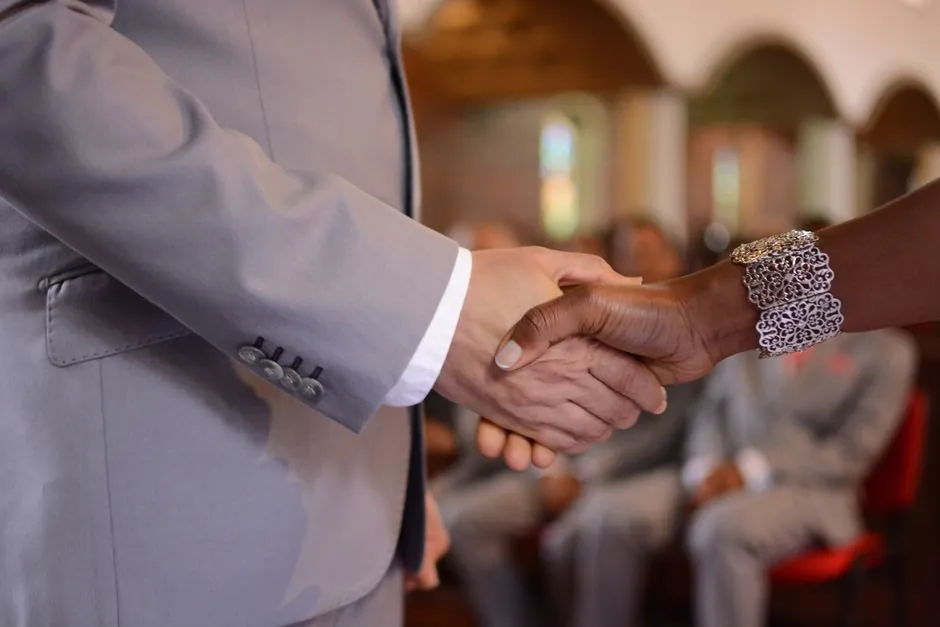
Hollywood has a longer and no more accurate track record. John Huston’s 1975 adaptation of The Man Who Would Be King, based on Rudyard Kipling’s novella, uses a Masonic grip as a plot-pivoting recognition scene between two British adventurers and a tribal chief, played with the kind of wide-eyed solemnity that suggests the filmmakers had done at least some research. By the time Nicolas Cage was running through the Library of Congress in National Treasure (2004), accuracy had been traded entirely for momentum. The pattern across film and television is consistent: the masonic handshake and its variants serve as shorthand for hidden coordination, a visual signal that two characters share a secret allegiance overriding their public obligations. What the historical record actually shows is considerably more mundane. The grips documented in ritual exposés from the eighteenth century onward, including Samuel Prichard’s Masonry Dissected of 1730, functioned as fraternal recognition tokens, a way for a traveler to identify a fellow lodge member in an unfamiliar city and claim hospitality or assistance. That is a social mechanism, not a conspiracy. Conflating the two makes for better television. It makes for worse history.
How Freemasons Actually Greet Each Other: Context and Ceremony
Popular imagination places the Masonic grip in shadowy corridors of power, exchanged between judges and politicians in moments of mutual recognition. The documented reality is considerably more procedural. Masonic grips belong to the lodge room, not the boardroom. They are exchanged as part of degree ceremonies, in which a candidate advances through successive ranks of the fraternity, and as part of the formal protocol governing visits between members of different lodges. The United Grand Lodge of England’s Book of Constitutions, along with equivalent grand lodge regulations across the United States, treats the exchange of recognition signs as a ceremonial function with defined rules, defined contexts, and defined participants. Nothing in those documents suggests use of a grip as a covert signal in civil or political life.
The grip functions within a system. It is one element among several, including passwords and catechetical responses, that together constitute what Masonic tradition calls “proof” of membership. No single element operates in isolation. A visitor who presents a grip but cannot supply the accompanying word and answer to a ritual question has not, by the standards most grand lodges observe, demonstrated sufficient proof. The process is deliberate by design. Freemasonry’s recognition system was developed precisely because lodges had no central registry of members. The multi-part examination substituted for the paperwork that did not exist, and it continues to function that way in lodges that maintain traditional practice.
Visiting a Strange Lodge: The Formal Examination Process
When a Freemason travels and wishes to attend a lodge he has never visited, he does not simply walk in. Most grand lodge constitutions require that an unknown visitor undergo a formal examination before being admitted to any degree work. This process, sometimes called “vouching” when a known member of the lodge can personally attest to the visitor’s standing, and “proving” when no such voucher is available, follows a structured sequence. The visitor is typically received in an anteroom by a committee of two or three lodge members, who proceed through a series of catechetical questions drawn from the ritual of the relevant degree. The masonic handshake, or grip, is tested as part of this sequence, not as a standalone gesture but as one point in a checklist that also includes the appropriate word and the correct response to specific questions about the candidate’s lodge, its number, and the grand lodge under whose authority it operates.
The purpose is verification, not theater. Grand lodge regulations in jurisdictions including New York, Pennsylvania, and England specify that a lodge’s Tyler (the officer stationed at the outer door) bears responsibility for ensuring that no uninitiated person gains entry to a tiled lodge. The examination committee’s report to the Worshipful Master, confirming or denying the visitor’s satisfactory proof, is a formal act recorded in some lodges’ minutes. Seen in this light, the grip is closer to a credential check than to a secret signal. It is a portable, memorized form of identification developed in an era before photographic membership cards, and it has persisted because ritual continuity is itself a Masonic value, not because the fraternity lacks better options.
Why the ‘Secret Handshake’ Myth Persists, and What It Actually Reveals
The grip, as a concept, does not need Freemasonry to feel threatening. Human beings are pattern-recognition machines, and a gesture that signals in-group membership to insiders reads, almost automatically, as exclusion or conspiracy to outsiders. That is not a moral failing; it is neuroscience. The problem arises when pattern recognition outpaces evidence. Modern viral content built around the so-called freemason secret handshake typically works by presenting two public figures shaking hands, circling a thumb position, and inviting the viewer to draw conclusions. The method is, to put it charitably, undiscriminating. Any firm handshake, any awkward grip, any camera angle that flattens a wrist produces a “positive.” Applied consistently, it would implicate most of the Fortune 500 and a significant portion of the British royal family in overlapping conspiracies. The analytical standard here should embarrass anyone who takes it seriously.
The Morgan Affair and the Birth of the Anti-Masonic Narrative
The more historically grounded version of the suspicion has a specific origin. In September 1826, a former Mason named William Morgan, living in Batavia, New York, announced his intention to publish a full exposure of Masonic ritual, including its grips and passwords. He was arrested on dubious charges shortly afterward, transferred to the custody of a group of men, and was never seen again. No body was conclusively identified. No one was ever convicted of murder. Several men received short prison sentences for conspiracy, and at least some of the local officials involved in Morgan’s arrest were themselves lodge members. That last detail was the accelerant. The Anti-Masonic Party, founded in New York in 1828, made the Morgan Affair its founding grievance and built a national platform on the argument that Masonic grips and recognition signs constituted a private loyalty system that allowed brothers to protect each other from legal accountability. The party ran a presidential candidate in 1832 (William Wirt, who carried Vermont), published congressional investigations into Masonic influence, and forced several prominent politicians to declare publicly whether they held lodge membership. It was the first organized third party in American electoral history, and its core claim, that secret recognition signals enabled a parallel justice system, proved far more durable than the party itself, which had collapsed by 1838.
The Anti-Masonic Party’s framing did not disappear when the party did. It migrated into nativist movements, into the Know-Nothing Party of the 1850s, into twentieth-century pamphlet literature, and eventually into digital content with no publication date and no named author. Each iteration recycled the same structural argument: the grip is not a symbolic gesture, it is a mechanism of mutual protection among the powerful. The historical record does not support that reading at scale. What it does support is that the Morgan Affair exposed genuine procedural failures in upstate New York’s legal system, failures that would have been scandalous regardless of whether any lodge was involved. Freemasonry’s misfortune was to be entangled in a genuine local injustice at precisely the moment American democratic culture was becoming acutely sensitive to elite privilege. The grip became a synecdoche for everything that felt opaque and unaccountable about organized fraternal life, and synecdoches, once established, are extraordinarily difficult to dislodge with facts alone.
FAQ
What is a Masonic handshake, and how does it work?
Within lodge tradition, the practice is more precisely called a grip or token: a degree-specific form of handclasp used to identify a Freemason’s rank to a fellow member. Each of the three principal degrees of Craft Freemasonry carries a distinct grip, differentiated by the precise position of the thumb and fingers against the other person’s hand.
The practice is not a modern invention or a conspiracy theorist’s inference. Samuel Prichard’s Masonry Dissected (1730) documented the grips of all three degrees in enough detail that the pamphlet caused genuine alarm inside the fraternity. The physical mechanics, in other words, have been in the public domain for nearly three centuries.
How do Masons greet each other in everyday life?
Outside formal lodge settings, the overwhelming majority of Freemasons greet one another exactly as anyone else would: a handshake, a nod, or a wave. Recognition tokens are ceremonial instruments used during degree rituals and when a member formally visits an unfamiliar lodge to establish standing, not covert social signals deployed in offices or on street corners.
The United Grand Lodge of England’s Book of Constitutions is explicit that such tokens belong to the lodge room context. Treating them as an everyday social code misreads their function entirely and, frankly, overstates the average Freemason’s enthusiasm for ritual theatrics at the grocery store.
What is the Lion’s Paw grip in Freemasonry?
The Lion’s Paw, also referred to as the Strong Grip of a Master Mason, is the recognition grip associated with the third degree of Craft Freemasonry. It involves an interlocking of the fingers in a specific configuration and is symbolically tied to the legend of Hiram Abiff, the central allegorical figure of the Master Mason degree. In the narrative, the grip relates to the raising of Hiram after his murder by three ruffians.
Its physical description has been publicly available since 18th-century exposure texts, including Three Distinct Knocks (1760). Calling it a secret at this point requires a generous redefinition of the word.
What does the Masonic handshake in Line of Duty represent?
In the BBC police drama Line of Duty, grips and gestures are used as dramatic shorthand for corrupt mutual protection among officers. The show is fiction, but it drew on a real historical debate. UK public inquiries in the 1990s, including the Home Affairs Committee report of 1997, examined whether Masonic networks in the police and judiciary posed a conflict-of-interest risk, though the committee found no conclusive evidence of systematic corruption.
The Anti-Masonic movement of the 19th century raised similar concerns in the United States after the Morgan Affair of 1826. No documented evidence supports the dramatic implication that recognition tokens routinely coordinate institutional wrongdoing. The show is good television; it is not a primary source.
Does the Masonic handshake vary between different countries or rites?
Yes, significantly. Freemasonry has no single global governing body. Each US state maintains its own grand lodge with its own ritual tradition, as do the United Grand Lodge of England, the Grand Lodge of Scotland, and dozens of independent jurisdictions worldwide. The Scottish Rite and York Rite appendant bodies add further degree-specific grips beyond the three principal Craft degrees.
This jurisdictional fragmentation is one of the strongest factual rebuttals to the popular image of a single, universally recognized secret grip. A Master Mason from a Tennessee lodge visiting a lodge in Edinburgh may find meaningful ritual differences throughout the entire ceremony, not just in the handclasp.
