 Italiano
  English
| 0 Comments | James Whitfield
Boaz and Jachin are the names of the two freestanding bronze pillars that flanked the entrance porch of Solomon’s Temple in Jerusalem, built around 950 BCE under the Phoenician craftsman Hiram of Tyre. Their dimensions, materials, and decorative capitals are recorded in two biblical accounts, 1 Kings 7:15-22 and 2 Chronicles 3:15-17, making them among the most precisely described architectural elements in the Hebrew Bible. The names carry deliberate meaning: Jachin translates from the Hebrew as “He will establish,” and Boaz as “In him is strength,” a pairing that frames the temple entrance as a threshold of divine promise and power. Centuries after the Babylonians destroyed the original pillars in 587 BCE, they were adopted as central symbols in Freemasonry, where they mark the entrance to every lodge room and anchor the symbolism of the Fellowcraft Degree. This article traces the pillars from their biblical construction through the archaeological record, their Hebrew etymology, scholarly debates about their function, and their enduring place in Masonic ritual and Western cultural imagination.
The Biblical Account: Where Boaz and Jachin Appear in Scripture
Boaz and Jachin are the two bronze pillars that stood at the entrance of Solomon’s Temple in Jerusalem, described in detail in 1 Kings 7:15-22 and 2 Chronicles 3:15-17. Cast by the craftsman Hiram of Tyre, they were freestanding monuments at the temple porch, not structural columns. Jachin stood on the right (south) side; Boaz on the left (north).
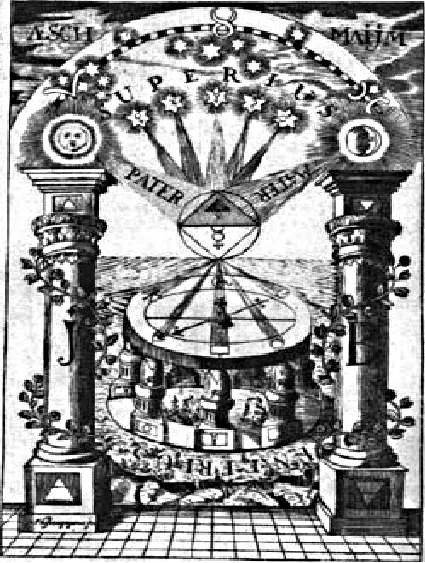
The more detailed of the two canonical accounts appears in 1 Kings 7:15-22, which records that each pillar stood eighteen cubits tall, with a circumference of twelve cubits and a capital of five cubits surmounted by elaborate pomegranate and lily-work decoration. The second account, in 2 Chronicles 3:15-17, broadly corroborates the placement and ornamentation but diverges on dimensions in a way that has occupied biblical scholars for centuries. Both texts agree on the craftsman responsible: Hiram of Tyre, a skilled bronzeworker whose mother was of the tribe of Naphtali and whose father was a man of Tyre. It is this figure whom Masonic tradition later develops into the central character of Hiram Abiff. The casting itself, both accounts confirm, was carried out in the Jordan plain near Succoth, where the clay soil was suitable for the large molds required.
The pillars’ position at the ulam, the entrance porch of the Temple, is significant precisely because they bore no structural load. They were not holding anything up. As the archaeologist and biblical scholar William F. Albright noted in his mid-twentieth-century studies of Solomonic architecture, freestanding entrance columns of this type were well attested across the ancient Near East, appearing at temples in Syria and Phoenicia during the same period. Their function was monumental and symbolic rather than architectural, which is exactly the quality that made them so durable as a concept in later religious and fraternal traditions. The naming convention recorded in 1 Kings 7:21 is precise: Jachin on the right, Boaz on the left, each name apparently bestowed at the moment of erection.
Discrepancies Between Kings and Chronicles
The dimensional discrepancy between the two accounts is one of the more persistent puzzles in the textual history of the Hebrew Bible. Where 1 Kings records eighteen cubits per pillar individually, 2 Chronicles gives thirty-five cubits for both pillars together, a figure that is arithmetically irreconcilable with the Kings account by any straightforward reading. Several explanations have circulated in the scholarly literature. The most widely accepted attributes the difference to scribal error, specifically the confusion of the Hebrew letter yod (representing ten) with he (representing five), a mistake that would collapse thirty-five into eighteen when combined with the capital measurement. Other scholars propose that the two texts were drawing on separate source documents that used different measurement conventions or counted the capitals differently. No single resolution commands universal agreement, and most modern critical editions of the Bible note the discrepancy in their textual apparatus without resolving it definitively. For the purposes of understanding the pillars’ cultural legacy, the precise height matters far less than the fact of their existence and their prominent placement.
Who Is Jachin in the Bible Beyond the Pillar?
The name Jachin does not originate with the Temple pillar. It appears earlier in the Hebrew Bible as a personal name: in Genesis 46:10, Jachin is listed among the sons of Simeon who traveled with Jacob’s household into Egypt, and the name recurs in Numbers 26:12 as the head of a Simeonite clan. After the Babylonian exile, a priestly family bearing the name appears in 1 Chronicles 9:10 and Nehemiah 11:10, associated with the restored Temple service in Jerusalem. This distribution across several centuries and social contexts suggests that Jachin carried established cultural resonance within Israelite society long before it was assigned to the southern pillar of Solomon’s Temple. The root of the name is generally parsed from the Hebrew verb kun, meaning to establish or to make firm, a reading that aligns naturally with the symbolic weight later placed on the pillar itself. Boaz, by contrast, is best known from the book of Ruth as the kinsman-redeemer who marries Ruth, and its root is commonly linked to the Hebrew phrase meaning “in him is strength.” Together, the names form a pairing that, even in their biblical contexts, carried connotations of establishment and power well before any architectural application.
What Boaz and Jachin Mean: Hebrew Etymology and Name Symbolism
The two names inscribed on Solomon’s pillars are not decorative labels. Each carries a specific theological charge rooted in Biblical Hebrew, and reading them together produces something closer to a creedal statement than a pair of architectural titles. Scholars working from the Masoretic text have parsed both names carefully, and while one reading is settled, the other remains a matter of productive debate.
Jachin (יָכִין, yāḵîn) presents the clearer case. The name derives from the Hebrew root כּוּן (kun), a verb meaning to establish, to make firm, or to set in order. Most translators and lexicographers, including those behind the Brown-Driver-Briggs Hebrew and English Lexicon, render it as “He will establish” or “He establishes,” treating the form as a third-person imperfect. The theological implication is forward-looking: a declaration of divine intention, a promise of permanence attached to the very threshold of the sanctuary. Boaz (בֹּעַז, bōʿaz) is the more contested name. The majority reading combines two Hebrew elements: bo (in him) and az (strength), producing “In him is strength” or, more compactly, “By strength.” A minority of scholars have proposed a derivation connecting the name to a root associated with swiftness or agility, though that reading has not achieved wide acceptance. The dominant translation remains the one built on az, and it is the reading that has shaped both Jewish liturgical commentary and, much later, Masonic interpretive tradition.
Placed side by side, the two names form a dyadic theological affirmation. The worshipper passing between the pillars moved through a declaration: the God who establishes, and the God in whom strength resides. Entry into the sacred precinct was framed, literally and linguistically, by attributes of the divine. Readers who have encountered the name Boaz elsewhere in scripture will know that the kinsman-redeemer in the Book of Ruth shares it. The coincidence has prompted occasional speculation about a symbolic link between the man and the pillar, but neither Kings nor Chronicles draws any such connection. The shared name is, as far as the text is concerned, exactly that: a shared name, nothing more.
Pronunciation Guide: Boaz and Jachin in Modern English
English speakers encounter these names most often in print before they hear them spoken, which has produced a small but persistent confusion about pronunciation. The standard English rendering is BOH-az for Boaz and JAY-kin for Jachin, and these are the forms heard in most lodge settings and church readings across the United States and United Kingdom. The Hebrew originals land differently: boh-AHZ places the stress on the second syllable, and yah-KHEEN preserves a guttural kh sound absent from English phonology entirely. Neither pronunciation is wrong in its own context. Readers who have encountered conflicting audio sources, particularly in documentary productions that alternate between English and academic Hebrew readings, can take the divergence as a function of transliteration rather than error. The Masonic tradition has used the anglicized forms for at least two centuries, and those forms are now conventional.
Architectural Specifications: Dimensions, Materials, and Decorative Capitals
The biblical record of the two pillars is unusually specific for an ancient text, yet the three primary source passages disagree with each other in ways that have kept archaeologists and biblical scholars productively arguing for generations. According to 1 Kings 7:15, each pillar stood 18 cubits tall (roughly 27 feet, or 8.2 meters) with a circumference of 12 cubits and a wall thickness of four fingers, confirming the hollow construction. Jeremiah 52:21 corroborates those figures almost exactly. 2 Chronicles 3:15, however, gives a combined height of 35 cubits for both pillars together, which either implies a different measurement convention or reflects a scribal error that no commentator has resolved to universal satisfaction. The table below makes the discrepancies visible at a glance.
| Measurement | 1 Kings 7 | 2 Chronicles 3-4 | Jeremiah 52 |
|---|---|---|---|
| Height (each pillar) | 18 cubits (~27 ft) | 35 cubits combined (disputed reading) | 18 cubits (~27 ft) |
| Circumference | 12 cubits | Not specified | 12 cubits |
| Capital height | 5 cubits | 5 cubits | 3 cubits |
| Pomegranates per capital | 200 (1 Kings 7:20) | 100 per row (2 Chr. 4:13) | 96 exposed (Jer. 52:23) |
| Wall thickness | 4 fingers (hollow) | Not specified | 4 fingers (hollow) |
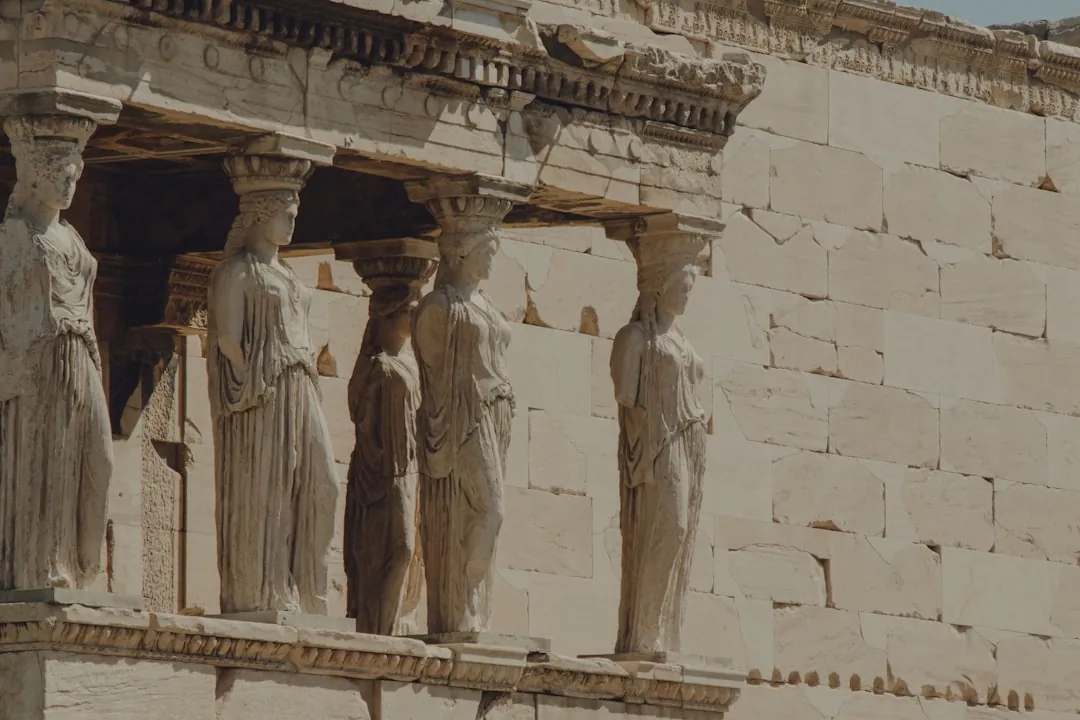
The material is described in Hebrew as nəḥōšet, a word that covers the full range of copper alloys, meaning modern translators render it as either bronze or brass depending on their preferred convention. The text specifies that the pillars were cast in the clay ground of the Jordan plain under the supervision of Hiram of Tyre, a craftsman described in 1 Kings 7:14 as the son of a widow from the tribe of Naphtali and a man of Tyrian bronze-working expertise. The hollow casting method was not a shortcut: it was standard practice for large ceremonial bronzes throughout the ancient Near East, reducing weight and the risk of structural cracking during cooling. The capitals, called koteret in the Hebrew text, added another 5 cubits of height and were among the most elaborately described decorative elements in the entire Solomonic building account. Each was wrapped in chainwork, ringed with two rows of pomegranates, and crowned with lily-work (shushan), a floral motif borrowed directly from Egyptian and Phoenician architectural vocabulary. The pomegranate count alone, somewhere between 96 and 200 depending on which passage and which exegetical tradition one follows, signals that these capitals were designed to overwhelm the eye rather than bear any load.
Comparison with Other Ancient Temple Pillars
Freestanding entrance pillars were not a uniquely Israelite architectural idea. The 9th-century BCE temple at Ain Dara in northern Syria features a monumental entrance flanked by large basalt orthostats, and the Phoenician temple at Kition on Cyprus shows clear evidence of freestanding pillars positioned at the threshold rather than integrated into the load-bearing wall system. Most relevant is the temple of Melqart at Tyre, described by Herodotus in his Histories (Book II, 44) as containing two pillars, one of refined gold and one of emerald, that shone brilliantly at night. Herodotus visited Tyre himself and reported this detail as a firsthand observation, which places the tradition of twin ceremonial pillars at the entrance of a Levantine temple firmly in the historical record, independent of any biblical source.
The implication for understanding the two pillars of Solomon’s Temple is significant. Rather than treating them as an isolated religious invention, the archaeological and textual evidence positions them within a recognizable Levantine tradition of freestanding threshold markers, objects whose purpose was symbolic announcement rather than structural support. That the hollow-cast bronze construction would have been useless as load-bearing columns only reinforces the point. The pillars stood, as the Ain Dara and Kition parallels suggest, to frame a sacred boundary, to mark the passage from the profane world into a consecrated space. It is precisely this threshold symbolism that Masonic ritual later absorbed and reinterpreted, transplanting an architectural convention of the ancient Near East into the lodge room’s ceremonial geography.
The Destruction and Historical Fate of the Original Pillars
The physical fate of the original pillars is documented with unusual precision for ancient history. When the Babylonian army under Nebuchadnezzar II sacked Jerusalem and razed Solomon’s Temple in 587/586 BCE, the bronze columns were among the most valuable prizes seized. Both 2 Kings 25:13 and Jeremiah 52:17 record the same outcome: the pillars were broken apart and the metal carried off to Babylon. The verb used in the Hebrew text is telling. These were not trophies transported intact; they were demolished on-site and stripped for their raw material, the fate of any large bronze object in the ancient Near East when a conquering army needed portable wealth.
Jeremiah 52:20 through 52:23 provides the most detailed inventory of the dismantling. The passage catalogs the dimensions, the decorative capitals, the pomegranates, and then offers a striking admission: the weight of the bronze was “beyond measuring.” That phrase is not rhetorical modesty. It signals an enormous quantity of metal recovered from a single structure, which partly explains why the columns appear nowhere in the archaeological record after 586 BCE. No fragment has been credibly identified. The Second Temple, rebuilt around 516 BCE under the patronage of the Persian court and described in the books of Ezra and Haggai, does not appear to have replicated freestanding pillars at its entrance. Herod the Great’s sweeping renovation of the Temple Mount, begun around 20 BCE and described in detail by the historian Josephus in Antiquities of the Jews, likewise makes no mention of equivalent bronze columns. What survived, then, was not bronze but text. The pillars persisted as a literary and theological object, passed through rabbinic commentary, early Christian exegesis, and eventually into the symbolic vocabulary of Boaz and Jachin Freemasonry. That absence of physical remains is, paradoxically, what gave them such extraordinary longevity as symbols. Objects that can be touched and measured stay fixed in time; objects known only through description can be reimagined by every tradition that inherits them.
Want to learn more?
/grand-lodge-of-england/” title=”Grand Lodge of England History”>Grand Lodge of England’s published educational resources at ugle.org.uk.”
Scholarly Debates: Function, Symbolism, and Archaeological Context
Few architectural elements in the ancient Near East have generated as much scholarly disagreement as the two freestanding pillars at the entrance of Solomon’s Temple. Three main interpretive frameworks have competed in the academic literature, and none has achieved the kind of consensus that would allow a textbook to settle the matter in a single sentence.
The oldest theory, that the pillars served a load-bearing structural function supporting a porch roof or lintel, has largely been set aside. The critical evidence is grammatical. The relevant passage in 1 Kings 7:21 uses the Hebrew verb wayyaqem, meaning “he set up” or “he erected,” rather than any term implying support from below. Biblical archaeologist John Monson, writing in Near Eastern Archaeology in 2000, noted that this phrasing consistently describes freestanding monuments elsewhere in the Hebrew Bible, not architectural supports. The structural reading, in short, asks the text to say something it does not say.
The cosmological theory, advanced most influentially by W.F. Albright in a 1942 paper in the American Journal of Semitic Languages and Literatures, proposed that the pillars functioned as giant cressets, metal basins designed to hold burning material. Albright connected them to the pillars of fire and cloud that, according to the Book of Exodus, guided Israel through the wilderness. This reading has attracted genuine scholarly interest, particularly because it would explain the names Jachin and Boaz as invocations of divine presence and dynastic continuity. Critics, however, have pointed out that no physical evidence of a fire-holding mechanism has been recovered, and the biblical description of the capitals, elaborate pomegranate-decorated bronze structures, fits a decorative or symbolic function far more naturally than combustion hardware. A third framework, the boundary-marker theory, treats the pillars as threshold monuments demarcating the boundary between the profane world and sacred space. This function is well-attested in Egyptian and Mesopotamian temple architecture, where paired obelisks or standing stones at temple gates carried exactly this liminal meaning. Most contemporary biblical archaeologists treat this interpretation as the most contextually plausible, while acknowledging that the pillars almost certainly carried cosmological and dynastic symbolism at the same time. Monumental architecture rarely communicates only one thing.
What Archaeological Excavations Reveal, and Don’t
The most honest answer to many questions about Solomon’s Temple is that the physical evidence remains frustratingly out of reach. The Temple Mount in Jerusalem is one of the most politically and religiously sensitive sites on earth, and systematic archaeological excavation beneath it has not been possible. Scholars working on the temple’s architecture must rely on the biblical text, ancient Near Eastern parallels, and a handful of comparative sites that shed indirect light on what Jerusalem may have looked like in the tenth century BCE.
Three sites have proven particularly instructive. The temple at Ain Dara in northern Syria, excavated by Syrian archaeologists in the 1980s and 1990s, shares a tripartite floor plan with the Jerusalem Temple described in Kings, and its entrance features stone bases that almost certainly held freestanding pillars. Tel Megiddo in northern Israel has yielded architectural remains from the same general period that help calibrate the scale and construction methods available to Solomonic builders. The Israelite sanctuary at Arad in the Negev, though smaller and later in date, provides direct evidence of a standing-stone tradition within the Yahwistic religious sphere. What none of these sites can supply is a direct parallel for the named, inscribed, bronze pillars described in 1 Kings 7. The comparative evidence confirms that freestanding pillars at temple entrances were a recognized architectural convention across the ancient Near East. It does not resolve what Jachin and Boaz specifically meant to the priests and worshippers who passed between them.
Boaz and Jachin in Freemasonry: Ritual, Lodge Layout, and the Fellowcraft Degree
When operative stonemasons gave way to speculative philosophy, the twin pillars of Solomon’s Temple traveled with them. In every regular Masonic lodge, two pillars (or their symbolic representations) flank the entrance to the lodge room. By convention established in the standard monitor texts published by grand lodges across the United States and the United Kingdom, the column associated with the Senior Warden bears the name Boaz, understood to signify Strength, while the Junior Warden’s column carries the name Jachin, interpreted as Establishment. These are not decorative choices. The placement encodes a theological proposition: that whatever is built must be both strong enough to stand and properly established to endure. Atop the capitals of both pillars, Masonic lodge furnishings traditionally place a terrestrial globe and a celestial globe, an elaboration with no basis in the biblical account that nonetheless appears with striking consistency in 18th-century lodge engravings, including those published in the Constitutions of the premier Grand Lodge of England.
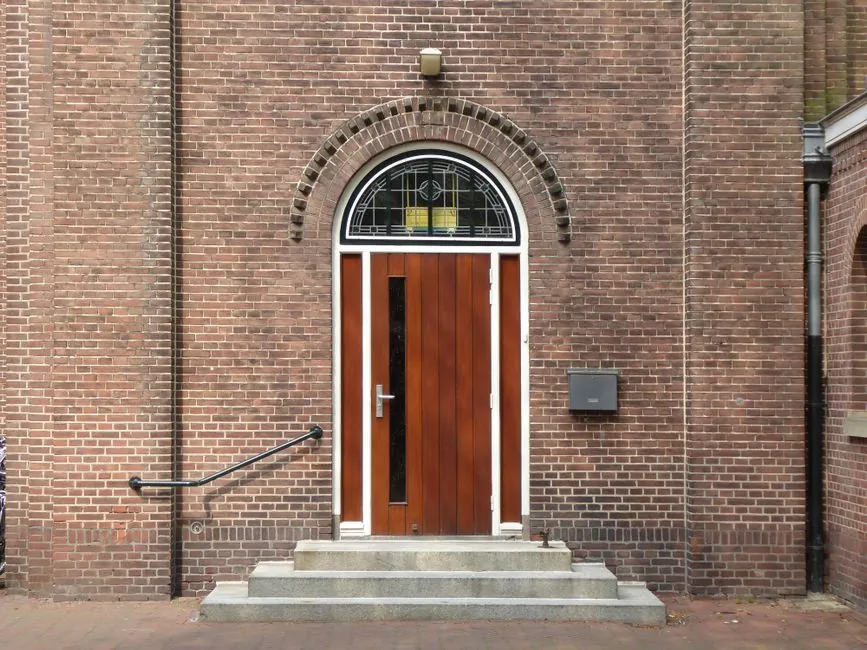
The Fellowcraft Degree, the second of the three degrees comprising the Blue Lodge, gives the twin pillars their most explicit ceremonial treatment. Candidates are symbolically said to pass between them as they advance in Masonic knowledge, framing the pillars as a threshold rather than a monument. The imagery is deliberately transitional: the candidate moves from the outer world into a deeper engagement with Masonic teaching, with the pillars marking the boundary between uninstructed curiosity and earned understanding. The connection to Hiram Abiff, the legendary architect of Solomon’s Temple whose fate anchors the third-degree narrative, means the pillars are never merely second-degree furniture. They are present, at least contextually, across all three degrees, functioning as a continuous architectural and moral backdrop to the entire initiatic sequence.
The Globes Atop the Pillars: A Masonic Addition
The terrestrial and celestial globes placed on the pillar capitals are a Masonic elaboration with no scriptural precedent. Neither 1 Kings 7 nor 2 Chronicles 4 mentions globes; those texts describe lily-work, chainwork, and pomegranates. The globes appear in lodge iconography from at least the 1720s onward, visible in the frontispiece engravings of early editions of James Anderson’s Constitutions and in lodge-room illustrations that circulated widely through the 18th century. Within Masonic interpretation, the terrestrial globe represents the fraternity’s engagement with the physical world and its members’ obligations to society, while the celestial globe gestures toward the moral and spiritual aspirations that Masonic ritual frames as its higher purpose. Grand lodge monitor texts describe the pairing as representing the universality of Masonic principles, a fraternity whose reach, in symbolic terms at least, extends across both the earth and the heavens. Whether one reads this as genuine cosmological ambition or as the rhetorical grandeur common to 18th-century fraternal organizations is, appropriately, left to the reader.
Boaz and Jachin in the Entered Apprentice and Master Mason Degrees
The Fellowcraft Degree may give the pillars their most explicit ritual treatment, but the first and third degrees have their own relationship to them. The Entered Apprentice, approaching the lodge as a candidate seeking passage, encounters the pillars as part of the physical and symbolic architecture of the lodge room before any formal instruction is given. They are among the first things a new candidate sees, which is, by design, the point. The Master Mason’s degree returns to Solomon’s Temple as its dramatic setting, placing the candidate within the narrative of Hiram Abiff’s fate and the Temple’s construction. In that context, the two pillars function as landmarks within a larger story, reminders that the structure being allegorized was real enough to have named columns, recorded dimensions, and a documented architect, even if the historical record and the Masonic legend diverge considerably on the details. Across all three degrees, the symbolism of Boaz and Jachin Freemasonry employs is cumulative, each encounter adding a layer to what is ultimately a sustained meditation on the relationship between strength, establishment, and the work of building something that lasts.
Beyond the Lodge: Boaz and Jachin in Tarot, Literature, and Popular Culture
The twin pillars did not stay confined to lodge rooms or biblical commentaries. By the early twentieth century, they had migrated into occult publishing, literary fiction, and esoteric philosophy, accumulating layers of meaning that sometimes connect back to their Solomonic origins and sometimes drift quite far from them. Knowing where the symbols appear outside Masonic ritual helps explain why a reader might encounter the names Boaz and Jachin in a tarot guidebook, a postmodern novel, or a Theosophical pamphlet and wonder how all three trace back to the same pair of bronze columns.
The High Priestess Card: Waite’s Deliberate Symbolism
The most widely recognized non-Masonic appearance of the pillars is the High Priestess card in the Rider-Waite-Smith Tarot, published in December 1909. The deck was designed by Pamela Colman Smith under the direction of Arthur Edward Waite, a Freemason, member of the Hermetic Order of the Golden Dawn, and prolific writer on Western esotericism. In Smith’s illustration, the High Priestess sits between two columns: one black, labeled “B” for Boaz, and one white, labeled “J” for Jachin. A veil decorated with pomegranates hangs between them, suggesting a threshold the viewer cannot cross.
Waite was not being impressionistic. In The Pictorial Key to the Tarot (1911), he wrote explicitly that the High Priestess “is seated between the white and black pillars of the mystic Temple, and the veil of the Temple is behind her.” He identified those pillars directly with Solomon’s Temple, describing the figure as seated “between the pillars of the sanctuary.” This is a direct textual link, not a later interpreter’s inference. Waite’s Masonic background shaped the iconography deliberately, and the card became one of the most reproduced images in Western occult publishing throughout the twentieth century, carrying the pillar symbolism into millions of households with no connection to either Freemasonry or the Hebrew Bible.
Cormac McCarthy and the Pillars as Literary Architecture
Cormac McCarthy’s Blood Meridian (1985) draws on the names as structural and thematic markers, using them as chapter epigraphs in a pattern that scholars of American literature have connected to the novel’s engagement with biblical duality and threshold imagery. The invocation is literary rather than doctrinal: McCarthy is interested in the symbolic grammar of opposing forces, the kind of binary framing the pillars have represented across traditions. Scholarly commentary, including work published in The Cormac McCarthy Journal, has examined how this biblical architecture shapes the text’s moral landscape without reducing it to allegory.
Beyond fiction, the pillars surface throughout Rosicrucian, Theosophical, and Hermetic literature as symbols of duality: active and passive, solar and lunar, mercy and severity. Helena Blavatsky’s The Secret Doctrine (1888) references opposing cosmic principles in terms that echo the pillar symbolism, and later Theosophical writers made the connection more explicit. In most of these contexts, the Masonic or biblical origin is acknowledged but treated as one tributary among several. The result is a symbol that has been, to use a precise word, decontextualized. That is neither a criticism nor an endorsement. It simply explains why the names Boaz and Jachin now carry different freight depending entirely on where a reader first encountered them.
Modern Replicas, Reconstructions, and Living Memorials
Physical representations of the twin pillars are not confined to historical memory or scriptural commentary. They exist today as tangible objects in lodge rooms, museum courtyards, church facades, and digital archives, each context shaping what the symbols are understood to mean. Masonic lodge rooms across the United States, the United Kingdom, and continental Europe routinely incorporate representations of the pillars, ranging from flat painted trestleboards to full three-dimensional columns flanking the Senior Warden’s station. Among the most historically significant installations is the pair housed within Freemasons’ Hall in London, the headquarters of the United Grand Lodge of England, where the columns function not as decorative afterthoughts but as active ritual furniture, present at every working of the First Degree. Their placement, proportions, and ornamentation follow conventions codified in the eighteenth century and refined through successive editions of the lodge’s constitutions. The pillars there are, in the most literal sense, living memorials: touched, walked past, and formally acknowledged by initiates every time a lodge is opened.
Outside the lodge room, the impulse to reconstruct Solomon’s Temple in physical form has produced some remarkable results. The scale model built in the 1960s for the Holyland Hotel in Jerusalem, now relocated to the Israel Museum grounds, renders the entire Temple precinct at a 1:50 ratio, with Boaz and Jachin proportioned against the competing biblical measurements that have occupied scholars for centuries. Designed under archaeologist Michael Avi-Yonah, it draws on the best available mid-twentieth-century scholarship, which also makes it a snapshot of interpretive consensus at a particular moment, now partly superseded. Reformed and Presbyterian churches have incorporated pillar imagery directly into their architecture as an explicit reference to the Solomonic prototype, a practice that carries no Masonic content but draws on the same scriptural vocabulary. More recently, digital reconstruction using photogrammetry and parametric 3D modeling has allowed architectural historians to test competing theories about the pillars’ height, capital design, and orientation without committing to a single physical interpretation. These virtual models have reopened debates that seemed settled, particularly around whether the columns stood free-standing or supported a structural element of the porch, a question the biblical text in 1 Kings 7 and 2 Chronicles 3 leaves genuinely unresolved. The pillars exist simultaneously as ritual objects, museum artifacts, architectural references, and open scholarly problems, which is a reasonably accurate description of their entire history.
FAQ
What do the names Boaz and Jachin mean in Hebrew?
Jachin (יָכִין) derives from the Hebrew root kun, meaning to establish or make firm. The name is most consistently translated as “He will establish.” Boaz (בֹּעַז) combines bo (“in him”) and az (“strength”), yielding “In him is strength.” Placed together at the temple entrance, the two names read as a paired declaration: divine establishment on one side, divine power on the other.
A secondary scholarly debate exists over the precise root of Boaz, but the strength reading remains dominant in both biblical scholarship and Masonic monitor texts, which consistently gloss the names along these lines.
Where exactly were Boaz and Jachin located in Solomon’s Temple?
According to 1 Kings 7:21, the pillars stood at the porch (ulam) of the Temple. Jachin was positioned on the right (south) side; Boaz stood on the left (north) side. They were freestanding monuments, not structural columns integrated into the building’s framework.
This placement at the threshold between the outer court and the sanctuary gave the pillars their primary symbolic function: markers of passage from the profane world into sacred space. That liminal quality is precisely what later traditions, including the Masonic ritual system, chose to emphasize.
What happened to the original pillars of Boaz and Jachin?
The Babylonian army destroyed Solomon’s Temple in 587/586 BCE. Both 2 Kings 25:13 and Jeremiah 52:17 record that the bronze pillars were broken apart and the metal carried off to Babylon. Jeremiah 52:20-23 provides a detailed inventory of the dismantling, noting the weight and dimensions of the fragments.
No physical remnant of the original pillars has been identified archaeologically. The Second Temple, rebuilt after the Babylonian exile, does not appear to have replicated them, making the twin pillars a monument that survives entirely through textual and symbolic transmission rather than material evidence.
How are Boaz and Jachin used in Freemasonry?
In the lodge room, the twin pillars flank the entrance and are most explicitly addressed in the Fellowcraft Degree, the second degree of the Blue Lodge. Masonic ritual identifies one pillar with strength and the other with establishment, following the Hebrew etymology closely.
Lodge monitors typically describe terrestrial and celestial globes atop the capitals, an elaboration absent from the biblical text. This addition reflects the 18th-century Masonic interest in cosmological symbolism. The pillars also anchor the broader lodge narrative centered on Hiram Abiff and the construction of Solomon’s Temple, connecting architectural history to moral allegory in a way that has remained structurally consistent since the ritual’s codification.
Why do the two pillars appear on the High Priestess Tarot card?
The Rider-Waite-Smith Tarot (1909) was designed under the direction of Arthur Edward Waite, a Freemason and occultist. Waite deliberately placed a black pillar labeled “B” and a white pillar labeled “J” behind the High Priestess figure, framing her as a guardian of a threshold drawn directly from the Temple porch imagery.
Waite confirmed this symbolism in The Pictorial Key to the Tarot (1911), making the connection explicit rather than inferential. The pairing of black and white also introduces a polarity reading (darkness and light, passive and active) that goes beyond the Hebrew etymology but is consistent with the esoteric tradition Waite was working within.
Were Boaz and Jachin structural columns that held up the Temple?
No. The biblical text describes them as freestanding pillars erected at the porch of the Temple. 1 Kings 7:21 uses the verb “he set up” rather than any language implying load-bearing function. Most contemporary biblical archaeologists classify them as monumental steles or ceremonial pillars.
Comparable freestanding entrance pillars have been documented at Phoenician and Syrian temples of the same period, suggesting a broader ancient Near Eastern convention for marking sacred thresholds with monumental columns that carried symbolic rather than structural weight. The architectural evidence consistently supports the ceremonial reading.
