 Italiano
  English
| 0 Comments | James Whitfield
The Fellowcraft degree is the second of the three degrees conferred in a Masonic lodge, positioned between the Entered Apprentice and the Master Mason. Where the first degree marks an initiation into the fraternity, the Fellowcraft degree turns the candidate’s attention outward, toward knowledge, reason, and the liberal arts. The degree draws on the imagery of the medieval stonemason’s craft, in which an apprentice who had demonstrated sufficient competence was elevated to the rank of Fellow of the Craft, gaining both new responsibilities and new privileges within the guild. In Freemasonry, that framework becomes a vehicle for exploring themes of intellectual development, proportion, and moral order. The ritual incorporates specific symbols, the winding staircase, the two great pillars, the letter G, each carrying layered meaning that the degree’s lecture is designed to unfold. This article examines the Fellowcraft degree in full: its historical roots, its ceremonial structure, its symbolism, the distinctions between jurisdictions, and its place in the broader progression from Entered Apprentice to Master Mason.
What Is the Fellowcraft Degree?
The Fellowcraft degree is the second of three degrees conferred in a Blue Lodge, the foundational unit of Freemasonry. Positioned between the Entered Apprentice and the Master Mason degree, it marks a candidate’s formal progression from initiation into a deeper engagement with the fraternity’s symbolic and intellectual traditions. Its central concern is the pursuit of knowledge.
The title itself carries a precise historical weight. In the operative stonemasons’ guilds of medieval Europe, a Fellow of the Craft was a journeyman, a worker who had moved beyond the most basic apprenticeship but had not yet attained the standing of a master. Speculative Freemasonry, which emerged from those guild traditions, preserved the terminology intact. The word “fellow” here retains its older English sense of an associate or companion within a recognized trade, not a casual acquaintance. That etymology matters, because the degree’s entire symbolic architecture is built on the idea of a craftsman in motion: no longer a raw beginner, not yet a completed master, but actively engaged in the work of self-improvement.
The degree’s governing theme, the cultivation of an informed, reasoning mind, distinguishes it sharply from the first degree. Where the Entered Apprentice ritual focuses on moral foundations and the candidate’s entry into the fraternal bond, the Fellowcraft journey turns outward toward the liberal arts and sciences, toward architecture as a metaphor for intellectual construction, and toward the obligation to pursue learning as a lifelong discipline. Advancement to this degree is not automatic; a candidate must demonstrate proficiency in the Entered Apprentice degree, typically by reciting a catechism or passing an examination before the lodge, before the lodge votes to confer the second degree. That requirement is not bureaucratic gatekeeping, it reflects the graduated, merit-based structure that Freemasonry inherited directly from the guild system it memorializes.
History and Origins of the Fellowcraft Degree
From Operative Guild to Speculative Lodge
Long before Freemasonry became a fraternal institution concerned with moral philosophy, the word “fellowcraft” described something entirely practical: a working mason who had completed his apprenticeship and earned the right to wages and independent labor. Medieval operative guilds organized their workforce into three grades, Apprentice, Fellow of the Craft, and Master, each carrying distinct privileges, responsibilities, and levels of access to trade knowledge. The Fellow of the Craft occupied the middle tier: no longer a raw learner bound to a single master, but not yet a master himself. He was, in the language of the guild, a journeyman in the fullest sense of the word. When speculative Freemasonry began repurposing this hierarchy in the late 17th and early 18th centuries, it retained the structure but fundamentally reinterpreted its meaning. The chisel and the plumb line became instruments of moral instruction rather than tools of construction. The Fellow of the Craft’s traditional command of geometry, the foundational science of the medieval builder, was elevated into a symbol of rational inquiry and intellectual development, a reframing that would define the Fellowcraft degree’s character for centuries.
The earliest surviving speculative Masonic manuscripts already hint at this two-tier inheritance. The Regius Poem (c. 1390), sometimes called the Halliwell Manuscript, and the Cooke Manuscript (c. 1410) both reference a distinction between apprentice and fellow, suggesting that the operative vocabulary was being absorbed into a proto-speculative context well before any formal lodge system existed. These documents don’t describe initiation rituals in the modern sense, but they establish the conceptual architecture, a graduated system of knowledge and obligation, that speculative Freemasonry would later systematize.
Codification in the 18th Century
The founding of the Premier Grand Lodge of England on June 24, 1717, is the conventional starting point for organized speculative Freemasonry, but the three-degree structure that modern Masons recognize did not spring fully formed from that first assembly at the Goose and Gridiron Alehouse in London. The crystallization of three distinct, sequential degrees, Entered Apprentice, Fellowcraft, and Master Mason, unfolded across roughly two decades. By the 1730s, lodge records and early exposés (including Samuel Prichard’s Masonry Dissected, published in 1730) confirm that the three-degree system was operational and widely recognized, with the Fellowcraft degree occupying its now-familiar middle position.
The 1723 Constitutions of the Free-Masons, compiled by the Reverend James Anderson under the authority of the Grand Lodge, did not enumerate degree rituals in explicit detail, that was never their purpose, but they codified the organizational and philosophical framework within which the degrees would develop. Anderson’s text placed conspicuous emphasis on the seven liberal arts and sciences: grammar, rhetoric, logic, arithmetic, geometry, music, and astronomy. Geometry, Anderson wrote, is “the basis of architecture” and the foundation of Masonic knowledge. This intellectual program mapped directly onto what the Fellowcraft degree lecture would later formalize, grounding the second degree’s emphasis on education and reason in an authoritative published document. By the mid-18th century, most jurisdictions across Britain and the American colonies had standardized around this three-degree model, cementing the Fellowcraft degree’s identity as the stage of intellectual inquiry between the moral foundations of the first degree and the culminating lessons of the third.
Key Symbols of the Fellowcraft Degree and Their Meanings
Jachin and Boaz: The Two Pillars
At the threshold of King Solomon’s Temple, and at the threshold of the Fellowcraft ceremony, stand two bronze pillars whose names carry the weight of scriptural authority. The Books of Kings and Chronicles record that Hiram of Tyre cast these columns for Solomon’s Temple in Jerusalem: Jachin, rendered as “He shall establish,” and Boaz, meaning “In strength.” Together, they frame the doorway as a statement of purpose before a single step is taken inside. In the degree’s ritual narrative, passing between them marks a candidate’s movement from the outer world of uninstructed labor into a space defined by order, proportion, and moral accountability. Architecturally, the pillars draw on a well-documented tradition of monumental gateway columns in the ancient Near East; symbolically, they compress an entire theology of divine covenant into two proper nouns. The Fellowcraft degree lecture addresses both names explicitly, treating them not as decorative detail but as the first lesson in a sequence of escalating instruction.
The Winding Staircase and the Liberal Arts
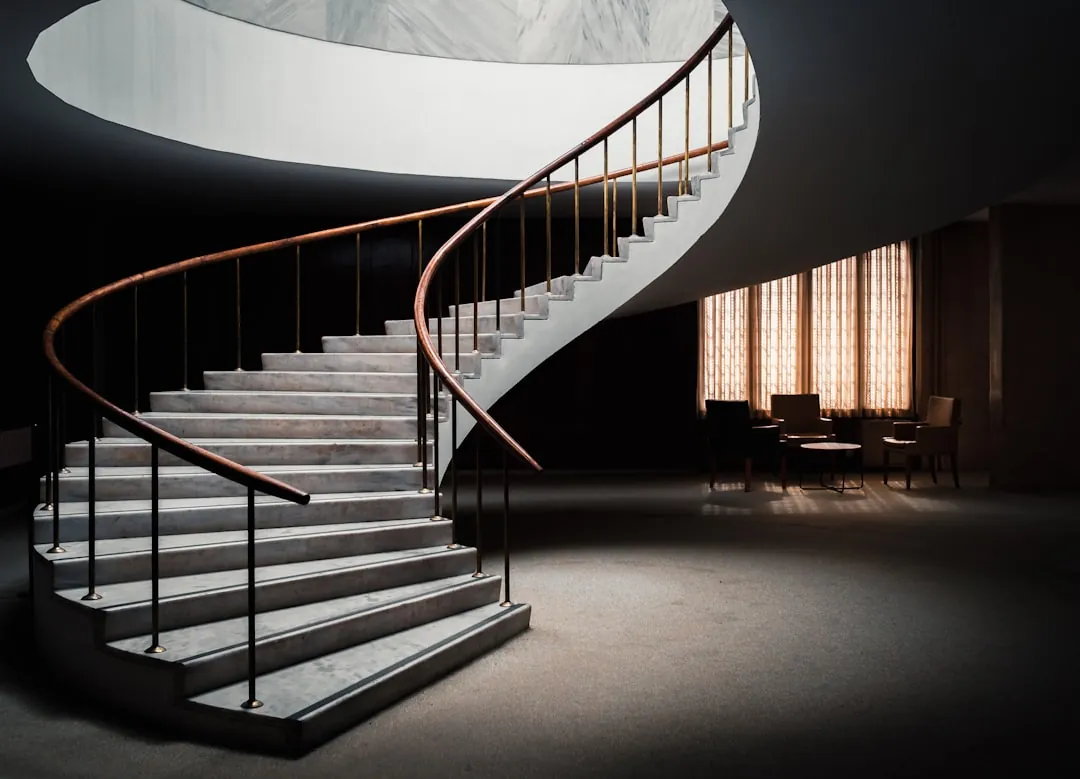
The winding staircase, ascending in flights of three, five, and seven steps, is one of the most architecturally legible allegories in the Fellowcraft degree. The three lower steps correspond to the classical trivium: grammar, rhetoric, and logic, the disciplines that govern language and reasoning. The five middle steps map onto the quadrivium plus one additional science: arithmetic, geometry, music, astronomy, and, in many ritual expositions, a fifth art that varies by jurisdiction. The seven upper steps complete the count with a reference to the full liberal arts curriculum as it was codified in medieval European universities and carried forward through the Renaissance.
This is not an accident of numerology. When the speculative lodge inherited the working tools and architectural vocabulary of operative stonemasonry, it also inherited a Renaissance civic ideal, that a free person’s education should encompass both language and number. The staircase encodes that ideal structurally, so the candidate does not merely hear a lecture on the liberal arts but physically enacts an ascent toward them, step by counted step. The Fellowcraft degree lecture, as preserved in expositions published by grand lodges, pauses on each flight to explain what branch of knowledge it represents and why that knowledge matters to a person of good character.
The 47th Problem of Euclid and the Letter G
Two of the degree’s most intellectually substantive symbols converge on a single theme: the primacy of geometry as both a practical science and a moral framework. The 47th Problem of Euclid, better known as the Pythagorean theorem, the proof that the square of a right triangle’s hypotenuse equals the sum of the squares of its other two sides, appears in Masonic tradition as an emblem of the master builder’s art. It is the mathematical principle that lets a craftsman establish a true right angle without mechanical instruments, a foundational technique for anyone setting out the ground plan of a building. In the Fellowcraft context, it stands for the power of demonstrated reason: a claim anyone can verify by following the steps of the proof.
The letter G, displayed prominently within the lodge room, reinforces the same argument from a different angle. The degree’s lecture is explicit that the G carries a double reference, to Geometry, the first and most essential of the mathematical sciences, and to the Grand Architect of the Universe, the non-sectarian designation for the Supreme Being that Freemasonry employs across jurisdictions. The rough and perfect ashlars, carried forward from the Entered Apprentice degree, remain visible in the lodge as a continuing reminder that the candidate’s moral self-improvement is itself a craft, one that demands the same precision, patience, and reverence for proportion that geometry demands of the builder. In this degree, symbolism is never merely decorative; it is the curriculum.
The Fellowcraft Ceremony: Structure and Ritual Elements
The ceremony conferring the Fellowcraft degree is deliberately more elaborate than the first. Where the Entered Apprentice ritual introduces a candidate to the fraternity as a newcomer, the Fellowcraft ceremony presupposes that foundation and builds on it. Before proceedings begin, the lodge is formally “called up”, the presiding Master declares it open at the degree of Fellowcraft, a procedural distinction that changes which officers participate and what business may be conducted. Candidates don’t simply walk in and receive the degree. First, they must demonstrate proficiency in the Entered Apprentice degree through a structured examination conducted by the lodge’s officers, confirming that the material of the first degree has been studied and retained. Only after passing that examination does the candidate advance to the ceremony itself.
The Obligation and the Fellowcraft Password
At the heart of every Masonic degree ceremony lies an obligation, a formal oath administered at the altar of the lodge, usually on a Volume of Sacred Law. The Fellowcraft obligation binds the candidate to secrecy regarding the degree’s ceremonial content and to standards of fraternal conduct toward fellow members. Published Masonic handbooks, including those issued by American grand lodges for public reference, confirm the obligation’s general character: it is moral and fraternal in nature, not legal or civil, and it carries no penalties enforceable outside the lodge room. Accompanying the obligation is the Fellowcraft password, a ceremonial marker of advancement that distinguishes a Fellowcraft from an Entered Apprentice when lodge business requires that distinction to be established. Neither the obligation’s precise wording nor the password itself is reproduced here; both are treated as internal fraternal material, and their general existence and function are widely documented in works such as Albert Mackey’s Encyclopedia of Freemasonry (1874).
The password is not a secret in any dramatic or conspiratorial sense. It functions more like a guild credential, a signal of completed work and accepted standing within a specific tier of the organization.
The Fellowcraft Lecture and Charge
Following the obligation, an officer of the lodge delivers the Fellowcraft degree lecture: a formal exposition of the degree’s symbols and their moral applications, organized as a series of questions and answers. This catechetical format has roots in operative guild practice and was codified in speculative Freemasonry’s early ritual manuals. The lecture covers the significance of the two pillars at the porch of Solomon’s Temple, the winding staircase of seven steps, the liberal arts and sciences, and the tools associated with the degree, each explained as an emblem of an intellectual or ethical principle. The question-and-answer format mirrors the educational method of the medieval university and reinforces the degree’s central theme of intellectual advancement through disciplined inquiry.
The ceremony concludes with the Fellowcraft charge, a formal address delivered to the newly advanced member. Where the lecture is expository, the charge is exhortatory. It directs the new Fellowcraft to pursue learning as a lifelong obligation, to contribute to civic life, and to carry the fraternity’s values into his conduct outside the lodge. Published versions of this charge, including those in Duncan’s Masonic Ritual and Monitor (1866), emphasize scholarship and public duty in language that echoes Enlightenment ideals of the educated, responsible citizen. The charge closes the ceremony by translating the degree’s symbolism into a practical mandate: study, serve, and conduct yourself accordingly.
Want to learn more?
Fellowcraft Degree vs. Entered Apprentice: Key Differences
The two opening degrees of the Blue Lodge are not simply sequential steps on a single ladder, they represent fundamentally different relationships between the candidate and the craft. The Entered Apprentice degree is a degree of initiation: the candidate is received, obligations are taken, and the most elementary landmarks of the fraternity are communicated. The second Masonic degree, by contrast, is a degree of progress. The candidate is no longer a newcomer being welcomed; he is a working member expected to engage intellectually with the symbolic instruction placed before him. That shift, from reception to participation, defines everything that distinguishes the Fellowcraft from his predecessor.
| Category | Entered Apprentice | Fellowcraft |
|---|---|---|
| Degree position | First degree | Second degree |
| Primary theme | Initiation and reception | Progress and intellectual engagement |
| Working tools | 24-inch gauge and common gavel | Plumb, square, and level |
| Lodge privileges | Attendance only; no voice or vote | Right to speak and vote on matters within the degree (most jurisdictions) |
| Key symbols | Rough ashlar, point within a circle | Winding staircase, two pillars (Boaz and Jachin), middle chamber |
The practical distinctions carry real weight. In most Anglo-American jurisdictions, an Entered Apprentice attends lodge but holds no voice in its proceedings, he observes and listens, but the governance of the lodge does not yet concern him. The Fellowcraft degree changes that standing: the advanced candidate earns the right to speak and vote on matters that fall within his degree, a privilege reflecting the fraternity’s recognition of his demonstrated commitment. The symbolic vocabulary expands in parallel. Where the Entered Apprentice’s working tools, the 24-inch gauge and common gavel, are instruments of basic moral discipline, the plumb, square, and level introduced during the Fellowcraft degree ceremony address more pointed virtues: rectitude of conduct, morality, and the equality of human standing. The fellowcraft degree lecture is also substantially longer and more discursive than its first-degree counterpart, incorporating extended instruction on the liberal arts and sciences, the architecture of Solomon’s Temple, and the allegorical ascent of the winding staircase. That length is deliberate, it signals that the candidate is now expected to absorb and reflect, not merely to receive.
Privileges, Responsibilities, and Preparation Before the Degree
Advancement through the degrees of Freemasonry is not automatic. Before a lodge confers the second Masonic degree on a candidate, that candidate must demonstrate he has absorbed what came before. In most jurisdictions, this means delivering a proficiency, a memorized catechism drawn from the Entered Apprentice degree, before the lodge or before a committee of Master Masons appointed for the purpose. The recitation covers the obligations, modes of recognition, and symbolic lessons of the first degree, and passing it is a prerequisite, not a formality. Beyond the catechism itself, preparation typically involves sustained work with a lodge mentor: reviewing the Entered Apprentice lecture, becoming comfortable with the lodge’s ritual workbook, and developing enough familiarity with the symbolic vocabulary to engage meaningfully with what the Fellowcraft degree introduces. A candidate who arrives at the ceremony having done that work will find the symbolism coherent; one who has not will find it a sequence of theatrical gestures.
The privileges that come with advancement are real, if incremental. A Fellowcraft, in most jurisdictions governed by mainstream grand lodges, may attend lodge communications open to that degree, speak on matters properly before the lodge, and in many jurisdictions cast a vote, rights that remain withheld from Entered Apprentices, who occupy the most restricted standing. Yet the Fellow Craft’s standing is still provisional. Full membership in the lodge, with the complete set of fraternal rights and responsibilities that entails, is conferred only at the Master Mason degree. A Fellowcraft sits, in a sense, on the middle step: more recognized than he was, not yet fully arrived. This graduated structure is intentional; it mirrors the symbolism of progressive instruction that runs through the entire three-degree system.
Timeline for Completing the Fellowcraft Degree
One of the most common practical questions surrounding the second degree is simply: how long does it take? The honest answer is that it depends on three overlapping variables, jurisdictional rules, proficiency requirements, and lodge scheduling. Some grand lodges mandate a minimum interval between degrees; one calendar month between the first and second degree is a common floor, though certain jurisdictions set longer minimums or leave the matter entirely to the discretion of the lodge. Others impose no fixed waiting period, placing the pace in the hands of the candidate and his mentor. What almost every jurisdiction does require is demonstrated proficiency, which means the timeline is partly determined by how quickly a candidate can commit the Entered Apprentice catechism to memory, a task that takes some men two weeks and others two months.
Lodge scheduling adds a further layer of variability. Lodges typically meet once or twice a month, and degree work must be calendared, officers must be available, and a full team assembled for the ceremony. In smaller or rural lodges, this can introduce delays that have nothing to do with the candidate’s readiness. In larger urban lodges with multiple active candidates, the schedule may move more briskly. The Masonic Service Association has noted that the average American candidate completes all three degrees within six to eighteen months of initiation, though both faster and slower trajectories are common. The Fellow Craft’s ceremony charge, delivered at the conclusion of the degree, explicitly encourages continued study, signaling that the lodge views the conferral not as an endpoint but as a transition point in an ongoing process of Masonic education.
Regional and Jurisdictional Variations in the Fellowcraft Ritual
The Emulation Rite and British Practice
The United Grand Lodge of England works the Fellowcraft degree according to the Emulation Rite, a system of ritual practice that was codified in the early nineteenth century and has remained largely stable ever since. In Emulation working, the degree’s lecture, the extended catechetical explanation of the ceremony’s symbols and moral content, is delivered in a formal question-and-answer format between lodge officers, with precise wording that lodges are expected to reproduce faithfully. This differs structurally from many American workings, where the lecture may be delivered as a continuous address by a single officer rather than as a scripted dialogue, and where individual grand lodges retain the authority to approve variations in phrasing. The result is that a candidate initiated in London and a candidate initiated in Ohio will encounter the same symbolic architecture but experience it through meaningfully different theatrical and rhetorical forms.
Across the United States, the dominant ritual framework for the Fellowcraft degree is the Preston-Webb work, a system derived from the lectures of William Preston and later standardized by Thomas Smith Webb in his 1797 Freemason’s Monitor. Webb’s influence spread rapidly through American grand lodges during the early republic, and his version of the second Masonic degree, with its structured staircase lecture, its treatment of the liberal arts and sciences, and its particular handling of the pillars Jachin and Boaz, became the template that most American candidates still encounter today. Individual state grand lodges have introduced their own authorized variations over the intervening two centuries, so the Preston-Webb work is better understood as a family of related rituals than as a single fixed text. Nevertheless, the core sequence of the Fellow Craft Degree ritual, obligation, working tools, and the ascent of the symbolic staircase, remains recognizable from jurisdiction to jurisdiction.
The Scottish Rite and the York Rite, the two principal appendant bodies in American Freemasonry, do not confer the Fellowcraft degree independently; it remains exclusively a Blue Lodge degree, worked in a chartered lodge under grand lodge authority. Both appendant systems build philosophically on the symbolism introduced at this stage, the York Rite’s Royal Arch degrees, for instance, develop themes of architectural completion that resonate directly with the Fellow Craft’s unfinished temple, but neither body re-confers or supplements the degree itself. In continental Europe, several jurisdictions under the Grand Orient tradition incorporate additional allegorical passages or present different working tools, reflecting the looser standardization that characterizes Continental Freemasonry. Despite this range of practice, the symbolic core holds: the twin pillars, the winding staircase, and the letter G appear consistently across jurisdictions, confirming that the degree’s foundational grammar is shared even when its precise vocabulary is not.
The Fellowcraft Degree in Modern Freemasonry Practice
Within contemporary lodge practice, the Fellowcraft degree occupies a sometimes uneasy middle position. In many jurisdictions, the interval between the first and second degrees is measured in weeks rather than months, and candidates occasionally pass through all three degrees in rapid succession, a pace that has generated genuine internal debate among Masonic educators. Critics within the fraternity argue that compressing the timeline risks reducing a structured intellectual curriculum to a sequence of ceremonies, stripping the second degree of the reflection its symbolism is designed to prompt. The Masonic Service Association and numerous grand lodge education committees have responded by publishing structured study guides that treat the degree as a genuine course of inquiry, not a formality to be cleared before the third degree. Several grand lodges, including those in jurisdictions such as Virginia and Massachusetts, have gone further, introducing mandatory proficiency requirements and guided reading programs that candidates must complete before advancing, precisely to ensure the Fellowcraft’s emphasis on the liberal arts, civic responsibility, and reasoned inquiry receives something more than ceremonial acknowledgment.
The degree also carries its share of misconceptions, most of them traceable to the broader mythology that surrounds Freemasonry in popular culture. To state the record plainly: the Fellowcraft degree does not confer full lodge membership, that status is reserved for the third degree, the Master Mason. It involves no passwords to power, no access to hidden hierarchies, and it appears in no credible conspiracy framework as a meaningful rank of control. The Fellowcraft degree symbolism, the two great pillars, the winding staircase, the middle chamber, is allegorical, drawn from architectural and biblical tradition, and Masonic scholars from Albert Mackey in the nineteenth century to more recent contributors in the Heredom journal have consistently framed it as a meditation on education and moral development. What makes the degree particularly relevant to modern fraternal identity, those same scholars argue, is precisely its insistence that intellectual engagement is not optional. In an era when fraternal organizations compete for members’ attention and time, a degree that demands the candidate actually think, about geometry, about civic virtue, about the relationship between knowledge and character, represents something worth preserving carefully.
FAQ
What is the Fellowcraft degree in Freemasonry?
The Fellowcraft degree is the second of three degrees conferred in a Masonic Blue Lodge, sitting between the Entered Apprentice and the Master Mason. Its central theme is the pursuit of knowledge and intellectual development, expressed through symbols drawn from the seven liberal arts and the architecture of King Solomon’s Temple.
The name carries real historical weight: “Fellow of the Craft” was a medieval guild designation for a journeyman mason who had moved beyond apprenticeship but had not yet attained the rank of master. Freemasonry preserved that terminology and layered it with allegorical meaning, making this degree the tradition’s primary meditation on learning and reason.
How long does it take to complete the Fellowcraft degree?
The timeline varies by jurisdiction and by the individual candidate’s preparation. Most grand lodges require a candidate to demonstrate proficiency in the first degree, typically through a memorized catechism, before the second ceremony is conferred. Some jurisdictions mandate a minimum waiting period between degrees; others leave the pace to the candidate and his lodge mentor.
In practice, the interval between the Entered Apprentice and the conferral of the Fellowcraft degree ranges from a few weeks to several months. Candidates are generally advised to treat that waiting period as study time, since the second degree’s symbolism builds directly on what came before.
What are the main symbols of the Fellowcraft degree?
The principal symbols introduced at this stage include the two great pillars of King Solomon’s Temple, Jachin and Boaz, and the winding staircase of three, five, and seven steps, which represents the liberal arts and sciences. The letter G, standing for Geometry and the Grand Architect of the Universe, is among the most visually prominent emblems of this degree.
The working tools, the plumb, the square, and the level, are formally presented here as well, each carrying a distinct moral application. The 47th Proposition of Euclid (the Pythagorean theorem) is also associated with this stage as an emblem of the craft’s reverence for geometry and proportion.
What privileges does a Fellowcraft have in the lodge?
In most jurisdictions, a Fellowcraft may attend lodge meetings opened at that degree, address the lodge on matters before it, and cast a vote, rights not available to Entered Apprentices.
A Fellowcraft is not yet a full lodge member, however. Full membership, along with the right to attend all lodge communications regardless of degree, is conferred only at the third degree. The precise scope of privileges varies by grand lodge jurisdiction, so candidates should consult their own lodge’s bylaws for the specifics that apply to them.
What does 47 mean in Freemasonry?
The number 47 refers to the 47th Proposition of Euclid’s Elements, the geometric proof commonly known as the Pythagorean theorem, which states that in a right-angled triangle the square of the hypotenuse equals the sum of the squares of the other two sides. Within the lodge, this proposition serves as a symbol of Freemasonry’s veneration of geometry as the foundation of architecture, order, and moral proportion.
The emblem appears on Past Master jewels in several jurisdictions, linking it to the lodge’s leadership tradition. Its presence in Masonic iconography is an homage to the intellectual heritage of the operative stonemasons from whom the fraternity traces its symbolic lineage.
