 Italiano
  English
| 0 Comments | James Whitfield
Geometry occupies a singular place in Masonic philosophy, not merely as a branch of mathematics, but as the language through which order, proportion, and meaning are believed to be inscribed into the natural world. The second section of the Fellowcraft degree, as recorded in William Preston’s Illustrations of Masonry (1772), declares geometry “the foundation of Freemasonry” and the “noblest of sciences.” That claim has shaped lodge instruction, ritual symbolism, and architectural practice for centuries. Sacred geometry, a term that extends basic geometric principle into the realm of spiritual and philosophical significance, sits at the intersection of Masonic intellectual tradition and its symbolic vocabulary. The square and compass, the letter G, the proportions of a lodge room, the layout of Solomon’s Temple, each draws on geometric relationships that Masons have treated as evidence of a rational, ordered creation. This article traces those connections from their historical roots in medieval operative craft to their current role in speculative Freemasonry, examining specific ratios, symbols, degrees, and esoteric parallels along the way.
What Is Sacred Geometry in Freemasonry?
Sacred geometry in Freemasonry is the practice of treating specific shapes, ratios, and proportions as carriers of philosophical and moral meaning. Where conventional geometry describes spatial relationships in purely mathematical terms, the Masonic tradition assigns those same relationships symbolic weight, drawing on Neoplatonic and Hermetic frameworks that circulated widely across early modern Europe.
That distinction is not incidental. Freemasonry did not invent the idea that geometric forms could carry meaning beyond measurement. Neoplatonic thinkers, working from Plato’s Timaeus, had long argued that number and proportion were the organizing principles of creation. Hermetic writers of the Renaissance amplified this view, treating geometry as a bridge between the material and the intelligible. When speculative Freemasonry consolidated in the early eighteenth century, it inherited these frameworks and adapted them for its own ritual and moral instruction. The result was a symbolic vocabulary in which the square, the compass, and the ratio of a perfectly proportioned arch were not just tools of the trade. They were allegories for virtue, reason, and the relationship between human effort and a larger ordering principle.
Geometry vs. Sacred Geometry: Where the Line Falls
Ordinary geometry is a descriptive discipline. It measures angles, calculates areas, and establishes spatial relationships with no reference to meaning beyond the mathematical. Sacred geometry takes those same relationships and assigns them philosophical weight. A right angle is not merely useful for squaring a wall; in Masonic catechisms, it becomes a symbol of moral rectitude. The equilateral triangle does not only describe a stable structural form; it represents balance and, in some ritual contexts, a triune principle. Masonic ritual makes this distinction explicit rather than leaving it implied. The working tools of each degree are introduced with formal explanations of their symbolic application, a practice that separates the lodge from the workshop in precisely this way.
Why Freemasonry Calls Geometry the ‘Noblest of Sciences’
William Preston’s Illustrations of Masonry, first published in 1772, provides the clearest early articulation of this position. Preston frames geometry as the intellectual foundation of the craft, arguing that measurable proportion and moral virtue are linked rather than parallel. His text describes geometry as the science “by which the architect raises his superstructure in just proportion,” then extends that logic directly to the formation of character. This is not a casual metaphor. Preston was systematizing a curriculum, and geometry sat at its center because it offered something rare: a discipline that was both rigorously demonstrable and endlessly allegorical. A lodge could point to Euclid and to virtue in the same breath, and Preston’s Illustrations made that connection a formal part of Masonic education for generations of members on both sides of the Atlantic.
Historical Origins of Geometry in Masonic Tradition
The connection between sacred geometry Freemasonry scholars study today and the practical knowledge of medieval builders is not metaphorical. It is historical. Operative stonemasons who raised the great Gothic cathedrals of Europe worked without calculus, without engineering software, and often without formal written instruction. What they had instead were geometric ratios, passed down through guild apprenticeships and encoded in manuscript constitutions that predate the speculative lodge by three centuries.
The Medieval Operative Mason and the Geometric Toolkit
The 3-4-5 right triangle was the operative mason’s most reliable field instrument. A rope knotted at twelve equal intervals could be arranged into a triangle with sides of three, four, and five units, producing a perfect right angle at the corner where the shorter sides met. This is a direct application of the Pythagorean theorem, and cathedral builders used it to lay foundations, align walls, and set keystones long before the theorem was a school exercise. The vesica piscis, formed by the intersection of two circles of equal radius, provided a proportional framework for arched windows and vaulted ceilings. The golden section appeared in facade proportions at sites including Chartres and Notre-Dame de Paris, whether by deliberate calculation or accumulated craft intuition remains a matter of scholarly debate. Compass-and-straightedge construction was not decorative. It was structural. The square, the level, and the plumb rule were measuring instruments before they became Masonic geometry symbols laden with moral meaning.
When operative guilds declined in the late 17th century, their tools did not disappear. They migrated into the symbolic vocabulary of the speculative lodges that replaced them. The compass that once scribed an arch became an emblem of circumscribed behavior. The square that once checked a stone’s face became a symbol of moral rectitude. The geometry in Masonic ritual preserved the form of these instruments while transforming their function entirely.
From the Old Charges to the 1723 Constitutions
The Old Charges, a body of manuscript constitutions dating from the Regius Poem of approximately 1390 onward, already framed geometry as the queen of the seven liberal arts and the foundation of all craft knowledge. The Regius Poem states explicitly that masonry depends upon geometry, and several later manuscripts in the same tradition repeat the claim with variations. These documents were not philosophical treatises. They were guild regulations, read aloud at admissions ceremonies to establish the legitimacy and antiquity of the craft. Geometry was positioned not as one skill among many but as the master science from which all building knowledge derived.
James Anderson’s Constitutions of the Free-Masons, published in 1723 under the authority of the United Grand Lodge of England (founded on June 24, 1717), carried this tradition into the speculative era with deliberate continuity. Anderson traced the lineage of Masonic geometry from Euclid through the builders of Solomon’s Temple and on to the cathedral architects of medieval Europe, arriving finally at the London lodges of his own time. The argument was genealogical as much as philosophical: speculative Masons were the rightful heirs of a geometric tradition stretching back to antiquity. Whether Anderson’s historical claims hold up to modern scrutiny (many do not), the Constitutions succeeded in codifying Freemasonry and mathematics as inseparable, a pairing that has defined the fraternity’s self-understanding ever since.
The Philosophical Foundation: ‘God Geometrizes’
The aphorism “God geometrizes” sits at the heart of how sacred geometry Freemasonry absorbed and formalized centuries of philosophical tradition. Plutarch, in his Quaestiones Convivales, attributed the phrase to Plato. The idea is straightforward: divine intelligence does not act arbitrarily. It expresses itself through proportion, ratio, and measurable order. For 18th-century Masons, many of whom held Deist sympathies, this was not a poetic flourish. It was a theological statement. A creator who geometrizes is a creator whose work can be studied, admired, and partially understood through reason and observation. That alignment between geometry and rational theology made the aphorism a natural fit for lodge philosophy.
Hermetic philosophy reinforced this view from a different angle. Circulating through Renaissance Europe in the form of texts attributed to Hermes Trismegistus, Hermeticism treated number and geometric form as the hidden grammar of creation. The universe, in this framework, was not chaos shaped by whim. It was a structured emanation, readable by those trained to see its patterns. Early Masonic thinkers drew on this tradition directly. The lodge room itself, with its checkered floor, its pillars, and its orientation toward the east, reflects a cosmological model in which space is not neutral but symbolically charged and geometrically organized.
The Grand Architect of the Universe and Geometric Order
The Grand Architect of the Universe (G.A.O.T.U.) is the term Masonic ritual uses for the supreme being required of all candidates. It is deliberately non-confessional. A Christian, a Jew, a Muslim, and a Deist can each stand in the same lodge and address the same concept without doctrinal conflict. What the G.A.O.T.U. specifies is not a religion but a function: the intelligence behind measurable, proportioned creation. The square and compasses on the altar are not decorative. They represent the tools by which that intelligence, in Masonic symbolic logic, brought the universe into ordered existence. Geometry is not just a human discipline in this reading. It is the method of creation itself.
This framing kept Freemasonry theologically inclusive while still demanding a metaphysical commitment. Members were not asked to agree on scripture. They were asked to agree that the cosmos has structure, and that structure implies a structuring intelligence. The geometry in lodge symbolism is the evidence offered for that claim.
Hermeticism, Kabbalah, and Their Masonic Intersections
Hermetic and Kabbalistic traditions contributed distinct but compatible frameworks to Masonic symbolism, particularly in the higher degrees. The Scottish Rite, which extends to the 32nd degree, incorporates numerological patterns and geometric arrangements that reflect both traditions. Kabbalah’s Tree of Life, with its ten sefirot arranged in a specific geometric configuration, informed certain degree structures and ritual imagery. Hermeticism contributed the idea that the adept, through study and initiation, could perceive the underlying mathematical order that ordinary perception misses.
Neither tradition was adopted wholesale or uncritically. Masonic ritual filtered these influences through its own symbolic vocabulary, producing a system that borrows the intellectual architecture of Hermeticism and Kabbalah without formally committing to either. The result is a body of Masonic geometry symbols that carry layered meanings, accessible at different levels depending on the degree and the attentiveness of the individual member. Scholars such as Antoine Faivre, whose work on Western esotericism is widely cited in academic literature, have traced these currents in detail, noting that Freemasonry functioned as one of the primary vehicles through which Renaissance esoteric ideas survived into the modern period.
Key Sacred Geometry Symbols and Their Masonic Meanings
Sacred geometry in Freemasonry is not a single symbol but a coordinated vocabulary of forms, each carrying a precise allegorical charge within the lodge’s ritual instruction. The square and compass are the most widely recognized pair in that vocabulary. The square, a right-angle instrument, represents moral rectitude and the regulation of earthly conduct. The compass governs the drawing of circles, and by extension, the setting of boundaries around desire and spiritual aspiration. Together, the two tools frame a complete ethical program: measure what is below, circumscribe what reaches upward.
| Symbol Name | Geometric Property | Masonic Allegorical Meaning |
|---|---|---|
| Square | Fixed right angle (90°) | Moral rectitude; regulation of earthly conduct |
| Compass | Defines a circle from a fixed center | Boundaries of desire; spiritual aspiration kept in proportion |
| Letter G | Central point within the emblem | Geometry as discipline; the Grand Architect of the Universe |
| Point Within a Circle | Equal radius in all directions from a center | The individual bounded by duty; balance of personal and social obligation |
| Equilateral Triangle | Three equal sides; three 60° angles | Balance, perfection, and the tripartite nature of creation |
The letter G, suspended at the center of the square and compass in lodge iconography, performs a deliberate double duty. It stands simultaneously for Geometry and for the Grand Architect of the Universe, collapsing the mathematical and the theological into a single glyph. This compression is not accidental. Masonic catechisms from the eighteenth century consistently treat the two meanings as inseparable: to understand geometric proportion is, within the lodge’s symbolic framework, to apprehend something of the ordering intelligence behind creation. Other forms extend the same logic. The point within a circle teaches the Mason to keep conduct within the circle of duty. The checkered floor of black and white squares encodes the Pythagorean contrast of light and shadow. The double cube, used as the form of the Sanctum Sanctorum in Solomonic tradition, encodes a specific volumetric ratio that Masonic monitors describe as emblematic of perfection through proportion.
The Square and Compass as Geometric Instruments
Both tools are drawn directly from the operative stonemason’s workshop, where the square tested the accuracy of a stone’s face and the compass transferred measurements across a working drawing. Their elevation to emblems of virtue is a deliberate act of symbolic translation. William Preston documented this process in his Illustrations of Masonry, first published in 1772, arguing that the working tools of the craft carried moral instruction precisely because they were practical instruments first. The symbolism gains weight from the reality. A square that cannot test a true right angle is useless on a building site, and a virtue that cannot be applied to daily conduct is equally hollow. Preston’s framework insists on that parallel, and it has shaped Masonic monitors in Britain and the United States ever since.
The Equilateral Triangle and Its Degree Associations
The equilateral triangle, with all sides equal and all interior angles fixed at 60°, appears prominently in the Royal Arch and Scottish Rite degrees. Its geometric perfection makes it a natural vehicle for ideas of balance and completeness. In Royal Arch ritual, the triangle is associated with the recovery of lost knowledge, its three points sometimes linked to wisdom, strength, and beauty. Within the Scottish Rite, particularly at the higher degrees, the form recurs as a symbol of the tripartite nature of creation. The equilateral triangle also connects Freemasonry’s symbolic language to a much older tradition: Pythagoras considered the equilateral triangle the first perfect figure, and that philosophical inheritance passed through Renaissance Neoplatonism before finding a home in lodge instruction. The geometry is simple. The interpretive tradition built around it is anything but.
Want to learn more?

Specific Ratios and Proportions in Masonic Symbolism
Sacred geometry in Freemasonry is not purely decorative. The symbolic language of the craft encodes specific mathematical relationships, and three of them recur with enough consistency across Masonic ritual, lodge design, and educational literature to deserve close examination: the Pythagorean 3-4-5 triangle, the golden ratio (φ ≈ 1.618), and the Fibonacci sequence that converges toward it. Each one carries a distinct role inside the fraternity’s symbolic architecture, and each has a documented history within Masonic instruction that predates modern interest in sacred mathematics.
The Pythagorean Theorem in the Fellowcraft Degree
The 47th Problem of Euclid, which most readers know as the Pythagorean theorem, holds a formal place in Masonic ritual. In many jurisdictions, it serves as the emblem of the Past Master, displayed on his jewel of office. Its appearance in the Fellowcraft degree is deliberate. The degree presents operative stonemasonry as the foundation of speculative philosophy, and the 3-4-5 right triangle is the simplest whole-number proof that the theorem works in practice. A triangle with sides measuring 3, 4, and 5 units will always produce a perfect right angle. Medieval builders used knotted ropes in exactly this configuration to square foundations. Masonic ritual reclaims that practical tool as philosophical instruction: the same mathematical law that governed the quarry governs the mind. Albert Mackey’s Encyclopedia of Freemasonry (1874) describes the 47th Problem as “that sublime proposition which is the foundation of all Masonic geometry,” a phrase that signals how seriously 19th-century Masonic scholars took the connection between geometry in Masonic ritual and operative craft tradition.
The choice of Euclid’s numbering, rather than Pythagoras’s name alone, is also significant. Masonic ritual consistently references Euclid’s Elements as the codification of geometric knowledge passed from antiquity through the medieval guilds. The theorem is not presented as an abstract curiosity. It is framed as evidence of a continuous intellectual lineage from ancient builders to the lodge room.
The Golden Ratio in Lodge Architecture and Regalia
The golden ratio is harder to pin down in Masonic sources than the Pythagorean theorem, but the evidence is not absent. Several 18th- and 19th-century lodge rooms in England and the United States were proportioned with length-to-width ratios approximating 1.618, a figure that Masonic writers of the period linked explicitly to what they called “divine proportion,” borrowing the term from Luca Pacioli’s 1509 mathematical treatise of the same name. The altar furniture of certain lodges, including the volume of sacred law stand and the tracing board frames, shows similar proportioning. Whether these choices were always intentional or sometimes the product of craftsmen working within a broader European architectural tradition is a question historians debate. What is clear is that Masonic educational literature from the mid-19th century onward treats φ as a meaningful ratio, not an incidental one.
The Fibonacci sequence enters this discussion because its successive terms (1, 1, 2, 3, 5, 8, 13…) produce ratios that converge on φ as the numbers grow. Masonic writers citing the sequence in lodge educational materials typically use it to illustrate mathematical order in natural forms: the spiral of a nautilus shell, the branching of a tree, the arrangement of seeds in a sunflower. The argument is consistent with the G.A.O.T.U. framework at the center of Masonic theology. If the Great Architect designed the universe, the reasoning goes, then mathematical harmony is evidence of that design. The sequence functions as a rhetorical bridge between observable nature and the symbolic geometry of the lodge, rather than as a ritual element in its own right. Masonic geometry symbols of this kind operate in the space between mathematics and metaphor, which is precisely what makes them durable across centuries of fraternal instruction.
Sacred Geometry in Masonic Architecture and Temple Design
Sacred geometry in Freemasonry finds its most tangible expression not in ritual alone, but in stone, proportion, and architectural intention. From the symbolic blueprint of Solomon’s Temple to the precisely measured lodge rooms of the nineteenth century, geometric principles have shaped the physical spaces where Masonic work takes place. The connection is deliberate, documented, and traceable across centuries of lodge design.
Solomon’s Temple as the Geometric Archetype
The First Book of Kings (chapter 6) records the Temple’s dimensions: sixty cubits long, twenty wide, and thirty high. That 1:3 ratio between width and length is not incidental. Masonic ritual treats these proportions as a geometric and moral ideal. The Temple is not a ruin to be excavated or a building to be literally reconstructed. It functions as a blueprint, a standard against which the lodge room, and by extension the individual Mason, is symbolically measured.
This reading of the Temple as moral geometry has deep roots. Anderson’s Constitutions of 1723 placed the Temple at the center of the fraternity’s founding mythology, describing Solomon as the Grand Master of a lodge of architects. Later Masonic ritual elaborated this framework considerably. By the time the Scottish Rite degrees were codified in the nineteenth century, the Temple’s proportions had become a recurring reference point for discussions of harmony, balance, and the relationship between part and whole. The structure was never purely historical in this context. It was, from the beginning, an argument about ratio.
The Lodge Room as Sacred Space: Orientation and Proportion
A traditional Masonic lodge room encodes its geometry through layout. The room runs east to west, with the Worshipful Master seated in the east, the direction of the rising sun and the symbolic source of light and knowledge. The altar sits at the geometric center of the floor. At the entrance stand two pillars, named Jachin and Boaz after the twin columns described in 1 Kings 7:21, flanking the threshold as they flanked the porch of Solomon’s Temple.
The mosaic pavement, the black-and-white checkered floor found in most traditional lodge rooms, reinforces the geometric character of the space. Its grid pattern is not decorative in origin. Masonic monitors, the printed guides to ritual that lodges have published since the eighteenth century, consistently describe the pavement as representing the ground floor of Solomon’s Temple and, by extension, the duality of human experience. The grid is a geometric statement before it is an aesthetic one.
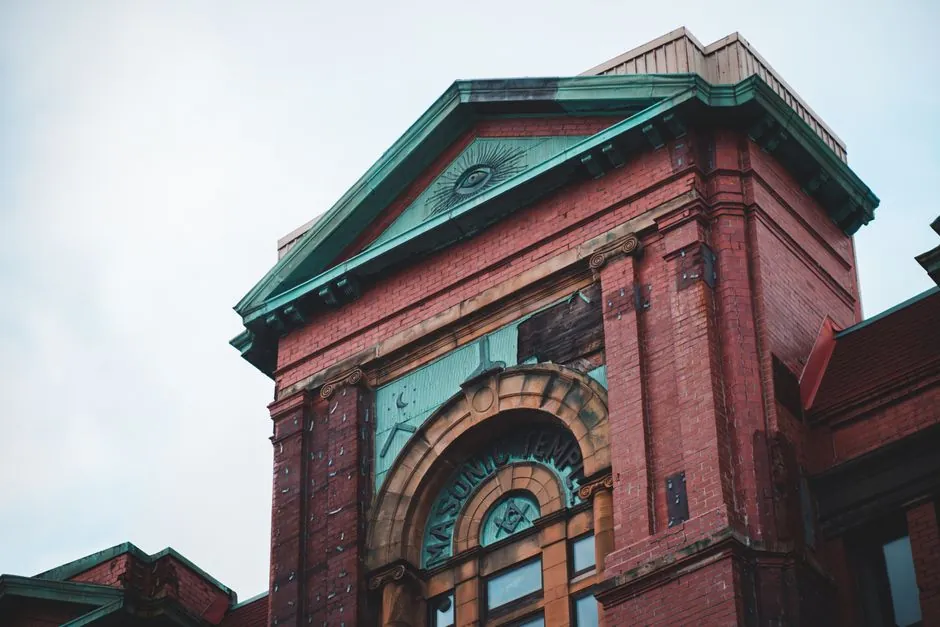
Notable lodge buildings have carried these principles into monumental architecture. The House of the Temple in Washington, D.C., completed in 1915 and designed by architect John Russell Pope, features thirty-three exterior columns, each standing thirty-three feet high. The reference is explicit: thirty-three is the highest degree of the Scottish Rite. Pope’s design also draws on the Mausoleum at Halicarnassus, one of the Seven Wonders of the Ancient World, connecting the building to a longer tradition of architecture understood as symbolic statement. The building is not a lodge room in the conventional sense, but it demonstrates how Masonic geometry symbols scale from the intimate space of a ritual chamber to the public face of a major civic structure.
Sacred Geometry Across Masonic Rites and Degrees
Sacred geometry in Freemasonry does not appear uniformly across all degrees and rites. Each branch of the fraternity engages with geometric symbolism at a different depth, and the contrast is instructive. What begins as practical moral instruction in the Blue Lodge becomes, in the higher degrees of the Scottish and York Rites, a more elaborate philosophical framework drawing on Pythagorean, Hermetic, and Kabbalistic sources.
The Blue Lodge: Working Tools and the Fellowcraft Lecture
The first three degrees, collectively known as the Blue Lodge, introduce geometry through the working tools of the stonemason: the twenty-four inch gauge, the common gavel, the square, the level, the plumb, and the compasses. The Fellowcraft degree (second degree) delivers what Masonic ritual texts call the “Middle Chamber lecture,” which names geometry as the foundation of all the liberal arts and sciences. The language is deliberate. Geometry is presented as a moral discipline, not a metaphysical one. A candidate learns that the square tests right angles and that the plumb ensures uprightness, and both tools carry explicit ethical meanings. The emphasis at this stage is practical and allegorical rather than esoteric. Geometry teaches proportion, honesty, and precision, virtues a good craftsman and a good citizen share equally.
The York Rite’s Royal Arch degree takes a markedly different approach. Its central narrative concerns the rediscovery of a lost word and a lost geometrical key, framed as wisdom concealed beneath the ruins of Solomon’s Temple and recovered by the Temple’s original architects. The geometry here is not a teaching aid. It is presented as recovered sacred knowledge, the intellectual inheritance of the master builders who first raised the Temple. This narrative structure gives the York Rite its distinctive character: geometry becomes an object of quest rather than a tool of instruction.
Albert Pike and the Scottish Rite’s Geometric Philosophy
Albert Pike’s Morals and Dogma of the Ancient and Accepted Scottish Rite of Freemasonry, published in 1871, remains the most extensive English-language treatment of geometric symbolism within Masonic degree work. Pike devotes substantial passages to geometric allegory in several of the higher degrees, including the 25th degree (Knight of the Brazen Serpent) and the 32nd degree (Master of the Royal Secret). He draws connections between Pythagorean number theory, Hermetic cosmology, and the symbolic architecture of the degrees, arguing that the ancient philosophers encoded universal truths in geometric form and that Masonic ritual preserves traces of that tradition. Pike was careful, however, to frame his interpretations as personal reading rather than binding doctrine. In his own preface he wrote that the Scottish Rite had “no authoritative interpretation” of its symbols and that each Mason was free to find his own meaning. That caveat matters. Morals and Dogma is a work of one man’s scholarship, not a creed. Scholars such as S. Brent Morris, writing for the Scottish Rite Research Society, have noted that Pike drew heavily on the comparative religion literature of his era, much of which has since been revised or superseded. The Scottish Rite’s engagement with Masonic geometry symbols is therefore best understood as a 19th-century synthesis of available classical and esoteric sources, ambitious in scope and historically significant, but not a uniform or officially mandated theology of geometry.
Critiques and Alternative Perspectives on Sacred Geometry in Modern Freemasonry
Not every Masonic scholar accepts the framing of sacred geometry Freemasonry enthusiasts have popularized over the past century. A significant strand of academic criticism holds that the term “sacred geometry,” as it is now commonly applied to Masonic symbolism, is largely a 20th-century retrofit. Earlier Masonic writers, from the 18th-century constitutions of James Anderson onward, treated geometry as moral metaphor. They used the square, the level, and the plumb line to illustrate ethical conduct. They did not weight those tools with the esoteric cosmology the phrase now implies. Scholars such as those published in peer-reviewed Masonic studies journals have noted that period lodge records and manuscript rituals rarely, if ever, invoke ratios like phi or sequences like Fibonacci. The connections are asserted in popular books and documentary films. They are almost never sourced to a lodge minute, a degree ritual, or a letter from an 18th-century Grand Lodge officer.
The distinction is not a minor technical quibble. It carries real weight for credibility. Describing Masonic geometric symbolism as historically documented allegory is a defensible, well-supported position. The fraternity’s founders drew on classical geometry as an intellectual and moral framework, and that connection is traceable in primary sources. Claiming that the same symbols encode cosmic ratios or universal mathematical truths is a different argument entirely, and a far less supportable one. Critics inside Freemasonry, including some grand lodge historians, have pushed back against what they see as an inflation of the tradition’s symbolic claims. Their concern is practical: when Masonic geometry symbols are presented as keys to hidden universal laws, the fraternity’s actual, documented history gets buried under speculation. The symbols of Freemasonry are rich enough on their own terms. They do not need a layer of unverifiable mysticism to be historically interesting or intellectually serious.
FAQ
What is the difference between geometry and sacred geometry in Freemasonry?
Ordinary geometry is the mathematical study of shapes, angles, and spatial relationships. Sacred geometry assigns those same relationships symbolic or philosophical significance, treating certain proportions as reflections of a higher rational order rather than purely practical measurements.
Freemasonry operates in both registers simultaneously. The square, the plumb, and the level began as the operative mason’s working instruments. In speculative Freemasonry, they became vehicles for moral allegory. William Preston’s Illustrations of Masonry (1772) makes this dual function explicit, presenting geometric principles as equally valid for building stone walls and for building character.
What does ‘God geometrizes’ mean in Masonic philosophy?
The phrase is traced to Plato via Plutarch and holds that divine intelligence expresses itself through geometric proportion and measurable order. Freemasonry adopted it as a philosophical anchor for the concept of the Grand Architect of the Universe, a deliberately non-denominational supreme being understood as the rational source of creation.
As a theological position, it aligns closely with Deism, the view that reason and natural law rather than revealed scripture define the relationship between creator and creation. Deism was widely influential among 18th-century Masonic founders, which explains why the phrase found such a comfortable home in lodge philosophy without endorsing any single religious tradition.
How is sacred geometry used in Masonic rituals and degrees?
Geometric symbolism enters Masonic ritual primarily through the working tools presented at each degree. The square and compass appear across all three Blue Lodge degrees. The 47th Problem of Euclid, better known as the Pythagorean theorem, holds a central place in the Fellowcraft degree and serves as the emblem of the Past Master.
Higher degrees in the Scottish and York Rites engage more elaborate frameworks, drawing on Pythagorean, Hermetic, and Kabbalistic traditions. Albert Pike’s Morals and Dogma (1871) documents these layers in considerable detail, treating geometric symbolism as a philosophical inheritance rather than a set of operative instructions.
What are the main sacred geometry symbols in Freemasonry?
The most prominent are the square and compass, the letter G (representing both Geometry and the Grand Architect of the Universe), the equilateral triangle, and the point within a circle. The double cube altar, the checkered floor of the lodge room, and the twin pillars Jachin and Boaz also carry documented geometric significance.
Each of these is addressed in Masonic catechisms and degree lectures as a vehicle for moral instruction. Masonic ritual manuals consistently frame them as symbols to be interpreted, not objects to be venerated, a distinction the fraternity has maintained since the speculative tradition took shape after 1717.
Why do Freemasons emphasize geometry so heavily in their teachings?
The emphasis reflects the fraternity’s foundational origin story. Freemasonry traces its symbolic lineage to the builders of Solomon’s Temple and the medieval cathedral architects, for whom geometry was the master science of the craft. When operative masonry gave way to speculative Freemasonry, geometry was retained as the moral and philosophical core of lodge instruction.
The Fellowcraft degree lecture, as preserved in Preston’s Illustrations of Masonry, calls geometry “the foundation of Freemasonry”, a designation that has shaped lodge teaching for over two centuries. The practical skill of the working mason became, in speculative hands, a framework for reasoning about proportion, order, and ethical conduct.
