 Italiano
  English
| 0 Comments | James Whitfield
Of all the regalia associated with Freemasonry, the apron is the most immediately recognizable and the most misunderstood. It is not ceremonial costume or theatrical prop. The Masonic apron descends directly from the leather aprons worn by operative stonemasons in medieval Europe, men who built cathedrals and guild halls with their hands and marked their craft membership through the tools they carried and the clothes they wore. When speculative Freemasonry formalized in 1717 with the founding of the Premier Grand Lodge of England, the apron came with it, transformed from a practical garment into one of the fraternity’s most layered symbols. Albert Mackey, the 19th-century Masonic scholar, called it “the most honorable badge that can be conferred on any man.” That claim has been repeated in lodge rooms ever since. This guide traces the apron’s origins, unpacks what its materials, colors, and emblems actually signify at each degree of the Craft, and addresses the practical questions, including what happens to an apron after its owner dies, that neither lodge publications nor conspiracy forums tend to answer clearly.
What Is a Masonic Apron?
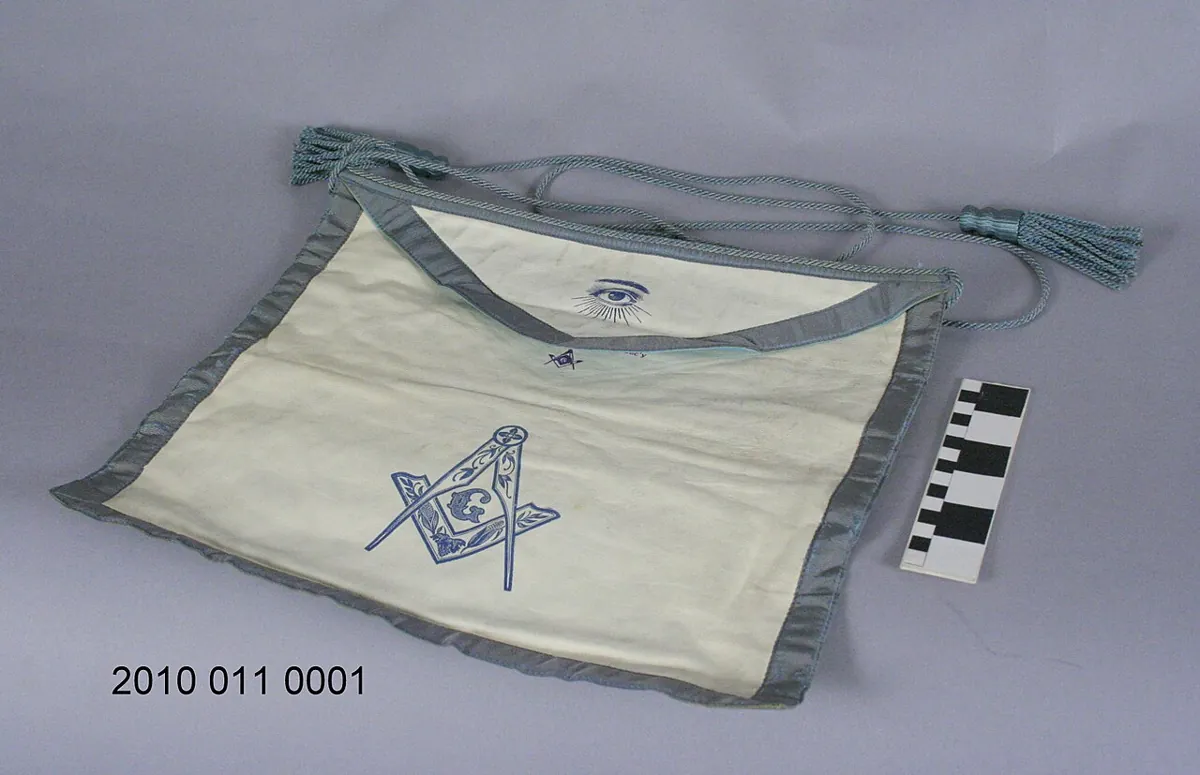
The Masonic apron meaning centers on a single, durable idea: this piece of ritual regalia, worn by Freemasons during lodge meetings and ceremonies, is a direct symbolic descendant of the working aprons worn by operative stonemasons. It is the oldest and most universally recognized item of Masonic dress, predating many of the fraternity’s other emblems and regalia.
Albert Mackey’s Encyclopaedia of Freemasonry (1874) identifies it plainly as “the badge of a Mason,” a phrase that lodge ritual still repeats today. That continuity is worth pausing on. In an institution known for layered ceremony and evolving symbolism, the apron has remained the one constant across centuries, jurisdictions, and degrees. Its logic is straightforward: stonemasons wore aprons because the work demanded it, protecting clothing from stone dust, mortar, and the friction of rough materials. Speculative Freemasonry, which emerged from those operative guilds, inherited the garment and transformed it into something representational rather than functional.
Modern examples are typically made of white lambskin or a lambskin-like synthetic, though construction, embellishments, and dimensions vary depending on the degree held and the rite practiced. A newly initiated Entered Apprentice receives a plain white apron with no ornamentation, while higher degrees and certain appendant bodies introduce color, embroidery, and symbolic imagery that encode the wearer’s standing within the fraternity. The material itself carries meaning: lambskin, as an ancient symbol of innocence and purity, was chosen deliberately, and that choice is explained to candidates during initiation in most jurisdictions. The lambskin apron in Freemasonry is not decorative in the conventional sense. It functions as a portable, wearable statement of the values the fraternity asks each member to internalize.
History and Origins of the Masonic Apron
From Operative to Speculative: The Transition
Long before any philosophical fraternity adopted the apron as a symbol, medieval stonemasons wore it for entirely practical reasons. Leather aprons protected the body from stone chips, tool edges, and the general punishment of physical labor. Within the operative guilds that constructed Europe’s cathedrals and civic buildings, the garment also served as a social marker: the cut, material, and condition of an apron communicated a mason’s rank, whether he was an apprentice just learning to dress stone or a master capable of overseeing an entire building campaign. When speculative lodges began to emerge in the late 17th century, drawing membership from gentlemen, merchants, and intellectuals who had never touched a chisel, the operative apron was not discarded. It was retained, deliberately, as a living inheritance from the craft tradition. The functional object became a moral one. Where the working mason’s apron once shielded him from physical harm, the speculative Mason’s apron came to represent the protection of personal virtue and the dignity of honest labor. That reinterpretation is central to understanding Masonic apron symbolism: the garment’s meaning was not invented from nothing but translated, carefully, from one context into another.
Early Standardization Under the Grand Lodge System
The founding of the Premier Grand Lodge of England on June 24, 1717, marked the point at which Freemasonry acquired a governing institution capable of setting standards across member lodges. Apron usage was part of that institutional project from early on. James Anderson’s Constitutions of 1723, the foundational regulatory document of English Freemasonry, references appropriate lodge dress, and the revised Constitutions of 1738 reinforced those expectations. Neither text prescribed exact dimensions or decorative schemes with the precision that later regulations would demand, but they established the principle that a Mason’s appearance in lodge was a matter of collective concern, not personal improvisation.
Through the 18th century, apron designs grew considerably more elaborate, shaped by artistic fashions and by the rapid proliferation of additional degrees and rites, each generating its own regalia conventions. The situation became complex enough that the formation of the United Grand Lodge of England in 1813, which united the rival “Moderns” and “Antients” grand lodges, included efforts to regularize regalia alongside ritual. The UGLE’s subsequent regulations specified apron dimensions, the permitted use of sky-blue borders for Master Masons, and the distinctions appropriate to lodge officers and grand lodge ranks. That process of standardization did not eliminate variation entirely, particularly across different rites and jurisdictions, but it imposed a coherent framework on what had been a patchwork of local custom. The lambskin apron in Freemasonry emerged from this period as the recognized baseline: plain, white, and deliberately modest, its simplicity carrying its own symbolic weight against the increasingly ornate aprons of higher degrees.
Symbolism and Meaning of the Masonic Apron
The Lambskin: Purity, Innocence, and Moral Labor
The choice of lambskin for the Entered Apprentice apron was not arbitrary. Across Egyptian, Hebrew, and Christian traditions, the lamb had long functioned as a symbol of innocence and moral purity before any Masonic lodge put the material to ritual use. Freemasonry did not invent this association; it inherited and formalized it. Lodge instruction in the standard monitorial texts, including those codified in Webb’s Freemason’s Monitor of 1797, describes the lambskin apron as “the badge of a Mason” and characterizes it as “more ancient than the Golden Fleece or Roman Eagle, more honorable than the Star and Garter.” That last claim is pointed: the apron outranks hereditary decorations because its honor derives from personal conduct, not birth or royal favor.
What the lambskin communicates is not a finished state but a standard to work toward. The ritual framing presents Masonic apron symbolism as aspirational. A candidate receives the white apron at initiation as a symbol of the purity he is expected to pursue, not as a certificate of purity already achieved. The Masonic Service Association’s published explanations consistently emphasize this: the apron marks the beginning of moral labor, a lifelong project with no formal completion date. The triangular flap, known in lodge terminology as the “fall,” reinforces this reading. Instruction associates it with the number three, corresponding to the three degrees of the Blue Lodge, each representing a progressive stage in that same unfinished work of self-improvement.
Masonic Apron Meaning in the Bible: What the Tradition Actually Claims
A persistent question among researchers and curious readers concerns whether the apron carries a biblical dimension. Masonic ritual does make a scriptural allusion, but it presents that allusion as symbolic rather than theological. Several ritual workings reference the account in Genesis where Adam and Eve fashion coverings from fig leaves after the Fall, interpreting this as the first recorded instance of human beings using an apron-like garment to mark a transition in moral awareness. The apron, in this reading, becomes a symbol of the human condition itself: the recognition of imperfection and the impulse to address it. Ritual monitors do not claim doctrinal authority over Genesis or assert that Freemasonry represents a continuation of biblical practice. The reference functions as allegory, the same way the fraternity uses the construction of Solomon’s Temple as a backdrop for moral instruction without claiming to be a religious institution. Scholars such as S. Brent Morris, writing for the Masonic Service Association, have been careful to draw this line. The biblical allusion enriches the symbolism without crossing into theological prescription, consistent with the fraternity’s broader policy of requiring belief in a Supreme Being while remaining formally non-denominational.
Types of Masonic Aprons by Degree and Rite
Blue Lodge Aprons: Entered Apprentice Through Master Mason
The three foundational degrees of the Blue Lodge trace a deliberate visual progression, and the apron worn at each stage is the most immediate marker of where a candidate stands within the Craft. At the First Degree, the Entered Apprentice receives a plain white lambskin apron with no decoration whatsoever. That absence is the point. The United Grand Lodge of England’s working instructions describe this apron as “more ancient than the Golden Fleece or Roman Eagle, more honorable than the Star and Garter” precisely because it carries no rank, no embellishment, and no pretension. It is the starting condition, not an achievement.
Advancement to the Second Degree, Fellowcraft, brings the first visual change: two rosettes appear at the lower corners of the apron’s body. Small as they are, these additions signal that the candidate has moved beyond the threshold. The rosette, a stylized flower motif with roots in classical architecture, appears throughout lodge decoration; its presence on the apron connects the individual to the broader symbolic vocabulary of the Craft. At the Third Degree, Master Mason, a third rosette joins the pair, and many jurisdictions introduce a pale blue border along the apron’s edges. That blue is not incidental. It is the color most closely associated with the Blue Lodge itself, referencing the celestial canopy under which operative stonemasons traditionally worked and which Masonic lodge instruction has long used as a symbol of universality. The three rosettes together are sometimes interpreted within lodge teaching as representing the three principal officers, though ritual instructions vary by jurisdiction and grand lodge.
| Degree / Body | Base Color | Border Color | Key Emblems / Ornamentation |
|---|---|---|---|
| Entered Apprentice (1°) | White lambskin | None | Plain; no ornamentation |
| Fellowcraft (2°) | White lambskin | None or minimal | Two rosettes at lower corners |
| Master Mason (3°) | White lambskin | Pale blue (many jurisdictions) | Three rosettes; sometimes square and compasses |
| Royal Arch Chapter | White | Scarlet / crimson | Triple Tau, keystone, additional Chapter emblems |
| Scottish Rite (32°) | White | Black with gold or crimson | Double-headed eagle, degree-specific embroidery |
Royal Arch and Higher-Degree Aprons
Beyond the Blue Lodge, apron design shifts considerably in both color and complexity. The Royal Arch Chapter, recognized by the United Grand Lodge of England as the completion of the Third Degree, uses aprons with a scarlet or crimson border. That crimson carries deliberate symbolic weight within Chapter instruction, referencing themes of sacrifice and restoration that run through the Royal Arch narrative. The masonic royal arch apron also typically displays the Triple Tau, a compound symbol formed from three interlocking T-shapes, along with the keystone motif central to the Chapter’s legend. These are not decorative flourishes; each emblem corresponds to a specific element of the degree’s ritual content.
Scottish Rite bodies, which extend through thirty-two numbered degrees in the Southern Jurisdiction of the United States (governed by the Supreme Council, 33°), maintain their own apron specifications at several points along that progression. The 32nd Degree apron commonly features a white field with a black border trimmed in gold, and the double-headed eagle, the Scottish Rite’s most recognized emblem, appears prominently. York Rite bodies outside the Chapter, including the Cryptic Council and the Knights Templar Commandery, likewise maintain distinct apron or regalia specifications, with the Commandery moving toward a military-order aesthetic that includes black mantles and Maltese cross imagery rather than the lambskin format of the Craft degrees. Across all these bodies, the governing principle holds: Freemason apron levels are legible documents, encoding in fabric and emblem exactly which body conferred the degree and what themes that degree addresses.
Want to learn more?
Masonic Apron Colors and Their Significance
Color in Masonic regalia is not decorative accident. Across the fraternity’s many bodies, rites, and jurisdictions, the hue of an apron communicates degree, office, and affiliation in a visual shorthand that any informed observer can read at a glance. The system is not perfectly uniform worldwide, since each grand lodge retains sovereign authority over its own ritual practice, but the broad color associations have remained stable enough across centuries to be treated as a coherent symbolic vocabulary.
White is the universal foundation. Every Masonic body, from the simplest Blue Lodge to the most elaborately structured appendant order, begins with white. The lambskin apron presented at initiation is white precisely because it signals a beginning: the candidate arrives without Masonic history, and the undecorated white surface represents that clean slate. As a member advances, color is added to the white field rather than replacing it, which is itself a meaningful design choice. Pale or sky blue, the color most closely identified with Craft Masonry (the three foundational degrees of Entered Apprentice, Fellow Craft, and Master Mason), appears as edging, lining, or decoration on lodge officers’ aprons across many jurisdictions. In a number of grand lodge systems, the Worshipful Master and principal officers wear aprons with a more prominent sky-blue trim to distinguish them from the general membership. Royal or dark blue, a deeper and more saturated shade, steps up the hierarchy further: grand lodge officers in several jurisdictions wear aprons edged or lined in this richer tone, marking jurisdictional seniority above the individual lodge level. Scarlet or crimson belongs primarily to the Royal Arch Chapter, where the color reflects the degree’s thematic preoccupation with discovery, restoration, and the recovery of lost knowledge. In the United States, the Royal Arch is conferred under the York Rite, and its chapter officers typically wear aprons in which crimson is the dominant accent. Black represents the sharpest departure from the apron’s usual associations. In certain jurisdictions and high-degree bodies, black aprons appear in memorial or funeral contexts, acknowledging mortality in a garment that otherwise celebrates moral aspiration. Some Rose Croix chapters within the Ancient and Accepted Scottish Rite also employ black in specific ceremonial settings.
Purple Masonic Apron Meaning
Purple occupies a specific and well-defined position in the Masonic color system, though it appears in two distinct contexts that are sometimes conflated. Its primary home is the Cryptic Rite, the body of degrees (Royal Master, Select Master, and Super Excellent Master in some jurisdictions) that form the Council of Royal and Select Masters within the York Rite. Cryptic Rite regalia characteristically uses purple as its signature color, and council officers’ aprons display it prominently. The choice carries the same historical resonance it carries in secular heraldry: a color long associated with authority, dignity, and rank above the ordinary.
The second context is jurisdictional rather than ritual. In a number of grand lodge systems, particularly in the United Kingdom and parts of the Commonwealth, past masters (those who have completed a full term as Worshipful Master of a lodge) are entitled to wear aprons that incorporate purple as a distinguishing mark of their former office. This usage is not universal; some American grand lodges use different color conventions for past masters, and a few use no color distinction at all. Readers researching a specific apron should consult the regulations of the relevant grand lodge, since the Masonic world has no single global uniform code. What purple consistently signals, across both contexts, is seniority beyond the foundational Craft degrees, a step further along the initiatic ladder that the white apron first represents.
Embroidery, Emblems, and Design Variations Across Lodges
Grand lodges set the structural rules, but within those rules, the visual language of individual aprons has historically been anything but uniform. Working tools, pillars, the square and compass, the All-Seeing Eye, and lodge-specific emblems have all appeared as embroidered or painted decoration, varying by jurisdiction, rite, and the personal resources of the brother commissioning the work. The United Grand Lodge of England publishes specific guidance on approved apron designs for its member lodges, specifying dimensions, border colors, and permissible emblems for each rank. Other grand lodges, particularly in North America and continental Europe, maintain their own standards, which is why a Scottish Rite apron and an English Craft apron can look strikingly different even when they represent equivalent degrees. The diversity is not arbitrary; it reflects the federated, jurisdiction-by-jurisdiction structure of Freemasonry itself, where no single governing body holds authority over the whole.
Surviving aprons in collections such as those held by the Library and Museum of Freemasonry at Freemasons’ Hall in London document the full range of this variation. Aprons from the 18th and 19th centuries frequently incorporate silk embroidery, fringe, painted allegorical scenes, and even watercolor miniatures, reflecting both the wealth of individual members and the regional embroidery traditions of the time. American aprons from the same period show comparable ambition, with some examples featuring hand-painted celestial imagery alongside the standard working-tool motifs. Today, most regalia suppliers offer machine-embroidered aprons that meet grand lodge specifications at a fraction of the historical cost. Bespoke hand-embroidered aprons remain available from specialist makers, but they are the exception rather than the rule, and the broader shift toward standardization has made contemporary aprons more legible as rank indicators at the expense of individual craft.
Modern vs. Historical Apron Designs
The contrast between an 18th-century apron and its modern counterpart is, in a sense, a document of how Masonic culture has changed. Early aprons were personal objects, often commissioned from local craftspeople and decorated according to the taste and means of the owner. A Master Mason in 1780 Philadelphia might have worn an apron that bore little visual resemblance to one worn by a counterpart in Edinburgh, even if both held the same degree. The symbolism was recognizable; the execution was individual. That individuality reflected a period when Freemasonry was still consolidating its ritual forms and grand lodges were only beginning to assert design authority over their member lodges.
Contemporary aprons are products of institutional standardization. Machine embroidery ensures that the working tools on an Entered Apprentice apron in Ohio look essentially identical to those on one in Ontario. This consistency serves a practical purpose: it makes rank and affiliation immediately readable to any Mason in the room, regardless of which lodge issued the apron. What is lost, as Masonic museum curators frequently note, is the sense of the apron as a made object with a particular history. The older pieces reward close examination in a way that a modern printed apron simply does not. Both serve the same Masonic apron symbolism function, but only one of them doubles as a record of the craftsman who made it and the brother who wore it.
Care, Storage, and What to Do with a Masonic Apron After Death
A Masonic apron is personal regalia in the fullest sense of that phrase. Unlike a lodge banner or a piece of furniture that belongs to the institution, the apron is assigned to a specific individual and follows him through his Masonic career. Most grand lodges recommend storing it in a dedicated apron case, typically a rigid or semi-rigid sleeve lined with fabric, designed to protect the material from creasing, dust, and accidental damage. Proper storage is practical preservation, not ceremonial fastidiousness, and this matters especially for older or hand-embroidered pieces whose materials degrade without reasonable care.
The lambskin apron, traditional for the Entered Apprentice degree, requires attentive handling. Genuine lambskin is susceptible to moisture, which causes warping and mold, and to prolonged direct sunlight, which dries and cracks the leather over time. Cleaning should use products suited to the specific material, whether natural leather or the synthetic alternatives now common in lodge supply catalogs. Many lodges issue care guidance alongside the apron itself; members unsure of the right approach are better off consulting the supplier or their lodge secretary before attempting any restoration. A damaged apron can sometimes be repaired by a specialist in leather goods or textile conservation, though for heavily deteriorated pieces replacement is occasionally the more practical outcome.
What happens to an apron after a Mason’s death carries particular weight, and families are sometimes unprepared for the question. Masonic funeral rites, practiced in varying forms across grand lodge jurisdictions, traditionally include placing the apron in or on the coffin as part of the service. The ritual framing is explicit: the apron is described as the badge of a Mason, and its inclusion in burial acknowledges the role it played throughout his lodge life. Families who prefer not to follow this practice have other meaningful options. The apron may be kept as a memorial item, passed to a family member who is also a Mason, donated to a lodge or Masonic museum for archival or educational purposes, or returned to the lodge for use in future memorial services. None of these choices is universally prescribed; the decision belongs to the family. In all cases, the best first point of contact is the lodge the Mason attended or, for broader guidance, the relevant grand lodge. Both are equipped to advise families on regional customs, available resources, and the appropriate handling of other regalia found among a deceased member’s possessions.
How Non-Masons Perceive the Apron, and What the Record Actually Shows
Of all the objects associated with Freemasonry, the apron is among the least concealed. Albert Mackey’s Encyclopedia of Freemasonry, first published in 1874 and still widely cited, devotes several pages to the garment’s symbolism. Grand lodge educational materials, state-published Masonic monitors, and introductory handbooks distributed to new initiates have described the apron’s meaning openly for more than two centuries. The notion that it represents some layer of impenetrable secrecy collapses quickly against the published record. Popular culture and conspiracy-adjacent media have framed the garment as “arcane regalia,” a prop in shadowy ritual, or physical evidence of hidden agendas. The historical documentation tells a far more straightforward story: the apron is a working-tool symbol whose moral meaning (purity of life and conduct) is spelled out plainly in the very ceremonies critics claim are hidden.
The public visibility of the apron reinforces this in concrete, dateable terms. Freemasons wore their aprons at the laying of the cornerstone of the United States Capitol on September 18, 1793, a ceremony attended by thousands of onlookers and reported in contemporary newspapers. Civic parades, public building dedications, and fraternal funerals throughout the 18th and 19th centuries displayed the garment openly on city streets across Britain and America. Anyone present at those events, Mason or not, could observe the Masonic apron symbolism in action. Perhaps the most quietly subversive quality the apron actually possesses is its deliberate democracy: inside the lodge room, every man present wears the same white lambskin, whether he is a laborer or a senator. Rank, wealth, and title are checked at the door. That leveling function is not a secret the fraternity guards; it is a point the fraternity advertises. The gap between public perception and documented practice says more about the persistence of myth than about anything the Craft has tried to conceal.
FAQ
What does a Masonic apron symbolize?
The apron carries layered symbolic weight: purity, moral labor, and a commitment to self-improvement. In its most elemental form, the plain white lambskin worn at initiation represents a clean moral slate, the idea that a new member enters the lodge unburdened by prior failures of character. Albert Mackey’s Encyclopaedia of Freemasonry identifies it as the preeminent badge of the fraternity, explicitly ranking it above the decorations of civic or knightly orders in symbolic honor. That is a striking claim, and Mackey makes it without apology.
Why do Freemasons wear aprons?
The garment is a direct inheritance from the leather aprons worn by operative stonemasons in medieval guild tradition. Craftsmen wore them for obvious practical reasons: protection against stone chips, mortar, and tool edges. When speculative Freemasonry formalized with the founding of the Premier Grand Lodge in London on June 24, 1717, the apron was retained and deliberately reinterpreted.
No longer a shield for the body during physical labor, it became a symbol of the moral and intellectual work the fraternity asks of its members. The continuity with craft tradition was intentional, anchoring the organization’s philosophical framework in the concrete reality of skilled manual work.
What is the difference between aprons for different Masonic degrees?
Ornamentation increases with each degree, providing a visible record of a member’s progress. An Entered Apprentice wears a plain white lambskin with no decoration. A Fellowcraft’s version adds two rosettes at the lower corners; a Master Mason’s apron adds a third rosette and typically a pale blue border. The progression is deliberate: simplicity at the start, accumulated detail as responsibilities grow.
Beyond the Blue Lodge, the distinctions multiply. Royal Arch Chapter aprons introduce scarlet or crimson. Scottish Rite and York Rite bodies each maintain their own specifications for color, emblem, and trim, governed by the regulations of the relevant grand body rather than individual preference.
What does the white lambskin apron mean in Freemasonry?
White lambskin carries associations with purity and innocence that predate Freemasonry by centuries, appearing across religious and cultural traditions from ancient ritual sacrifice to Christian iconography. Within lodge ritual, the symbolism is applied directly to the new initiate: the garment signals that the candidate enters with a clean moral record and accepts a personal obligation to maintain it.
Lodge ritual makes the historical claim explicit, instructing the Entered Apprentice that the apron is “more ancient than the Golden Fleece or Roman Eagle.” Whether taken literally or as rhetorical emphasis, the line underscores how seriously the fraternity treats this otherwise modest piece of white leather.
What should be done with a Masonic apron after the owner’s death?
Traditional Masonic funeral rites call for the apron to be placed in the coffin with the deceased, framing it as the member’s personal badge carried beyond the lodge. The practice reflects the fraternity’s view of the garment as inseparable from the individual who earned it, not a piece of lodge property to be recirculated.
Families who prefer to keep it have recognized alternatives. Donation to a Masonic museum or lodge archive is common and ensures the item is preserved with appropriate context. Consulting the relevant grand lodge for guidance on disposition is a reasonable first step, as customs vary between jurisdictions.
